
This comprehensive article dives deep into the world of robotics, exploring the history, types, engineering components, applications, and future trends of robots, offering readers an in-depth understanding of how these remarkable machines work and shape our lives.
The hospitality industry can leverage the gender characteristics of service robots to influence customers' decisions, according to new research from a team in the Penn State School of Hospitality Management.
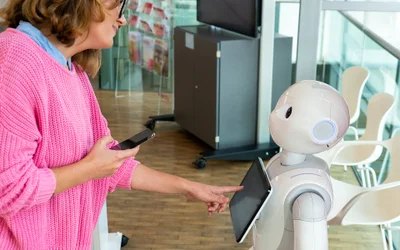
Service robots have evolved from simple automated machines to intelligent adaptive systems that can navigate unpredictable environments and interact with humans.
AI-powered artificial muscles made from pliable materials are reshaping recovery, from stroke rehabilitation to prosthetic design. These machines help people regain motion, strength, and confidence.
A team of researchers from ITMO University, Tel Aviv University, and University of Aveiro have come up with a new way to improve the mechanical properties of spider webs.
EPFL researchers have developed a customizable soft robotic system that uses compressed air to produce shape changes, vibrations, and other haptic, or tactile, feedback in a variety of configurations.

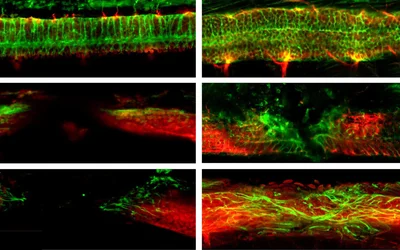
Combining biology and robotics, scientists at EPFL have built a robotic microsurgery platform that can perform high-precision, micrometer-resolution dissections to advance our understanding of how the vertebrate body forms during embryonic development.
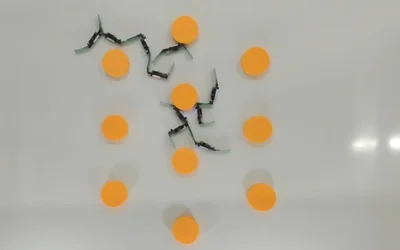
In this episode, we talk about about how an ant inspired robotics platform could be the future of swarm robotics due to its simple, affordable, flexible, and scalable nature.
Ever wondered how robotic arms achieve precise movement in manufacturing, healthcare, or logistics? It’s all about smart design — from sturdy components and kinematics to advanced control systems. Discover how these elements work together to deliver accuracy, flexibility, and real-world efficiency.
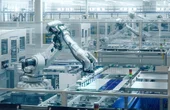
Robotic joints, which are sometimes known as axes, are the moveable parts of a robot that cause relative motion between adjacent links. These links refer to the rigid components that connect the joints to ensure their proper and straightforward operation.
EPFL researchers have developed a method that allows a flapping-wing robot to land autonomously on a horizontal perch using a claw-like mechanism. The innovation could significantly expand the scope of robot-assisted tasks.
EPFL researchers have teamed up with Dartfish and the Lausanne Hockey Club to push the boundaries of sports-performance analysis by applying computer vision and machine-learning technology to action on the ice.
Kuźnia Polska, in cooperation with ASTOR, Kawasaki Robotics CEE Hub, and Photoneo, developed an automation solution for a bin picking application that enables the picking of two types of parts from two different containers.
Beach cleaning operations focus on removing the waste we can see, such as plastic water bottles and trash, often using gas-powered tractors that bury microplastics beneath the top layer of sand. In contrast, the Cornell Nexus robot will use renewable solar energy to collect and remove microplastic waste.
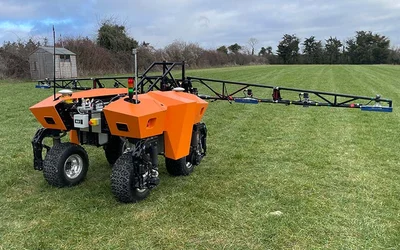
Widely publicised in the media, there are rising concerns both within the agricultural industry and from government policymakers as to whether food production can keep up with unprecedented future demands.