Real-Life Superpower: Researchers Use Magnetic Nanoparticles to Improve Spider Web Strength
A team of researchers from ITMO University, Tel Aviv University, and University of Aveiro have come up with a new way to improve the mechanical properties of spider webs.

13 Aug, 2025. 3 minutes read
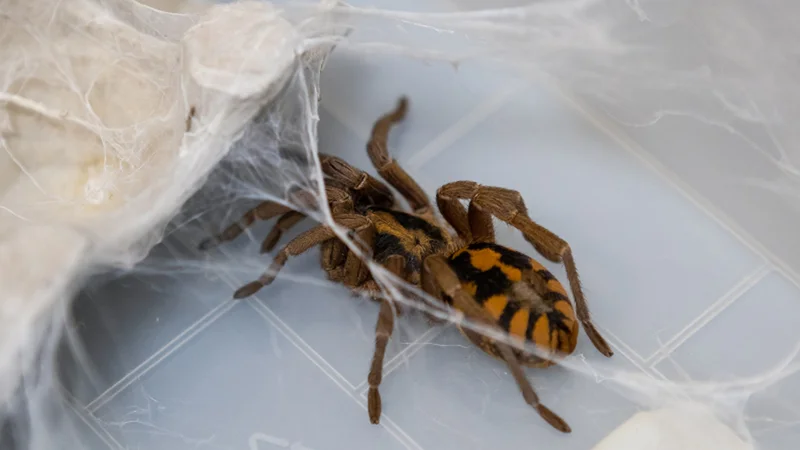
Hapalopus sp. Columbia Gross spider from an ITMO lab. Photo by Dmitry Grigoryev / ITMO NEWS
This article was first published on
news.itmo.ruA team of researchers from ITMO University, Tel Aviv University, and University of Aveiro have come up with a new way to improve the mechanical properties of spider webs. To achieve this, they introduced a solution of magnetic nanoparticles into the spiders’ silk glands. In the future, the modified web can be used to create flexible magnetically controlled elements in soft robots or durable microchip substrates in flexible electronics. The related article was published in ACS Applied Bio Materials.
Spider web is a natural material with quite a few incredible properties. It’s three times stronger than kevlar, a material used to make bulletproof vests. It’s also resistant to low and high temperatures, elastic, and stretchable – it can stretch by 30-40% without breaking; at the same time, the material is lightweight, thin, and biocompatible. All of these properties make spider web a perfect candidate for application in various fields, from medicine to ecology and robotics. For instance, it can be used to produce materials for targeted drug delivery and tissue regeneration, as well as flexible and light-weight robotic limbs.
In order to scale up its production, scientists study how spider silk is formed and attempt to recreate it artificially in the lab or improve its functional properties – for example, make the natural material stronger. For this purpose, spiders are usually sprayed with a solution containing magnetic nanoparticles; these can also be added to the animal’s diet to increase the web’s strength. However, these methods are not very effective because most of the nanoparticles are expelled through metabolism and only a small portion reaches the silk glands.
Researchers from ITMO University, Tel Aviv University, and University of Aveiro have developed a new method that can produce an 82% increase in the Young modulus, which is a measurement of the material’s resistance to stretching or compression. The team suggested injecting magnetic Fe3O4 nanoparticles directly into the silk glands of Holothele incei spiders. In the study, spiders received treatments every three days under anaesthesia; in two weeks, the magnetic nanoparticles were first detected in the web with energy-dispersive X-ray spectroscopy.
After the injection, the nanoparticles entered the silk gland and affected the spatial organization of spidroin, the protein forming the web. This interaction increased the share of β-sheets, a secondary structure of the web that affects its strength. The β-sheet increased from 48% to 71%. In its turn, this had an effect on the Young modulus – it reached 82%, meaning that the web became stronger and firmer.
“This gain in the Young modulus makes the web in strength to biological tissue such as cartilage. We hypothesized that this is due to the charges of nanoparticles and the protein “broth” that makes up the web: the nanoparticles act like bridges, attracting certain spidroin amino acids and making the resulting silk structure more ordered. Moreover, the nanoparticles imbued the web with magnetic properties that allow us to control the fiber. In our study, we used magnetite as a model object. In future studies, the technology and the nanomaterials’ composition can be improved to produce modified spider silk for controlled soft robots. Our method also preserves the silk’s original structure, its flexibility, and light weight,” explains Anastasia Kryuchkova, the paper’s first author and the head of a lab at ITMO’s Faculty of Biotechnologies.
One promising application of this modified fiber is in the production of miniature objects, such as soft robots. At their core these robots have not rigid frames, but elastic materials that give them their flexibility and mobility. Spider silk can be used in the joints of such robots to give their limbs additional degrees of freedom and movement. Magnetic nanoparticles within the silk will respond to changes in an external magnetic field, making it possible to control the robot in this manner. The scientists also suggest that modified silk could be a suitable substrate for microchips in flexible electronics, as their durability would be improved thanks to the silk’s flexibility.
This study was supported by the national program Priority 2030.