

Protect sensitive electronics by understanding the current limiting resistor, learning how to calculate appropriate values, and applying them in LEDs, transistors, microcontroller inputs and other circuits.
This guide explains how potentiometer pins interact with mechanical rotation, resistive tracks, and load conditions across various circuit configurations. It provides clarity for both low-power electronic designs and high-precision embedded systems.
This technical article explains the theory behind potentiometer schematics. It shows how to implement mechanical and digital potentiometers in practical circuits, tailored for engineers, and students.
Engineering teams can achieve AI-ready design data with five-level maturity model by Keysight. The unified, traceable data accelerates design cycles, boosts IP reuse, and reduces costly re-spins.
Focused laser-like light that covers a wide range of frequencies is highly desirable for many scientific studies and for many applications, for instance quality control of manufacturing semiconductor electronic chips.
Scientists at ITMO have come up with a new way to protect microelectronics devices from counterfeit. The new technology is based on gold and silicon nanoparticles with unique optical properties that make it possible to create unclonable functions with a record information density.
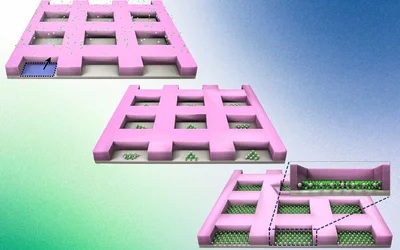
An international team of scientists was first to demonstrate that halide perovskites can serve as a base for nonlinear on-chip optical components. As an example, they can be used to build ultrafast optical chips and transistors, and, potentially, other integrated optical systems.
Silicon wafers are thin slices of highly pure crystalline Silicon, used in the production of integrated circuits. This article delves into the fascinating world of silicon wafers, unraveling their production process, unique properties, and the wide range of applications that make them indispensable.
Puntozero redesigned the cold plate of the power electronics of Dynamis PRC’s electric race car for additive manufacturing. The result was a 25% lighter liquid-cooled heat sink and bioinspired flow guides that increased the heat transfer surface area by 300%.
This article provides a comparison between NB-IoT and LTE-M protocols and explores how NB-IoT facilitates energy-efficient and latency-tolerant IoT solutions for hard-to-reach locations.
The article covers the basics of TinyML, a technology that improves the privacy, energy efficiency, affordability and reliability of devices utilising artificial intelligence. Be a part of TinyML for good, an online event and showcase of ideas that aims at exploring the topic in more detail.
Article #6 of our Circuit Protection Series: The Factories of the Future Will Demand Advanced Circuit Protection Technology to Keep Everything Connected.
Article #5 of our Circuit Protection Series: Ports like RS-485 and Ethernet are a key part of any communication system but can be vulnerable to stress.
Understanding forward bias vs reverse bias configurations in diodes, exploring the theoretical aspects, implementation, applications, and considerations while noting the key differences between forward bias vs reverse bias operating modes in diodes.
For most of our nRF52 Series, we have a chip-scale package and a Quad-Flat No-leads (QFN) option. With our nRF52840, we introduced the aQFN package to our product portfolio.
A long-time stalwart of high-speed consumer connectivity, Wi-Fi's latest version introduces technical changes that offer greater support for wireless sensor networks.
In this episode, we talk about a blind cane from Stanford University that borrows self-driving tech to increase the mobility of visually-impaired people by 20% as well as an effort from Texas A&M to develop enhanced touchscreens which will enable users to feel textures on their smart devices.