

Protect sensitive electronics by understanding the current limiting resistor, learning how to calculate appropriate values, and applying them in LEDs, transistors, microcontroller inputs and other circuits.
This guide explains how potentiometer pins interact with mechanical rotation, resistive tracks, and load conditions across various circuit configurations. It provides clarity for both low-power electronic designs and high-precision embedded systems.
This technical article explains the theory behind potentiometer schematics. It shows how to implement mechanical and digital potentiometers in practical circuits, tailored for engineers, and students.
Engineering teams can achieve AI-ready design data with five-level maturity model by Keysight. The unified, traceable data accelerates design cycles, boosts IP reuse, and reduces costly re-spins.
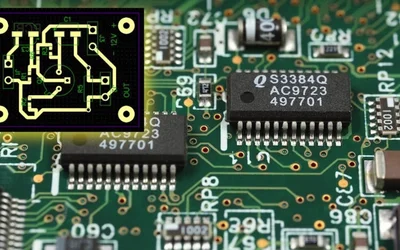
Focused laser-like light that covers a wide range of frequencies is highly desirable for many scientific studies and for many applications, for instance quality control of manufacturing semiconductor electronic chips.
Scientists at ITMO have come up with a new way to protect microelectronics devices from counterfeit. The new technology is based on gold and silicon nanoparticles with unique optical properties that make it possible to create unclonable functions with a record information density.
An international team of scientists was first to demonstrate that halide perovskites can serve as a base for nonlinear on-chip optical components. As an example, they can be used to build ultrafast optical chips and transistors, and, potentially, other integrated optical systems.
Researchers from ITMO University have come up with a new kind of wireless chargers – boxes with a uniformly distributed magnetic field inside them. Placing a device anywhere in the box will charge it, which makes the new technology stand out from its competitors, which can only ensure power transfer across short distances.
NANOWEB® is an extremely thin, transparent, conductive film that consists of an invisible, nanostructured metal mesh fabricated onto a glass or plastic surface. With its unrivaled transparency, conductivity, and flexibility, this patented functional film holds immense potential for both passive and powered use cases, with applications including electromagnetic interference shielding, antennas, 5G/6G redirection systems for elimination of dead spots, and deicing/defogging devices for vehicle windows and eyewear.
Capacitors store electrical energy, similar to batteries, and are used in many electronic devices. Due to their voltage-storing nature, handling them can be dangerous. This article outlines various techniques and safety measures to safely discharge capacitors.
Widely publicised in the media, there are rising concerns both within the agricultural industry and from government policymakers as to whether food production can keep up with unprecedented future demands.
A new method for the miniaturisation of biosensors will enable new possibilities for minimally invasive implants. The miniaturised transistors are fabricated on thin, flexible substrates, and amplify biosignals, producing currents more than 200 times larger than analogous alternatives.
Learn the best methods and industry standards for cleaning circuit boards, removing contaminants like dust, flux residues, and corrosion to ensure optimal performance and longevity!
Engineers at Caltech and the University of Southampton have collaboratively designed an electronics chip integrated with a photonics chip (which uses light to transfer data)—creating a cohesive final product capable of transmitting information at ultrahigh speed while generating minimal heat.
PCBs are extensively used across industries, powering devices from simple gadgets to complex systems. In this article, we’ll understand the importance of PCB thickness, the various factors affecting it, and its impact on design and other factors.
In this episode, we talk about the tattoo-like flexible wearable technology that’ll provide seamless high precision health monitoring for patients and enthusiasts.