Featuredpodcast
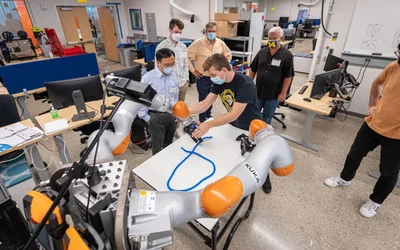
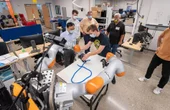
In this episode, we talk about how engineers are tackling the problem of sorting through piles using robotics and a platform that leverages fake data to train robots more efficiently.
In this episode, we talk about how engineers are tackling the problem of sorting through piles using robotics and a platform that leverages fake data to train robots more efficiently.
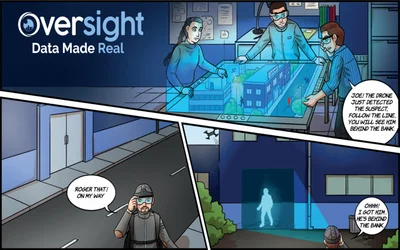
Using AR/VR technology, Oversight gives emergency responders the ability to literally SEE THROUGH WALLS and strengthens the connectivity between control rooms and field operators.
This article was originally published in The Robot Remix. Subscribe for strategic insight into the robotics and automation industry.
This comprehensive article dives deep into the world of robotics, exploring the history, types, engineering components, applications, and future trends of robots, offering readers an in-depth understanding of how these remarkable machines work and shape our lives.
16 minutes read.
21 minutes read.
16 minutes read.
23 minutes read.
19 minutes read.
27 minutes read.



University
At the Harvard John A. Paulson School of Engineering and Applied Sciences (...
42 Posts

Robotics & Automation
READY Robotics is a robotics software company that vastly simplifies robot ...
24 Posts

Automation Machinery Manufacturing
We are a company in flying robotics, specializing in Non-destructive inspec...
23 Posts
Everyone, guess how fast is it?
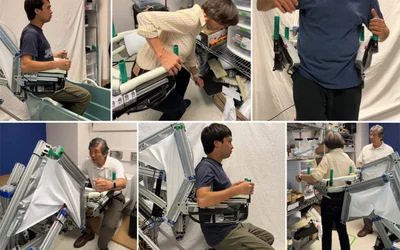
The new design could assist the elderly as they age in place at home.
The hospitality industry can leverage the gender characteristics of service robots to influence customers' decisions, according to new research from a team in the Penn State School of Hospitality Management.
Service robots have evolved from simple automated machines to intelligent adaptive systems that can navigate unpredictable environments and interact with humans.
Engineers at Princeton and North Carolina State University have combined ancient paper folding and modern materials science to create a soft robot that bends and twists through mazes with ease.
A research team from ETH Zurich and the University of Zurich (UZH) has developed a novel approach to treating spinal cord injuries: controllable microrobots deliver stem cells directly to the site of an injury, where they promote nerve cell regeneration.
Cornell engineers have developed a robotic collective that behaves less like a machine and more like a material that flows, reshapes and adapts to its environment without centralized control.
From hospital wards to crop fields, from microscopic swarms to biohybrid machines powered by fungi, robotics research at Cornell spans an astonishing range of scale, application and ambition.
In this episode, we talk about how engineers are tackling the problem of sorting through piles using robotics and a platform that leverages fake data to train robots more efficiently.

Using AR/VR technology, Oversight gives emergency responders the ability to literally SEE THROUGH WALLS and strengthens the connectivity between control rooms and field operators.

5 minutes read
This article was originally published in The Robot Remix. Subscribe for strategic insight into the robotics and automation industry.

6 minutes read
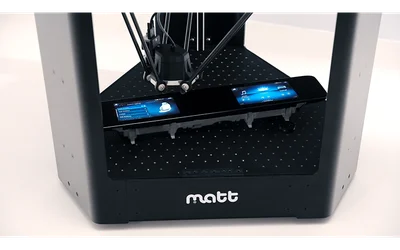
MATT overtakes challenges met during the process of testing in-vehicle-infotainment systems using its characteristic adaptability and capabilities to support an effective operation throughout the testing process.

4 minutes read
The inertial navigation system is a basic component of obtaining a continuous navigation solution in various applications. The system suffers from a growing error over time. This article proposes a machine-learning-based adaptive neuro-fuzzy inference system to improve navigation performance.
Food processing techniques require the removal of moisture from the crop without destroying its nutritional qualities. The article proposes a dehydrator/oven whose temperature and humidity can be perfectly controlled and its generated heat is evenly distributed in its drying chamber.
Columbia Engineers build a robot that learns to understand itself, rather than the world around it
Automation is one of the cornerstones of warehousing in Industry 4.0, but it will require a combination of technology working in concert to make it a success.
Monthly robotics news blog. Discover the latest products, research, tutorials, and security news for robotics.

6 minutes read
In this episode, we talk about how engineers inspired by some of biology’s most miniature wonders (like dandelions' seeds and microorganisms' cilia) are using their knowledge to make major breakthroughs in biosensing, robotics, biomedical engineering, and more.
Lights-out manufacturing refers to the manufacturing methodology where factories are fully-automated. While true lights-out factories are still rare today, manufacturers can look to companies like FANUC, in Japan, for inspiration.

3 minutes read
90 Shore A TPE-based elastomer for large 3D-printed rubber-like parts.

The winning teams each receive manufacturing and business support to take their design to the next level.
Many manufacturers are struggling to find skilled labor for their manufacturing plants? According to the Society of Manufacturing Engineers, 89% of manufacturers are having difficulty finding skilled workers in the United States today.
4 minutes read
This solution for FAVI enables the automation of picking parts from bins using two KUKA robots navigated by 3D vision and robotic intelligence from Photoneo.