In response to the OKDo Engineering Challenge, Marcel Ochsendorf and Sebastian Kindorf developed a medical device that uses thermal imaging for remote patient monitoring. Their innovative project won the Wevolver Community Vote.
BVLOS, swarm, and military-grade encryption will enable wider and more diverse applications of drones, while cutting-edge software platforms enable operators to improve fleet coordination with more data control
This comprehensive article dives deep into the world of robotics, exploring the history, types, engineering components, applications, and future trends of robots, offering readers an in-depth understanding of how these remarkable machines work and shape our lives.
The hospitality industry can leverage the gender characteristics of service robots to influence customers' decisions, according to new research from a team in the Penn State School of Hospitality Management.
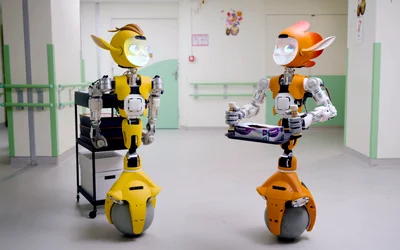
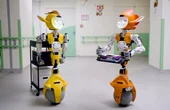
Service robots have evolved from simple automated machines to intelligent adaptive systems that can navigate unpredictable environments and interact with humans.
From hospital wards to crop fields, from microscopic swarms to biohybrid machines powered by fungi, robotics research at Cornell spans an astonishing range of scale, application and ambition.
An AI control system co-developed by SMART researchers enables soft robotic arms to learn a broad set of motions once and adapt instantly to changing conditions without retraining.
A new glove with more than three dozen actuators across all five fingers and the palm, developed by Cornell researchers, aims to reduce swelling for people suffering from edema.
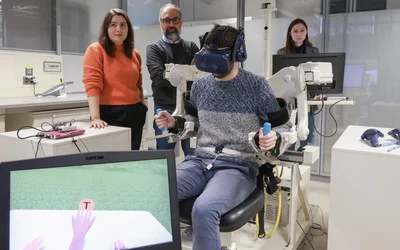
AI-powered artificial muscles made from pliable materials are reshaping recovery, from stroke rehabilitation to prosthetic design. These machines help people regain motion, strength, and confidence.
In response to the OKDo Engineering Challenge, Marcel Ochsendorf and Sebastian Kindorf developed a medical device that uses thermal imaging for remote patient monitoring. Their innovative project won the Wevolver Community Vote.
BVLOS, swarm, and military-grade encryption will enable wider and more diverse applications of drones, while cutting-edge software platforms enable operators to improve fleet coordination with more data control
Heaters are one of the most successful applications of printed electronics. At first they seem deceptively simple, yet their successful realization is in fact an art relying on the interplay of all the elements from the right material selection to right design, right printing, etc. Learn how here.
Advanced packaging of semiconductor-based sensors - specially on flexible substrates- brings very specific interconnection requirements. These often are related to a very narrow pitch of the interconnections or the fragility of the sensor. Learn how inkjet printing solves the issues
Textiles are tactile, sensorial and visual. Qualities can be modified or even expanded when technology is added, transforming passive textiles into active and interactive devices, monitoring and detecting bodily functions due to their constant contact with our skin.
Clean by ozone. It’s a term many may not be familiar with but for Arrow Lake they are on a mission to develop the world’s most efficient ozone technology and energy-efficient solutions with help from Protolabs.
Gesture recognition, leveraging the advanced capabilities of embedded devices and streamlined through specialized platforms is creating new means of human-machine interactions, paving the way for more intuitive and user-friendly device interfaces.
Spending your hard-earned budget on a robot is a step you don’t want to take lightly, Any worthwhile robot is likely to represent a significant piece of capital equipment.
So, let’s take a look at some hardware and what you might expect to pay for.
Unveiling the Duel of Digital Design - A Comprehensive Exploration of History, Syntax, and Applications of the two popular hardware description languages
In this third part of the series, we will take a deeper look at the development of the Shadow Hand and Glove, the technology behind the glove, and the potential impact of this system on the field of robotics.
As the Adapta Robotics team is an avid supporter of learning, and wanting to promote it in any way, shape or form, we decided to share with you the experience of one of our interns in the Students’ Program as he tackles the challenge of making MATT play chess.