
This Report shows how tools like artificial intelligence, digital twins, and on-demand manufacturing are no longer emerging concepts, but are already delivering measurable impact across the product lifecycle.
Do you find it challenging to understand the potential 3D printing holds for your organization? It can be easier to understand its benefits by studying real-world cases.
In this blog, we will take a look at a few of the biggest misconceptions about 3D printing, as well as dispel inaccuracies surrounding the technology, enabling you to come to an informed decision.
What is 3D printing? This article goes over the basics of 3D printing, otherwise known as additive manufacturing, covering its engineering principles and applications.
In this episode, we explore how researchers have developed an AI system that can watch a 3D print as it's being made, detect mistakes, and automatically correct them before the print fails
A live panel on how China, Europe, and the US are building, certifying, and reconciling additive manufacturing standards, and where those approaches still don't line up.
A crystal oscillator circuit uses a quartz crystal and an amplifier to generate a highly stable frequency reference. This guide explains Pierce oscillator design, load capacitance, negative resistance, drive level, startup behavior, and frequency stability in microcontrollers and RF systems.
Do you find it challenging to understand the potential 3D printing holds for your organization? It can be easier to understand its benefits by studying real-world cases.
In this blog, we will take a look at a few of the biggest misconceptions about 3D printing, as well as dispel inaccuracies surrounding the technology, enabling you to come to an informed decision.
“Toughness” is a combination of an object’s strength (how easily it breaks) and ductility (how easily it deforms). In this way, toughness and impact resistance are one and the same – especially in material science, as toughness is a measure for how easily your part breaks upon impact.
FFF 3D printing, or fused filament fabrication, is an additive manufacturing (AM) process in which thermoplastic material is pushed through a heated nozzle to create objects layer by layer.
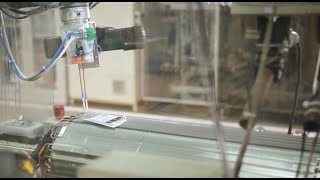
Picking of metallic objects belongs to one of the most commonly solved problems within the automation.

This solution enables the automation of parts picking and their precise placing to a predefined location within the desired cycle time.
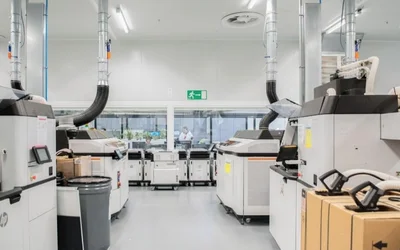
The new Protolabs whitepaper describes how additive manufacturing has established itself as a driver of innovation in medicine in recent years and what role 3D printing will play in the industry in the future.
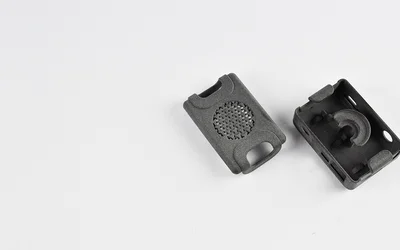
Entryphone have developed an entry phone product that perfectly meets the demands of the 21st century. Keen to get their exciting new product to market as quickly as possible, Protolabs' high-speed low-volume production model provided the support needed.
Art, culture and the craft of metal – Bryan Fuller's automotive and motorcycle design and customization shop 'Fuller Moto' inspires, educates and entertains those with a creative spirit and a do-it-yourself attitude and combines all these aspects together by creating 'rolling works of art'.
To date the huge demand for customized products confronts businesses and professionals from a broad array of industries with the question: how can customized products be designed accurately, effectively and at reasonable cost?