The Data Foundation for Engineering with AI
The data problem

14 Sep, 2026. 5 minutes read
Alexander Lavin of Pasteur Labs spent his New York presentation at CDFAM on simulation intelligence, and stopped partway through to name the thing underneath it: the data interfaces problem in digital engineering.
If you think you don’t have this data problem, you just haven’t run into it yet.
— Alexander Lavin, Pasteur Labs, CDFAM NYC 2025
Pasteur hit it early, four years before that talk, and ended up building a data engineering pipeline for its own machine learning staff before it could build much else on top.
That is the shape of it across four years of CDFAM presentations. Many of the talks that look like they are about AI turn out, once you get past the demo, to be about data: where it came from, what format it arrived in, and whether it carries the information the problem actually depends on.
A 2022 article opened on the gap between text-to-image progress and 3D engineering, and landed on the reason: “the same volume of open data does not exist for 3D objects in quite the same way.” Four years later, the three answers taking shape are common formats, synthetic data, and fields.

Formats are the Plumbing
Geometry has to move between tools before anything else can happen, and the format it moves in decides what survives the trip. The STL problem is the familiar version: a lattice or a TPMS structure described by a short mathematical function becomes an enormous pile of triangles the moment it is tessellated, and the design freedom is then capped by triangle count.
The 3MF Consortium’s Volumetric and Implicit Extension attacks this by letting a file carry spatial functions — a stack of images, a mathematical function, or both — so material properties and geometry travel as the thing itself. Jan Orend, who contributes to the specification on behalf of EOS, framed the stakes plainly in a CDFAM interview: the consortium exists to solve “the interoperability challenges that are holding back the industry.”
That matters more now than it did when the extension was released. Every agentic workflow demonstrated assumes tools can call each other and hand over geometry without losing what makes it meaningful. Wesley Essink of Siemens showed the receiving end, exporting the same implicit model out as volumetric data, mesh, B-rep, beams or slice data depending on where it was headed next.
Synthetic data, because the real stuff is expensive and wrong
The bottleneck Francis Bitonti of Lexset described in 2023 has aged well. Collect images, send them to a third party for annotation, wait, run quality assurance, send them back with feedback, repeat. Hundreds of people touching your data, biases and fatigue baked into the labels, security exposure, and a cycle his customers measured in months.
Before working with us this process can take about six months, and we’ve even had some customers say this takes a year to go and collect these data sets.
— Francis Bitonti, Lexset, CDFAM NYC 2023
His conclusion was that crowdsourcing does not scale with model size, and that simulation and synthetic data are where the field goes next. It went there. Verena Vogler of McNeel Europe described teams using Grasshopper to generate training sets as a matter of course. Wasil Rezk of BeyondMath showed models trained on self-generated data grounded in first principles rather than on a customer’s simulation archive, reporting predictions within a few percent of full CFD while needing an order of magnitude less data, and more to the point, generalising to geometries the model had never seen.
The economic argument is the one that lands with manufacturers. Training data you generate is training data you do not have to buy, annotate, or wait a year for.
Fields, where words run out
The most interesting shift is in what counts as data in the first place.
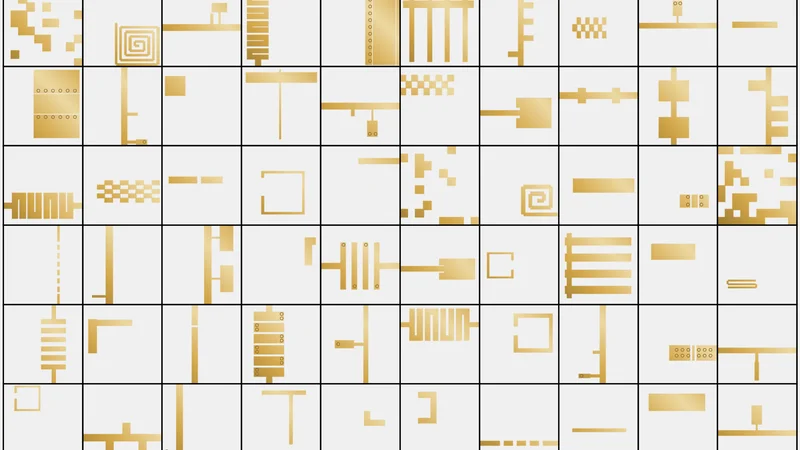
Mike Frei of ARENA-AI opened his Barcelona talk on human intuition — how we know by looking how heavy something is, learned across thousands of small physical feedbacks. Then he put up a band-pass filter, a structure used in RF constantly, and demonstrated how the electromagnetic wave propagates through it.
Probably few of you would know. Even fewer people actually have an intuition of how to change the structure to have it do something different.
— Mike Frei, ARENA-AI, CDFAM Barcelona 2026 · watch
An 8mm square, one layer, and the simulation still takes minutes. A modern system might be twenty layers and half a metre across. There is no vocabulary that compresses this usefully, because the thing being described is a continuous field, and language is the wrong container for it. His group’s answer is two models: a forward model that takes geometry and materials and characterises the electromagnetic behaviour, and an inverse model that runs the other way.
The same logic shows up in geometry tools. Essink’s demonstration of field-driven design treats a parameter as something that varies through space rather than as a number — lattice parameters, fillet radii, shell thicknesses, all under spatial control.
This is really where we can take data and map it to the geometry, because a lot of the data that we work with is either volumetric or planar.
— Wesley Essink, Siemens Digital Industries Software, CDFAM Barcelona 2026
The inputs he listed are instructive: CAD features, simulation output, raw point clouds, a CSV with a scalar at every point, image data. Any of it can drive geometry once geometry accepts fields as an input. Luminary’s case for physics AI as a strategic advantage rests on the same foundation — the value sits in the field data, and in being able to compute over it fast enough to stay in the loop.
What this adds up to
Formats decide what can move. Synthetic data decides what can be learned. Fields decide what can be expressed at all. The AI tooling is the visible layer, and it rests on those three.
Which is the same thing people at CDFAM were discussing in 2022, before there was much to demonstrate: more than geometry, this needs design intent and validation.
Hear it from the people building it
Search the CDFAM presentation index, with transcripts of every recorded presentation in the series. Search by speaker, company or topic, or search what was actually said to find the moment itself. Every result links to the exact second of the recording.