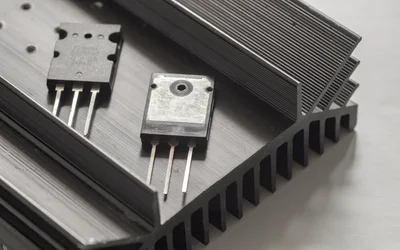


Protect sensitive electronics by understanding the current limiting resistor, learning how to calculate appropriate values, and applying them in LEDs, transistors, microcontroller inputs and other circuits.
This guide explains how potentiometer pins interact with mechanical rotation, resistive tracks, and load conditions across various circuit configurations. It provides clarity for both low-power electronic designs and high-precision embedded systems.
This technical article explains the theory behind potentiometer schematics. It shows how to implement mechanical and digital potentiometers in practical circuits, tailored for engineers, and students.
Engineering teams can achieve AI-ready design data with five-level maturity model by Keysight. The unified, traceable data accelerates design cycles, boosts IP reuse, and reduces costly re-spins.
Focused laser-like light that covers a wide range of frequencies is highly desirable for many scientific studies and for many applications, for instance quality control of manufacturing semiconductor electronic chips.
Scientists at ITMO have come up with a new way to protect microelectronics devices from counterfeit. The new technology is based on gold and silicon nanoparticles with unique optical properties that make it possible to create unclonable functions with a record information density.
An international team of scientists was first to demonstrate that halide perovskites can serve as a base for nonlinear on-chip optical components. As an example, they can be used to build ultrafast optical chips and transistors, and, potentially, other integrated optical systems.
Circuit card assemblies (CCA) give birth to a complete printed circuit board (PCB) after assembling every component. A printed circuit board has no electrical components and needs to go through a manufacturing process called circuit card assemblies which are the complete board assembly.
Carnegie Mellon University collaborators pioneer the CMU Array—a customizable, 3D nano-printed, ultra-high-density microelectrode array platform for next-generation brain-computer interfaces. This technology can transform the way doctors are able to treat neurological disorders.
Printed batteries offer thinness and flexibility, enabling new applications, but their production is deceivingly complex. Gunter Hübner from Stuttgart Media University offered some insights at the e-Swiss conference last week.
Experimenting in the world of Flexible Hybrid Electronics (FHE) comes with a variety of hurdles. Printing technologies are vastly different in terms of materials compatibility and have pros and cons that make them suitable for particular applications. Choosing materials that match the printing technology you intend to use is the most important decision you’re going to make.
But what if one could print, digitally, using any paste and ink on any substrate? Read more
Researchers have designed smart, colour-controllable white light devices from quantum dots, tiny semiconductors just a few billionths of a metre in size, which are more efficient and have better colour saturation than standard LEDs, and can dynamically reproduce daylight conditions in a single light
If the transition to renewables is to succeed, we will need a viable means of storing surplus heat and electricity. Globe spoke to experts from ETH Zurich about the promising technologies that could help us reach net zero.

The collaborative nature of open source projects brings together people across the world to work towards improving and monitoring our natural resources.
The pace of change in consumer electronics has always been fast which poses its own challenges for manufacturers. Here we take a look at 7 trends that will shape the future of product development and manufacturing in the industry…
Integrated circuit (IC) package types encompass a range of protective enclosures designed to shield semiconductor components from physical damage and corrosion. This article explores the various classifications of IC packages, each tailored to specific requirements and applications.
Into the future, more transport companies may start to integrate wastewater monitoring systems to manage these key facilities effectively. But this opportunity isn’t only limited to transport – any water monitoring capabilities can help reduce waste, and save energy, time and resources.
The German Aerospace Center (DLR) is researching the infrastructure and railway operational framework conditions, working on new, capacity-increasing concepts for vehicles, operations and infrastructure, as well as innovative methods for maintenance and servicing.