
Protect sensitive electronics by understanding the current limiting resistor, learning how to calculate appropriate values, and applying them in LEDs, transistors, microcontroller inputs and other circuits.
This guide explains how potentiometer pins interact with mechanical rotation, resistive tracks, and load conditions across various circuit configurations. It provides clarity for both low-power electronic designs and high-precision embedded systems.
This technical article explains the theory behind potentiometer schematics. It shows how to implement mechanical and digital potentiometers in practical circuits, tailored for engineers, and students.
Engineering teams can achieve AI-ready design data with five-level maturity model by Keysight. The unified, traceable data accelerates design cycles, boosts IP reuse, and reduces costly re-spins.
Focused laser-like light that covers a wide range of frequencies is highly desirable for many scientific studies and for many applications, for instance quality control of manufacturing semiconductor electronic chips.
Scientists at ITMO have come up with a new way to protect microelectronics devices from counterfeit. The new technology is based on gold and silicon nanoparticles with unique optical properties that make it possible to create unclonable functions with a record information density.
An international team of scientists was first to demonstrate that halide perovskites can serve as a base for nonlinear on-chip optical components. As an example, they can be used to build ultrafast optical chips and transistors, and, potentially, other integrated optical systems.
Extreme temperatures, vibrations, and electromagnetic interference can disrupt sensor performance. The Xsens Sirius Series offers a solution with its accuracy and reliability, even in the most demanding conditions.
LGA uses flat pads for connections, while BGA relies on solder balls for permanent mounting. This guide compares their thermal performance, electrical traits, reliability, and assembly pros and cons to help you choose the best IC package for your needs.
This article explores the principles, methods, and real-world applications of the solderability test, offering insights into how it enhances quality assurance across modern electronics manufacturing processes!
With help from recent gifts, the Stanford Wearable Electronics Initiative eWEAR-X is supercharging its efforts to transform researchers inspiration into reality by augmenting the Ideation and Prototyping Lab and providing seed funding for members of the university community.
The Silicon Photomultiplier (SiPM) is transforming optical sensing and LiDAR technology by providing high photon detection efficiency, low noise, and fast response times, enabling greater accuracy and resolution in applications such as autonomous navigation, environmental mapping, and 3D imaging.
Explore how TDKs Direct Retinal Projection DRP technology offers a breakthrough, enabling compact, energy-efficient AR glasses designed for all-day wear.
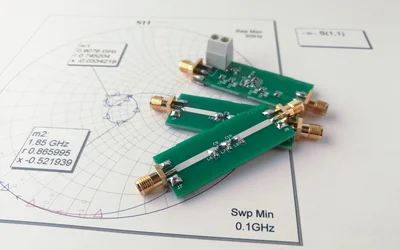
Learn how to calculate impedance in AC circuits – from basic RLC components to complex transmission lines and PCB traces. This guide covers the theory, formulas, methods, and tools needed to determine impedance accurately and ensure proper impedance matching in their designs.
Ambiq’s ultra-low-power edge AI technology is pushing health monitoring by enabling always-on, intelligent wearable devices that track vital signs in real time without relying on cloud connectivity.
Is soldering paste the same as flux? This technical article clarifies the differences for electronics engineers, covering their functionalities and practical implementations in both manual soldering (repairs, prototyping) and automated soldering (SMT reflow assembly)
Healthcare is facing a critical workforce shortage, with AI emerging as a key tool to support clinicians by improving diagnostics, treatment planning, and efficiency without replacing human expertise.