Connector Trends 2025: What Engineers Should Prepare For
This article explores the major trends shaping connector technology in 2025, including miniaturization, ruggedness, increased current density, advanced materials, digital transformation in design and selection, engineering challenges.

23 Jul, 2025. 6 minutes read
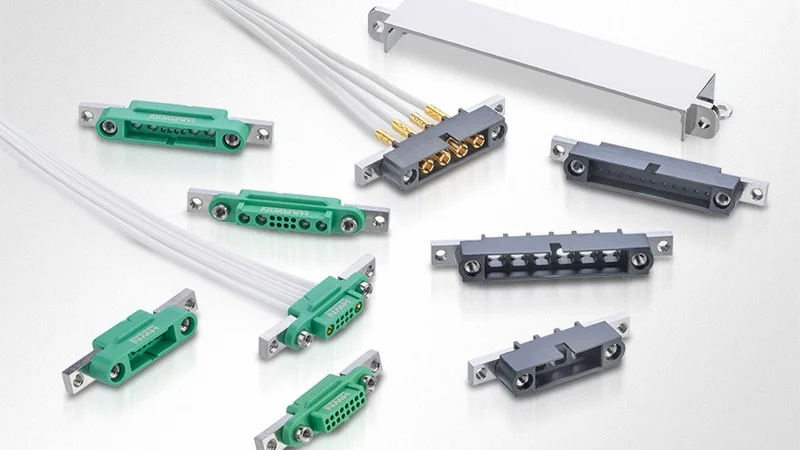
Connectors are fundamental to advanced electronic systems. This is reflected in the steady growth of the global connector market, which is projected to increase from $71.7 billion in 2024 to $105.7 billion by 2034. [1, 2] The growth of the connector market is supported by the broader use of connectors in industries such as aerospace, automotive, telecommunications, industrial automation, and consumer electronics. This growing market puts pressure on suppliers to anticipate and address future engineering challenges.
This article explores the major trends shaping connector technology in 2025, including miniaturization, ruggedness, increased current density, advanced materials, digital transformation in design and selection, engineering challenges, and how leading suppliers like Harwin are responding to these changes to support engineers.
Key Trends Shaping Connector Design in 2025
Miniaturization
Miniaturization is one of the defining factors in connector design, as manufacturers push for smaller, lighter, and more densely packed electronic assemblies. Compact devices used across sectors such as aerospace, automotive, telecom, and consumer electronics have also created a demand for connectors that occupy minimal board space and deliver robust performance. However, this trend of miniaturization introduces significant engineering challenges. For instance, as connectors shrink, maintaining electrical and mechanical integrity becomes more complex because signal integrity, thermal management, and mechanical robustness need to be preserved within much tighter tolerances. Moreover, engineers also face design challenges like increased susceptibility to electromagnetic interference and the risk of reduced mating cycles due to smaller contact areas.
Ruggedness and Reliability
Ruggedness and reliability are central in the design of the electronic systems deployed in harsh environments. In such conditions, electronic devices may face extreme temperatures, exposure to moisture, vibration, and mechanical shock. The connectors used in harsh environmental conditions should also be rugged and reliable, as connector failure can have severe consequences.
Moreover, the industry standard for operating lifetimes is also changing, with many applications requiring connectors to perform reliably for five to ten years or more. This focus on durability is reflected in a recent survey conducted by Harwin in April 2025. The survey collected insights from a broad range of North American connector buyers and engineers, including professionals in procurement, design, and executive roles across industries such as industrial, automotive, aerospace, and telecommunications. It was that found that reliability and operating life rank among the top criteria for connector selection, with 61% of respondents emphasizing high-reliability connectors and a significant proportion seeking products with a decade or more of dependable operation. [2]
Increased Current Density
Advanced applications require connectors that support higher current densities within smaller footprints. This necessitates improvements in contact design, material selection, and thermal management to prevent overheating and signal loss. Moreover, maintaining strict compliance with safety standards in miniaturized connectors is also quite challenging. In this regard, the balance between current-carrying capacity, voltage ratings, and insulation requirements is important to ensure that connectors can deliver the necessary power without arcing or excessive temperature rise.
Advanced Materials
Advanced materials, new alloys, composites, and surface coatings are being developed to enhance conductivity, improve mechanical durability, and provide corrosion resistance. Industries seek recyclable materials, lead-free alloys, and environmentally friendly coatings to minimize their ecological footprint and meet environmental standards.
Advanced materials also enable connectors to operate reliably in a wider range of conditions in applications that may involve exposure to chemicals or other challenging environments.
Digital Transformation in Connector Design and Selection
Digital tools are central in advanced connector design and selection. These tools have shifted the design and selection process from manual, catalog-based workflows toward faster, more intelligent, and more integrated design environments.
In this regard, online design platforms and AI-based configurators enhance design decision-making and optimization. Engineers utilize platforms that offer downloadable CAD models, parametric search filters, and side-by-side product comparisons. These platforms eliminate guesswork and enable quicker evaluation. According to Harwin’s 2025 North American survey, over half of connector specifiers either currently use or plan to use such online tools, with design file accessibility and product comparison features ranking highest in importance. Nearly 18% of respondents in the same survey reported using AI tools for tasks like initial connector selection and assisting PCB layout. [2]
Another important component of this digital transformation is 3D printing integration into connector development workflows. 3D printing for prototyping and small-batch production reduces lead times and allows for quick design customization. 3D printing also facilitates tooling design and material evaluation, enabling engineers to experiment with new concepts and materials without the constraints of traditional manufacturing processes.
Supplier digital support is also crucial in connector design and selection. Engineers expect easy access to technical documentation, online configurators and responsive customer service. Supplier and distributor websites are primary sources of information, and their ability to deliver easy-to-navigate platforms with up-to-date data and tools is a differentiator in the market. Moreover, responsive technical support, whether through digital channels or direct engagement, helps engineers to overcome design challenges and make informed decisions quickly.
Engineering Challenges and Customer Expectations
Modern connector designs are influenced by engineering challenges and customer demands. Engineers work within tight economic and logistical constraints while designing for more complex, compact, and multifunctional systems.
The supply chain disruptions caused by pandemics or global geopolitical situations causes long lead times and component shortages, affecting design timelines and procurement strategies. Due to such disruptions, engineers often have to redesign systems due to unavailable components, which can drive up costs, cause delays, and require additional validation work. Moreover, the cost pressure adds more complexity, as teams have to balance budget constraints while also maintaining performance and reliability.
Modern electronic systems are denser and more interconnected. Engineers are tasked with maintaining robust electrical performance in tightly packed assemblies while contending with mixed signal environments, higher power densities, and faster data rates. Therefore, compact connectors that are also easy to integrate and assemble without compromising mechanical or electrical reliability are imperative in such designs. However, designing such connectors that ensure clean mating, secure locking, and EMI shielding in these complex setups is quite challenging, especially in applications exposed to vibration, temperature extremes, or electromagnetic interference.
Engineers today expect more from their connector suppliers than just quality products. They seek partners who can offer rapid sampling, online configurators, downloadable 3D models, and immediate access to datasheets and compliance information. Without these resources, even well-designed connectors can fall short in fast-paced development environments.
Harwin’s Approach: Anticipating and Meeting Future Needs
Driving Innovation in Miniaturization, Ruggedness, and Material Science
Harwin’s strategy for staying ahead in the connector industry is based on innovation, particularly in miniaturization, ruggedness, and advanced material science. Harwin refines its connector designs to achieve smaller footprints without sacrificing performance or reliability.
For instance, their Gecko and Gecko-MT Series connectors are engineered specifically for applications where Size, Weight, and Power (SWaP) constraints are critical. Despite their ultra-compact form factor, they deliver industrial-grade ruggedness, withstanding extreme temperatures and harsh mechanical stresses. The addition of power contacts in the Gecko-MT variant broadens its utility in mixed-signal applications. [3]
Similarly, their Datamate Series is designed to perform in high-vibration and harsh environments. Datamate connectors are widely used in aerospace applications and demanding industrial environments. Their secure mating systems, vibration resistance, and high current-carrying capacity reflect Harwin’s attention to the mechanical and electrical challenges engineers face when designing for high-reliability deployments. [4]
Empowering Engineers with Digital Platforms and Technical Support
Harwin has invested heavily in digital platforms that streamline the connector selection and design process. Harwin’s digital ecosystem, which includes comprehensive online configurators, 3D model libraries, and rapid prototyping support, empowers engineers to make informed decisions quickly and efficiently. This digital infrastructure is complemented by a responsive technical support team that ensures customers’ access to expert guidance at every stage of their project.
Collaborative Solution Development with OEMs
Harwin works closely with OEMs to develop tailored connector solutions for niche and emerging applications. Harwin tailors its products by working closely with customers in the automotive, aerospace, and industrial sectors to meet unique technical and operational requirements. This collaborative approach ensures that the final solutions are aligned with novel applications.
Moreover, Harwin provides engineers with detailed technical documentation and access to expert advice, which helps them navigate complex design and procurement challenges. This focus on support helps engineers address challenges related to compatibility and supply chain disruptions.
Conclusion: Preparing for the Next Generation of Connectivity
The connector industry is transforming with new technologies, market demands, and application requirements. Engineers are expected to manage greater complexity in their designs, like integrating advanced digital tools and ensuring robust performance in more demanding environments.
Harwin’s strategy reflects an understanding of these industry shifts and the practical needs of engineers. The company’s focus on innovation is not limited to product development but extends to the support and resources it provides to its customers. Harwin aims to streamline the design journey for engineers and procurement professionals by investing in digital platforms, technical support, and collaborative problem-solving. To find out more, visit Harwin’s website.
References
Harwin. [Online] Available at: https://www.harwin.com/ (Accessed on July 10, 2025)
Connector Research 2025. [Online] Harwin. Available at: https://www.harwin.com/connector-research-25 (Accessed on July 10, 2025)
Gecko. Micro-Miniature Connectors for SWaP-C Optimization. [Online] Harwin. Available at: https://www.harwin.com/hri-range/gecko (Accessed on July 10, 2025)
Datamate. High reliability, miniature connectors for SWaP-C optimization [Online] Harwin. Available at: https://www.harwin.com/hri-range/datamate (Accessed on July 10, 2025)