Featured
Article #3 of the Enabling IoT Series. This article looks at how Time of Flight (ToF) sensors are used for this purpose and are changing the way we can interact with VR, and other video technologies.

Article #3 of the Enabling IoT Series. This article looks at how Time of Flight (ToF) sensors are used for this purpose and are changing the way we can interact with VR, and other video technologies.
PCB Trace Width Calculator
Glossary of Semiconductors Terms
Article #3 of the Enabling IoT Series. This article looks at how Time of Flight (ToF) sensors are used for this purpose and are changing the way we can interact with VR, and other video technologies.
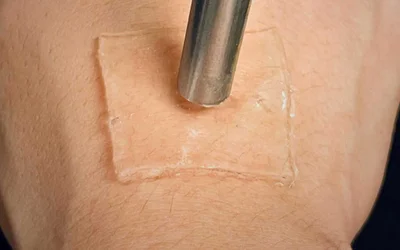
Canadian researchers have discovered that they can stick hydrogel plasters to the skin very effectively using ultrasound. Outi Supponen has now explained the underlying mechanism: imploding bubbles that form within the adhesive located between the plaster and the skin anchor the one on the other.
Open and honest communication is crucial to a successful design. Product and engineering decision-makers need to work in sync.
Semiconductors are the building blocks of modern electronics, powering everything from smartphones to satellites. This in-depth guide provides a comprehensive understanding of semiconductors' engineering principles and applications, delving into their fundamental concepts, materials, devices, manufacturing processes, and their impact on today's technology landscape.
18 minutes read.
20 minutes read.
26 minutes read.
17 minutes read.
21 minutes read.
29 minutes read.
Semiconductors
Nordic Semiconductor is a fabless semiconductor company specializing in wireless technology that powers the IoT.
181 Posts
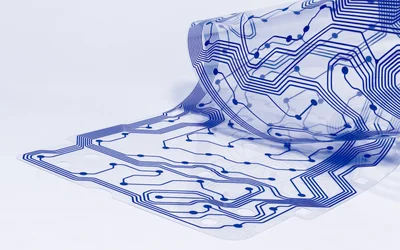
Exploring the shift to additive digital printing in modern electronics fabrication.
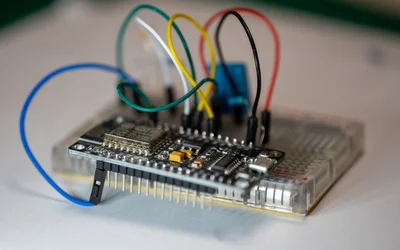
This article explains the ESP8266 pinout, covering GPIO mapping, boot-strapping pins, safe-to-use pins, flash connections, ADC limits, deep-sleep functions, and NodeMCU and D1 mini pin labels.
Learn how a Hall Effect Current Sensor works, including principles, topologies, specifications, comparisons and engineering applications.
A guide covering the full radio-frequency design workflow, starting from setting specifications and choosing topologies to matching, simulation, layout, and verification, to help antenna engineers.
Controlled impedance is the control of PCB trace impedance within specified tolerances. This article covers microstrip and stripline designs, IPC-2141A formulas, stackup selection, impedance tolerances, routing practices, and TDR testing for signal integrity.
Exploring the shift to additive digital printing in modern electronics fabrication.
A PCB design can be electrically correct, pass every design rule check and perform exactly as expected on an engineer's screen - and still cause significant problems when it reaches manufacturing.
A semiconductor is a material whose electrical conductivity falls between that of a conductor and an insulator and can be controlled by temperature, light, and impurities. This article covers semiconductor materials, doping, diodes, transistors, and integrated circuits.
Article #3 of the Enabling IoT Series. This article looks at how Time of Flight (ToF) sensors are used for this purpose and are changing the way we can interact with VR, and other video technologies.
Canadian researchers have discovered that they can stick hydrogel plasters to the skin very effectively using ultrasound. Outi Supponen has now explained the underlying mechanism: imploding bubbles that form within the adhesive located between the plaster and the skin anchor the one on the other.

2 minutes read
Open and honest communication is crucial to a successful design. Product and engineering decision-makers need to work in sync.

4 minutes read
Phosphors or QDs for color conversion in LCD and microLED ? Which will win? This is an evolving technology space to watch. Here, it is shown that phosphor technology is evolving, enabling not just red but also green narrowband color conversation with small particle sizes compatible with microLEDs

2 minutes read
Molecular particle free inks can offer extreme formability and stretchability, allowing the design and production of 3D shaped and/or in-mold electronics parts with extreme curvatures and complex shapes.
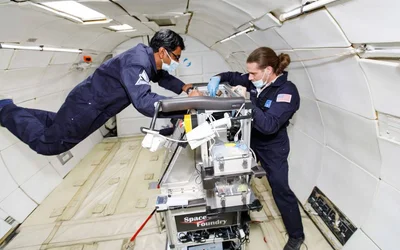
As NASA prepares to send astronauts back to the Moon to live and explore, capabilities for space-based manufacturing of sensors, circuits, and other electronics will become increasingly critical. Recent microgravity flights have helped to advance cutting-edge methods for 3D printing of electronics

4 minutes read
This article delves into the specifics of NPN and PNP transistors, their working principles, applications, comparisons, and factors to consider when choosing between them.
The rigid, flex and rigid-flex PCBs are all types of printed circuit boards. The rigid PCB is the traditional board and the base from which the other two variations came about, in response to industry and market needs. Flex PCBs introduced versatility to PCB fabrication and rigid-flex combines both for increased performance. Learn more about these board types, their benefits, disadvantages, and applications in this article.
How to overcome the traditional limits of LDS (laser direct structuring) to metallize 2D and 3D objects made from all kinds of surfaces?
A student article explaining how quasioptical framework is advantageous for developing radiative wireless power transfer systems with high efficiency.
Digital imaging giant Teledyne DALSA is one of the most senior residents at High Tech Campus Eindhoven. Using state-of-the-art X-ray detectors for medical, dental and industrial applications their ambition is to be both world and innovation leader in their field.

4 minutes read
Article #3 Electronics Innovation Series. As offices re-open the must embrace the use of data at a smart home scale.
It is incredible to see the progress that organic semiconductors (OSC) have made over the past 15-20 years. Ian Jenks explains in this short 5-min presentation how they are removing the long-existing barriers to adoption of OTFT technology.
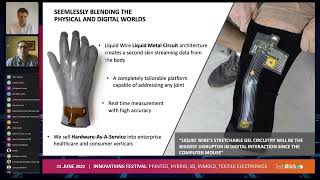
Gallium-Indium-Tin is an interesting material for stretchable electronics. It can be formed into a non-toxic RoHS-compliant gel and applied to almost any substrate to form stretchable conductive metallizations and circuits.
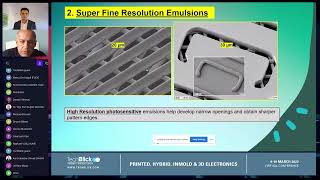
Screen printing never ceases to advance and is entering into ultrafine line printing territory. FERNANDO ZICARELLI explains in this short 5-min talks important considerations to achieve fineline printing and further push the resolution down: