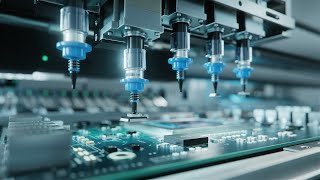
SMT stands for Surface-mount Technology, a method of soldering components directly onto a PCB. This article delves into the concept of SMT and the manufacturing process, as well as the benefits, drawbacks, and related terms.
Printed Circuit Boards (PCB) form the backbone of electronics, while Printed Circuit Board Assemblies (PCBA) complete the circuit with components – this article explores the differences, roles, and implications in hardware design and manufacturing of PCBA vs PCB.
Semiconductors are the building blocks of modern electronics, powering everything from smartphones to satellites. This in-depth guide provides a comprehensive understanding of semiconductors' engineering principles and applications, delving into their fundamental concepts, materials, devices, manufacturing processes, and their impact on today's technology landscape.

This article provides a technical overview of the brushless vs brushed motor paradigm, equipping design engineers with the analytical framework necessary to make informed, application-specific decisions.
Learn how USB 3.2 Gen 2x1 delivers 10Gbps high-speed performance with simpler single-lane routing, lower power consumption, and easier PCB design for embedded, FPGA, and industrial systems.
Explore how first-principles engineering and human judgment shape reliable high-voltage IC design, from yield thinking to long-term system lifetime and root-cause discipline.
This in depth article explores the theoretical foundation and practical considerations of connecting inductor in series for engineers and electronics students. Learn how series inductance works, why it increases total inductance, how mutual coupling affects it and how to design effective filters.
Learn how Altium Agile Teams enables secure hardware collaboration with centralized identity, role-based access, and full traceability — so teams can scale without sacrificing speed or control.
OMRONs XW4M/XW4N push-in terminal block PCB connectors are designed to simplify wiring, inspection, and maintenance while supporting consistent performance in industrial systems.
Soldering wires is the process of joining electrical conductors using a melted filler metal to create strong, low-resistance connections. This guide explains tools, techniques, heat control, materials, common defects, and engineering best practices for reliable electrical connections.
SMT stands for Surface-mount Technology, a method of soldering components directly onto a PCB. This article delves into the concept of SMT and the manufacturing process, as well as the benefits, drawbacks, and related terms.
Printed Circuit Boards (PCB) form the backbone of electronics, while Printed Circuit Board Assemblies (PCBA) complete the circuit with components – this article explores the differences, roles, and implications in hardware design and manufacturing of PCBA vs PCB.
As critical components in contemporary computing, choosing between ASICs and FPGAs carries significant implications, underscoring the importance of understanding their unique strengths and trade-offs in the constantly evolving digital landscape.
In this episode, we talk about why minimization of speakers and energy storage devices is crucial for the next generation of electronics and medical devices.
Understanding your rights and responsibilities is essential to securing your innovation. Further, taking advantage of cloud manufacturing can mitigate substantial risk.
Researchers have developed a new material for an electronic component that can be used in a wider range of applications than its predecessors. Such components will help create electronic circuits that emulate the human brain and that are more efficient at performing machine-learning tasks.
Article #1 Electronics Innovation Series. Enabling continued innovation while dealing with the constraints of supply chain uncertainty is a task for both designers and suppliers.
Mitigating electronics manufacturing delays starts with understanding where manufacturing processes can go wrong. We’ve highlighted the four key reasons here, giving you a starting point if you struggle with on-time deliveries.
Design for Manufacturing (DFM) builds upon five tenets that should apply to the decision chain starting from project initiation. This critical step within the manufacturing development cycle merges design requirements with production methods to create the best end results.
With today’s most advanced cloud manufacturing platforms, users can access the full capabilities needed to move seamlessly between prototyping, testing, and full-scale production
Rapid PCBA prototyping using electronics cloud manufacturing offers many advantages including problem identification, reduced error rate, lower costs, and shortened manufacturing timelines.
A team of researchers in Korea has been working on functional acoustic energy transmission (AET) systems, and their latest paper details a major breakthrough: Prototypes capable of powering LEDs, sensors, and Bluetooth transmitters at range and through materials include metal, tissue, and water.