Understanding Noise Sources from GHz to nHz and How to Control Them
Explore how frequency shapes EMC behavior from RF emissions to ultra-low-frequency drift, with mitigation strategies for robust, compliant electronic system design.

24 Mar, 2026. 6 minutes read
Electromagnetic compatibility (EMC) challenges rarely originate from a single faulty component or isolated design error. Instead, they emerge from the complex interaction of electronic systems across the entire frequency spectrum. From gigahertz-range RF emissions to nanohertz-scale drift and environmental disturbances, every frequency band introduces unique coupling mechanisms, noise sources, and failure modes.
Understanding how frequency governs electromagnetic behavior is essential for building reliable, compliant, and robust electronic systems. High-frequency noise may trigger radiated emissions failures, while low-frequency interference can silently degrade measurement accuracy or long-term system stability.
This guide explores how frequency fundamentally controls EMC behavior, examines real-world noise sources from GHz down to nanohertz levels, and outlines practical mitigation strategies that engineers can apply to ensure emissions compliance, immunity, and long-term reliability.
Why Frequency Controls EMC Behavior
Practical Meaning of EMC for Real Electronic Systems
Electromagnetic compatibility refers to a system’s ability to function correctly in its electromagnetic environment without introducing intolerable interference to other devices. In practice, this means meeting regulatory emission limits, maintaining immunity to external noise, and ensuring stable operation under real-world conditions.
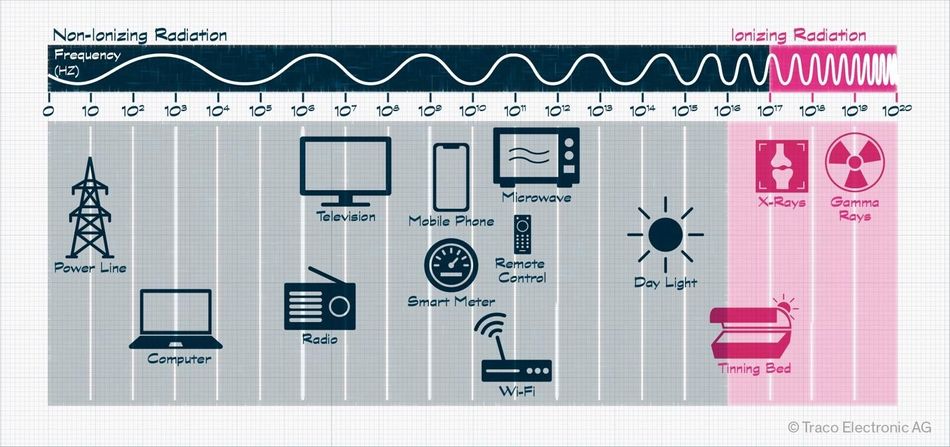
Every electronic product both generates and responds to electromagnetic energy. Whether this energy becomes problematic depends largely on frequency. The same voltage disturbance may be harmless at one frequency yet disastrous at another. EMC design is therefore fundamentally about understanding and controlling how signals propagate, couple, radiate, and interfere across frequency.
Why Noise Problems Are Fundamentally Frequency-Driven
Frequency determines how energy moves through conductors, dielectrics, and free space. At low frequencies, currents follow predictable paths, and coupling is dominated by magnetic and resistive effects. As frequency increases, parasitic capacitance, inductance, radiation, and wave propagation dominate system behavior.
High-frequency signals exploit unintended coupling paths such as trace capacitance, cable inductance, and enclosure openings. At very low frequencies, slow thermal and electrical drift quietly corrupt precision measurements. In both cases, failure mechanisms directly stem from frequency-dependent physics.
Wavelength, Skin Depth, and Coupling Efficiency
Wavelength decreases as frequency increases. At low frequencies, wavelengths may be kilometers long, making PCB features electrically small. At high frequencies, wavelengths shrink to centimeters or millimeters, allowing traces, cables, and connectors to behave as resonant antennas.
Skin depth also decreases with rising frequency, forcing currents to flow closer to conductor surfaces. This raises resistance, alters impedance, and intensifies EMI coupling through surface currents.
The Link Between Emissions, Immunity, and Reliability
Emissions and immunity are two sides of the same electromagnetic coin. Circuits that radiate strongly tend to be highly susceptible, while robust noise containment often improves immunity as well.
Over time, uncontrolled interference can degrade system reliability by stressing components, corrupting data, accelerating aging mechanisms, and causing intermittent faults that are notoriously difficult to diagnose.
High-to-Mid Frequency Noise (GHz to kHz): Digital, RF, and Switching Interference
RF Transmitters and Wireless Modules
Intentional RF sources such as Wi-Fi, Bluetooth, cellular radios, and radar modules generate strong emissions in the MHz to GHz range. While these systems are carefully designed for efficient radiation, their surrounding circuitry must remain immune to high field strengths.
Poor grounding, insufficient shielding, or improper isolation can allow RF energy to couple into sensitive analog, digital, or power circuits, leading to data corruption, jitter, or latch-up events.
Fast Digital Edges and Harmonic Generation
Modern microcontrollers, processors, and FPGAs generate extremely fast edge rates. A 1 ns rise time contains significant energy well into the GHz range, even if the clock frequency is only a few tens of megahertz.
These harmonics propagate along PCB traces, power planes, and cables, turning them into unintended antennas. Poorly terminated traces reflect energy, creating standing waves that amplify emissions and degrade signal integrity.
Switching Power Supplies and DC–DC Converters
Switch-mode power supplies and DC–DC converters are among the most aggressive noise sources in electronic systems. Their high di/dt switching edges generate broadband noise extending from kHz into hundreds of MHz.
Without careful layout, filtering, and shielding, switching transients couple into signal paths, excite cable resonances, and radiate from enclosures. Power distribution networks (PDNs) may resonate at specific frequencies, amplifying ripple and inducing ground bounce.
PCB Traces, Cables, and Enclosures as Antennas
As frequency rises, any conductive structure becomes an antenna. PCB traces behave as transmission lines, cables radiate strongly, and enclosure seams leak electromagnetic energy.
Even short interconnects can become efficient radiators when their electrical length approaches a quarter wavelength. Improper routing, insufficient return paths, and discontinuities significantly worsen radiation and susceptibility.
Typical High-Frequency EMC Failures
Common failure mechanisms in this frequency range include:
Radiated emissions exceeding regulatory limits
Signal reflections causing eye diagram collapse
Crosstalk between adjacent traces
These issues often appear during compliance testing and can require extensive redesign if EMC considerations were not addressed early.
Core Control Techniques
Effective mitigation at high and mid frequencies relies on layered control strategies:
Controlled impedance routing: Ensures predictable signal behavior and minimizes reflections.
Short return paths: Reduces loop areas and limits radiation.
Via stitching and solid reference planes: Provide continuous shielding and low-impedance current return.
Decoupling networks: Local bypass capacitors suppress transient currents before they propagate.
Low-Frequency Disturbances (kHz to Hz): Power and Environmental Coupling
Mains Hum and Harmonic Distortion
Power-line interference at 50 or 60 Hz and its harmonics is one of the most persistent EMC challenges. Magnetic coupling from transformers and power wiring induces hum in nearby analog circuits, audio paths, and sensor interfaces.
Rectifier switching and nonlinear loads inject harmonics that extend into the kilohertz range, contaminating sensitive systems and degrading measurement precision.
Ground Loops and Unintended Current Paths
At low frequencies, improper grounding often becomes the dominant interference mechanism. Ground loops form when multiple return paths allow circulating currents driven by small voltage differences between grounding points.
These loops introduce noise voltages across sensitive circuits, particularly in measurement and instrumentation systems where microvolt-level resolution is required.
Transformer Magnetic Leakage and Inductive Coupling
Transformers generate stray magnetic fields that easily couple into adjacent wiring. Low-frequency magnetic coupling is difficult to shield and often requires careful physical separation, orientation control, and thoughtful layout.
Inductive pickup in sensor loops, audio lines, and long cables frequently causes hum and baseline drift.
Impact on Precision Systems
Low-frequency disturbances degrade performance in applications such as:
Medical instrumentation
Precision data acquisition
Industrial sensing and control
Audio and acoustic equipment
Even minor noise levels can mask real signals, reduce accuracy, and destabilize control loops.
Practical Mitigation Strategies
Key techniques for suppressing low-frequency interference include:
Star grounding: Prevents circulating currents by enforcing single-point return paths.
Differential signaling: Rejects common-mode noise and ground offsets.
Twisted-pair wiring: Reduces magnetic pickup by canceling induced fields.
Very Low and Ultra-Low Frequencies (Sub-Hz to nHz): Drift and Long-Term Instability
Flicker (1/f) Noise in Semiconductor Devices
At ultra-low frequencies, flicker noise dominates semiconductor behavior. This noise mechanism causes slow, random variations in transistor parameters, introducing drift into amplifiers, voltage references, and precision ADC systems.
In applications requiring microvolt-level accuracy or long integration times, 1/f noise becomes the primary limiting factor.
Temperature Drift and Component Aging
Thermal variations and material aging cause gradual changes in electrical characteristics. Resistor values drift, reference voltages wander, and mechanical stresses shift circuit behavior.
Over months or years, these effects can lead to calibration errors, measurement bias, and performance degradation.
Battery Chemistry Noise and Reference Wander
Battery-powered systems experience slow voltage fluctuations driven by chemical reactions, load history, and temperature changes. Precision analog systems often struggle to maintain stable operation without regulated and filtered references.
Geomagnetic Variations and Environmental Stress
Extremely sensitive systems, including geophysical instruments and scientific sensors, may respond to geomagnetic field fluctuations and mechanical vibrations. These ultra-low-frequency effects require advanced mitigation strategies beyond conventional EMC approaches.
Mitigation Techniques for Ultra-Low Frequencies
Key stabilization strategies include:
Chopper-stabilized amplifiers: Suppress flicker noise through modulation techniques.
Thermal management: Enclosures, heat spreading, and insulation reduce temperature-induced drift.
Precision voltage references: Minimize long-term output variation.
Magnetic shielding: Reduces susceptibility to external magnetic fields.
Auto-calibration algorithms: Compensate for slow system drift during operation.
Conclusion: Designing for EMC Across the Full Frequency Spectrum
EMC challenges span more than twelve orders of magnitude in frequency, from gigahertz RF emissions to nanohertz-scale drift. Each region introduces distinct physical behaviors, coupling paths, and failure mechanisms that demand tailored design strategies.
Frequency-aware EMC design is no longer optional. As modern electronics push toward higher speeds, greater integration, lower voltages, and denser packaging, systems become increasingly sensitive to electromagnetic interactions.
Early EMC planning dramatically reduces redesign cycles, certification risk, and long-term reliability failures. By addressing electromagnetic behavior during architecture development, engineers can prevent costly late-stage compliance surprises and field reliability issues.
With decades of expertise in power electronics, Traco Power provides precision-engineered power solutions that support robust EMC performance, ensuring stable operation, regulatory compliance, and dependable long-term functionality across critical industrial, medical, and communication applications.