A rapidly-growing European medical device firm was looking for a partner for their high-end eye diagnostics device. Annual demand for this product is hundreds of units, with a design that could require modifications in order to respond to the changing market needs.
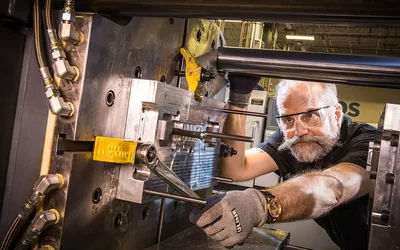
Most people consider 3D printing to be a prototyping process and injection molding to be a form of mass manufacturing. However, choosing between the two processes isn’t always straightforward.
What is 3D printing? This article goes over the basics of 3D printing, otherwise known as additive manufacturing, covering its engineering principles and applications.
A bone-like composite developed at EPFL, in collaboration with researchers from ETH Zurich, Empa and the University of Fribourg, uses naturally occurring enzymes to accelerate mineralization through an energy-efficient, room-temperature process.
The 3D printer filament market is flooded with choices, but what are the best PETG filaments available to engineers today? Here we look at some of the top brands.
A thorough tutorial for digital design engineers, hardware engineers, and electronics students on how to calibrate a 3D printer effectively. It covers theory and practical implementations.
Harness the potential of additive manufacturing by learning how to use a 3D printer. This guide provides the basics for digital design engineers, hardware engineers, and electronics students.
A rapidly-growing European medical device firm was looking for a partner for their high-end eye diagnostics device. Annual demand for this product is hundreds of units, with a design that could require modifications in order to respond to the changing market needs.
Most people consider 3D printing to be a prototyping process and injection molding to be a form of mass manufacturing. However, choosing between the two processes isn’t always straightforward.
Anodising produces aluminuim oxide on the surface of the metal, helping to protect your part against abrasion and corrosion. This video talks about anodising and why you may want to use the service for your metal parts.
The CREATE Education Project and 3DGBIRE are pleased to announce that they are now partnered with WorldSkills UK to launch a new Additive Manufacturing competition category aimed at Post-16 students in education and training throughout the UK.
The client, one of the world's leading manufacturer of automation machines, found RPWORLD to provide qualified prototypes and low volume solutions for monthly order of 40 units. They had a new tooling machine under R&D stage, a key component, the impeller assembly failed, which caused delay of the whole product development process.So the client contacted RPWORLD to address the delay problem.
Based in South Korea, Autocut is an automotive paint protection film (PPF) and tinted film solutions provider. It delivers software with 17000+ pattern data of paint protection films (PPF) and pre-cutting films for automotive aftermarket shops. Pre-cutting of the film based on the shapes of car parts is needed for productive PPF projects. With over 15 years of expertise, Autocut’s solutions are adopted in over 100 shops in South Korea.
Robots have helped us solve some of the most challenging problems in the industries. They come in all shapes and sizes and take care of many repetitive and hazardous tasks. Based on their design, they can be classified into cartesian, articulated, cylindrical, delta, polar, SCARA, and cobots.

Although 3D printing was predicted to be more widespread than it has turned out to be, the technology is still undergoing enormous development. Senior Researcher David Bue is in charge of establishing DTU’s giant ‘3D printing playground’, where new records for miniature printing are currently being set.
The world has seen a real boom in bicycles since the coronavirus pandemic – and those with gears are booming in particular. However, e-bikes require a complex design with a high level of precision.
In this episode, we talk about how a boutique custom motorcycle company is leveraging 3D printing to create desired components at a fraction of the cost and time required by conventional manufacturing techniques.