Top Vision Systems for Manufacturing in 2026
A deep-dive listicle guiding controls, automation, and quality engineers toward the best vision systems for manufacturing applications in 2026.

12 Jun, 2026. 11 minutes read
Key Takeaways
The global machine vision camera market will grow from USD 16.17 billion in 2025 to USD 17.52 billion in 2026, and to USD 26.13 billion by 2031, at an 8.33% CAGR. MarketsandMarkets projects growth from $15.83 billion in 2025 to $23.63 billion by 2030.
Area-scan cameras still lead in unit volumes, but line-scan models are growing fastest because continuous-process industries require wide-field inspection.
USB3 Vision accounted for 41.08% of camera shipments in 2025, yet CoaXPress is the fastest-growing interface, with a ~9% CAGR through 2031. Choose interfaces based on bandwidth and cable length needs.
Smart cameras integrate optics, processing, and communication. Cognex In-Sight 2800 uses a 1/2.8-inch CMOS sensor with 1440 × 1080 or 720 × 540 resolution and captures up to 45 fps, and it is IP67-rated.
High-resolution systems deliver up to 4096 × 3000 pixels in Cognex In-Sight 9000 area-scan models and up to 8192 × 7808 pixels in the Keyence CV-X 64 MP camera.
3D vision is maturing: Photoneo MotionCam-3D produces up to 1.68 MP depth maps at 20 fps with integrated NVIDIA GPU acceleration.
Engineers must balance throughput, resolution, fieldbus integration, and environmental ratings. Many smart cameras support PROFINET/EtherNet/IP for PLC integration and offer IP65–IP67 sealing for harsh plant environments.
Deep-learning platforms such as MVTec HALCON 26.05 achieve up to 5× faster inference than previous versions and include data-augmentation pipelines, enabling more complex inspection tasks on the edge.
Introduction
Vision systems for manufacturing, also called machine vision systems, combine lighting, optics, sensors, processing, and industrial communications to automate inspection, measurement, robot guidance, and code reading. They differ from general computer vision in three ways:
Industrial robustness: packaging meets IP-rated sealing, vibration and shock resistance, and temperature tolerance; integrated lenses, cables, and connectors survive industrial environments.
Deterministic performance: sensors capture images at fixed frame rates with hardware triggers; processors run real-time algorithms so PLCs can synchronize reject gates or robot pick-and-place.
Fieldbus integration: supports protocols such as PROFINET, EtherNet/IP, EtherCAT, and OPC UA for deterministic control as well as TCP/IP for data transfer.
This article presents a structured buyer's guide to machine vision systems for manufacturing in 2026. It explains the functional building blocks, selection criteria and market dynamics, then examines the leading systems across vendors.
Each entry highlights real specifications — sensor size, resolution, frame rate, interface bandwidth, processing capabilities and environmental ratings.
Functional Blocks of Manufacturing Vision Systems
Manufacturing vision systems decompose into five functional blocks.
Lighting
Illumination strongly influences image quality. Manufacturing systems often integrate high-intensity LED lighting — white, red, infrared or blue — to accommodate different surface materials.
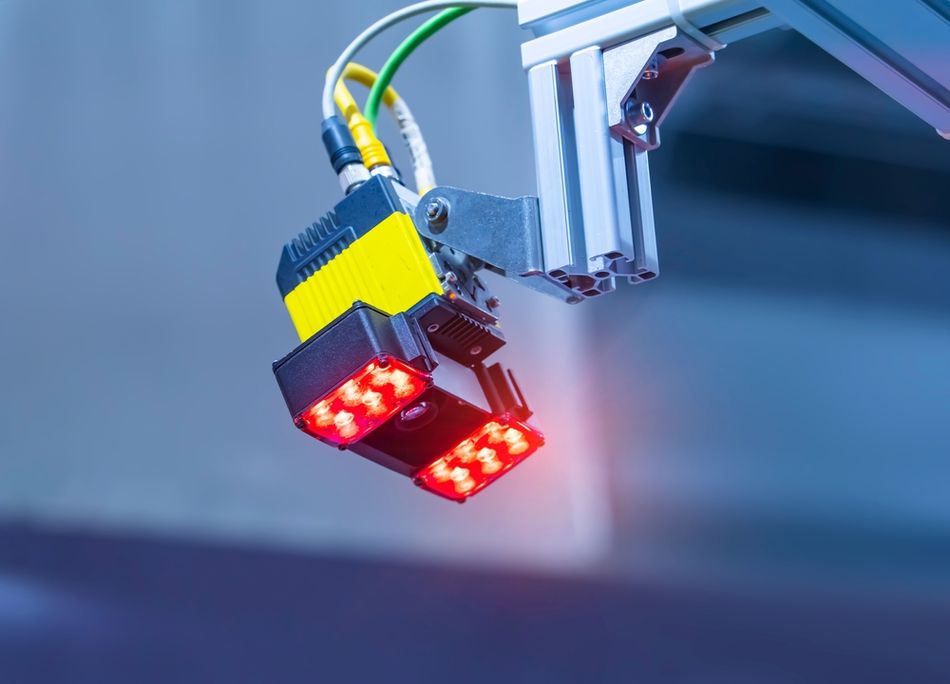
Keyence's IV3 smart camera uses internal LEDs and automatically selects the optimal lighting configuration based on AI-driven scoring.
Datalogic's P-series offers swappable color or infrared illumination modules. External bar lights, dome lights, or coaxial lights are used when bigger fields of view or low-angle illumination are needed.
Optics
Lens selection determines field of view, depth of field and measurement accuracy. Smart cameras often use C-mount or proprietary micro-video mounts. The Basler ace 2 uses a C-mount with a 1/2.3-inch Sony IMX392 sensor and 3.45 μm pixels.
Larger sensors require larger optical formats; the Cognex In-Sight 9000 area-scan camera uses a 1-inch line sensor for line-scan models.
Sensors
Most manufacturing vision systems employ global-shutter CMOS sensors for blur-free imaging at high speeds. Pixel sizes range from ~1.85 μm for the Omron FHV7 5 MP version to 7 μm for line-scan cameras.
Resolutions vary widely: entry smart cameras offer VGA (640 × 480) to 1.6 MP images, mid-range units deliver 3–5 MP, and high-end models achieve 64 MP. Frame rates depend on sensor size and readout architecture; some line-scan models achieve a 66 kHz line rate.
Processing
On-device processing determines whether a system qualifies as a smart camera (with imaging and computing in a single housing) or requires external processing. Smart cameras embed ARM or DSP processors and sometimes GPU accelerators. Cognex In-Sight 3800 integrates 4 GB of memory and optional liquid-lens autofocus.
Photoneo's MotionCam-3D includes an NVIDIA Pascal GPU with 256 CUDA cores for real-time depth computation.
PC-based systems rely on external PCs or vision controllers and can scale processing power using Intel CPUs or dedicated accelerators (e.g., Jetson, Hailo).
Suggested Reading: Understanding Nvidia CUDA Cores: A Comprehensive Guide
Output and interface
Once processed, inspection results must be communicated to automation equipment. Many vision systems support discrete I/O for simple pass/fail signals and high-speed communication protocols for more complex data. The Keyence IV3 provides multiple voltage-selectable inputs and outputs and supports EtherNet/IP and PROFINET along with FTP/SFTP image transfer.
Datalogic's P2X and P3X smart cameras connect via Gigabit Ethernet and support PROFINET, EtherNet/IP and Modbus TCP. For PC-based systems, GigE Vision, USB3 Vision or CoaXPress provide high-bandwidth image streaming.
Recommended Reading: Machine Vision Systems: Components, AI Integration & Selection Guide
Top Machine Vision Systems for Manufacturing in 2026
In this section, we discuss the most trending machine vision systems in the manufacturing industry.
Cognex In-Sight 2800 / 3800 series
The In-Sight 2800 is aimed at entry-level applications such as presence/absence inspection, simple measurement, and code reading. Its AI-powered ViDi tools require minimal training images, enabling quality engineers to set up inspections quickly.
The In-Sight 3800 offers higher resolutions and optional liquid-lens focusing for variable working distances. Thanks to higher frame rates and dual GigE ports, it suits higher-speed bottling lines, assembly verification, and multi-inspection tasks.
Parameter | In-Sight 2800 | In-Sight 3800 |
Sensor size | 1/2.8 inch CMOS | 1/2.3, 1/1.8 or 2/3 inch global-shutter CMOS |
Resolution | 720 × 540 (VGA) or 1440 × 1080 (1.6 MP) | 1.6 MP (1440 × 1080), 3 MP (2048 × 1536), 5 MP (2448 × 2048) |
Frame rate | Up to 45 fps at full resolution | Up to 52 fps (3 MP) and 47 fps (5 MP); high-speed 1.6 MP model reaches 125 fps |
Optics | Integrated 12 mm or 16 mm lens modules; optional C-mount | C-mount; optional liquid lens autofocus |
Processing | Embedded processor with ViDi deep-learning tools; 7.5 W power | 4 GB memory, dual GigE, optional GPU acceleration |
Interface | Serial, Ethernet, PROFINET, EtherNet/IP, OPC UA, 24 V I/O | Dual 10/100/1000 Base-T Gigabit Ethernet plus fieldbus protocols |
Protection | IP67; 0–40 °C operating range | IP67 with integrated multi-torch illumination |
Cognex In-Sight 9000
The line-scan model targets continuous processes: web inspection, steel or paper rolling, wide PCBs and semiconductor wafers. The 66 kHz line rate allows imaging at production speeds exceeding 800 m/min. Encoder inputs ensure pixel-synchronized acquisition for accurate measurement.
The area-scan 9912 captures 12 MP images for dimensioning large parts, packaging inspection and robot guidance. Both models support GigE Vision and integrate 24 V I/O for deterministic triggering.
Parameter | 9000 Line-scan | 9000 Area-scan (9912) |
Sensor | 1 inch CMOS line sensor with 7 µm pixels | 17.6 mm diagonal CMOS with 3.45 µm pixels |
Resolution | 2048 × 16,384 (2048 pixels per line, 16,384 lines) | 4096 × 3000 pixels (~12 MP) |
Scan/frame rate | 66 kHz line rate (~15 µs scan time) | 14 fps monochrome, 8 fps color |
Lens mount | C-mount | C-mount |
Interface | GigE Vision (PoE), serial RS-232; IEEE 1588 PTP and dual encoder inputs | GigE Vision with PoE; 24 V power, discrete I/O |
Protection | IP67 sealed; 1.5 A at 24 V DC | IP67; 24 V supply |
Keyence CV-X / IV3 / XG-X series
Keyence's CV-X platform spans from compact 0.31 MP cameras to a 64 MP high-resolution powerhouse for inspecting entire panels or PCBs. The LumiTrax technology synchronizes strobe lighting and camera exposures to extract surface shape and texture, improving defect detection on reflective parts. Suits high-resolution measurement of electronics, automotive components and packaging.
The IV3 series emphasizes ease of use. By automatically controlling lighting and focus through built-in AI, it reduces setup time and reliance on operator expertise.
The IP67 housing and PoE support allow flexible mounting inside machines. Ideal for presence/absence checks, code reading and simple classification.
Series | Resolution range | Notable features |
CV-X | 0.31 MP to 64 MP; top model (CA-H648MH) delivers 8192 × 7808 pixels with ≈57.6 ms image transfer | LumiTrax and multi-spectrum lighting; hybrid algorithms combining shape-based search and texture analysis; multi-camera setups |
IV3 | 1/2.9 inch CMOS, 1280 × 960 pixels; auto-focus and AI-controlled lighting; exposure 12 µs–10 ms; EtherNet/IP, PROFINET, PoE or 24 V; IP67; ~300 g without lighting | AI-based imaging selects optimal lighting and focus using scores for color, shape and speed |
XG-X | 12-bit processing, camera support up to 21 MP; multi-head configurations | Programmable environment with ladder-style logic; high-speed communication; optional telecentric optics |
Basler ace 2 and blaze ToF
Basler's ace 2 cameras deliver high frame rates through 5 GigE. They are cost-effective options for PC-based machine vision, especially in packaging, pharmaceutical blister inspection and electronics assembly.
Sony IMX392 global-shutter CMOS, 1920 × 1200 resolution, 3.45 µm pixels, 168 fps
5 GigE interface, up to 5 Gbit/s; body 55.5 × 29 × 29 mm, 100 g
IP30 housing, −10 °C to 50 °C, C-mount
The blaze-102 ToF camera brings depth sensing to manufacturing tasks. Its IP67 rating and integrated lighting suit bin picking, robot collision avoidance, and dimensioning.
640 × 480 VGA depth map and intensity images at 30 fps
Sony DepthSense IMX556 with integrated 850 nm VCSEL; working range 0.3–10 m with ±5 mm accuracy over 0.5–5.5 m
GigE with PoE; IP67; latency <85 ms; 67° × 51° field of view
Teledyne DALSA Genie Nano 5GigE and Linea HS
The Genie Nano 5GigE line offers scalable resolution options for general manufacturing inspection. Easy GenICam and 5 GigE Vision integration. Suitable for sorting, pick-and-place guidance, tire inspection and beverage filling lines.
Family covers 2 MP (2064 × 1544) to 30 MP (5420 × 5420). Nano-5G-M2050 uses Sony IMX252 with 3.45 µm pixels at 187 fps
Larger models include Nano-5G-M4040 (4112 × 3008 at 63 fps) and Nano-5G-M5400 (5420 × 5420 at 15 fps)
TurboDrive boosts data rates above 5 Gbit/s; ~76 dB dynamic range; robust metal bodies
The Linea HS TDI cameras target extremely high-speed web and print inspection, electronics inspection and gene sequencing. TDI sensors accumulate light across multiple exposures to improve sensitivity at high line rates, enabling imaging of low-contrast defects at full production speeds.
CMOS time-delay-integration sensors, 4k to 32k pixels, line rates up to 400 kHz (5 Gpixel/s)
16k multi-array sensors combine red/green (64 stages) and blue (128 stages) for color TDI
Camera Link HS with up to seven lanes (10.3 Gbit/s each); selectable 8 or 12 bit output
SICK Inspector / Lector
SICK's Inspector smart cameras are versatile tools for mid-range inspection with built-in measurement, pattern recognition and classification. High-resolution sensor and adjustable focus make them suitable for packaging verification, small-part inspection and OCR.
5.1 MP color CMOS (2464 × 2048 pixels), 2.74 µm pixels, 30 fps
Integrated adjustable-focus lens and white LED illumination; tasks include object detection, measurement, OCR, code identification
IP65, 24 V DC, 10/100/1000 Mb Ethernet, EtherNet/IP, PROFINET, RS-232/RS-422
The Lector code reader excels at high-speed code decoding in logistics, packaging and production tracking.
1.3 MP monochrome CMOS (1280 × 1024), 50 Hz scanning
Integrated infrared LED; auto-focus; working range 300 mm – 1.5 m; code resolution 0.25 mm
IP65; 1D/2D barcode decoding; PROFINET, EtherNet/IP, EtherCAT, CAN
Zebra VS40
The VS40 targets factory automation and logistics. Swappable lighting modules and lenses allow adaptation to different targets. Global-shutter imaging at 60 fps suits code reading, packaging inspection and moderate-speed assembly lines. Dual IP65/IP67 rating, shock and vibration resistance simplify deployment in harsh environments.
2.3 MP global-shutter CMOS, 3 µm pixels, up to 60 fps
Field-replaceable illumination modules (red, blue, infrared, white); two lens options (standard 30° × 19° and wide 46° × 29°)
IP65/IP67; 0–45 °C operating; PoE or 24 V DC; multiple I/O; full barcode symbology support
Recommended Reading: Enhancing Quality Control with Machine Vision Systems
AI and Deep-learning Integration in Manufacturing Vision
Machine vision has historically relied on rule-based algorithms (edge detection, thresholding, geometric matching). However, deep learning is becoming mainstream for classification, anomaly detection, and segmentation.
Cognex ViDi: The In-Sight series runs ViDi deep-learning tools on-device to perform defect classification, OCR, and segmentation. ViDi accelerators within the camera ensure deterministic cycle times.
Keyence AI: The IV3 series integrates AI to automatically configure lighting and focus. It scores images based on color, shape, and speed to automatically select optimal conditions. Additional learning functions refine inspection criteria in response to new product variations.
MVTec HALCON deep learning: HALCON 26.05's new object detector provides up to 5× faster inference, enabling real-time detection of small and overlapping objects. Classification and segmentation networks include training tools.
Edge AI accelerators: NVIDIA Jetson Xavier/Orin and Hailo-8 boards deliver several TOPS at low power, suitable for PC-based vision with deep learning.
Recommended Reading: Introduction | The 2026 Edge AI Technology Report
Industrial Integration - Interfaces and Fieldbus protocols
Interface | Bandwidth / feature | Typical uses |
GigE Vision | 1 Gbit/s (GigE) or 5 Gbit/s (5GigE); cable length up to 100 m using Cat6; PoE for power and synchronized triggers | Area-scan cameras; easy PC integration; multi-camera setups |
USB3 Vision | 5 Gbit/s over short (<5 m) cables; plug-and-play on PCs | High-bandwidth lab setups and portable instruments |
CoaXPress | Up to 12.5 Gbit/s per cable; multiple lanes for >50 Gbit/s; cable length 40–100 m; power over coax | High-speed line-scan and high-resolution area-scan; low-latency triggers |
Camera Link HS | Up to 10.3 Gbit/s per lane; multiple lanes for >70 Gbit/s; deterministic | High-performance TDI line-scan (Teledyne Linea HS); real-time streaming |
PROFINET / EtherNet/IP / EtherCAT | Industrial Ethernet for deterministic PLC comms; 100 Mbit/s–1 Gbit/s; distributed I/O and safety | Smart cameras and vision processors exchanging inspection results, measurements, triggers |
OPC UA | Platform-independent machine-to-machine comms; complex data types and metadata | Higher-level integration to MES and condition monitoring |
Selecting the right interface depends on the required data rate, cable distance, determinism and existing plant networks. Smart cameras often embed PROFINET or EtherNet/IP modules; PC-based systems rely on GigE or CoaXPress for image streaming while using fieldbus gateways for control.
Suggested Reading: Enabling Robust Automotive Communication: Ethernet ESD Protection
Application Contexts in Manufacturing
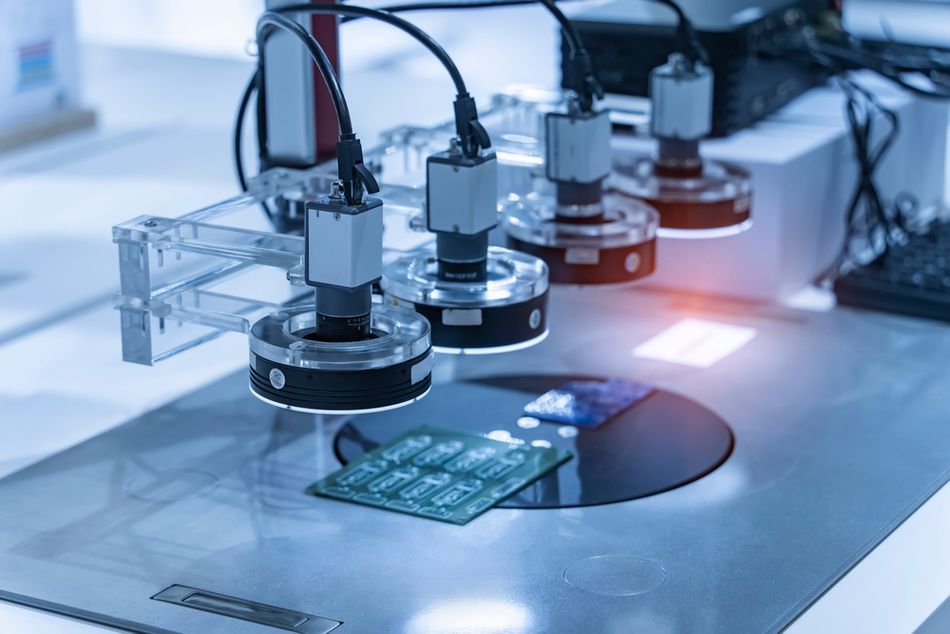
PCB and semiconductor inspection: High-resolution cameras like Teledyne Genie Nano and Cognex In-Sight 9000 area-scan check solder joint quality, component alignment and labeling. Line-scan models inspect continuous webs of printed circuits.
Automotive component inspection: Systems verify brake caliper dimensions, detect paint scratches and read Data Matrix codes on engine blocks. IP67 cameras withstand oil and coolant.
Pharmaceutical blister inspection: 5 MP color smart cameras (SICK Inspector) check for missing tablets, foil sealing and legible expiration dates.
Food and beverage packaging: Smart cameras inspect fill levels, cap presence and label alignment; code readers (SICK Lector, Zebra VS40) ensure traceability.
Logistics and warehousing: Code readers decode barcodes and QR codes at high speed; 3D ToF cameras measure parcel dimensions for shipping cost calculation.
Robot guidance and bin picking: 3D cameras like Photoneo MotionCam-3D provide point clouds for robot grasp planning; 2D cameras with pattern recognition locate parts on conveyors.
Conclusion
Vision systems for manufacturing have evolved from simple rule-based imagers to AI-enabled, high-resolution smart cameras and multi-camera PC-based platforms. The global market is expanding at a healthy 8–9% CAGR, driven by smart factories, tighter quality requirements and the integration of machine vision into robotics. Selecting the right system demands careful consideration of throughput, resolution, AI integration, industrial communication and environmental robustness.
By understanding functional blocks, evaluating selection criteria and reviewing the top systems presented here — Cognex In-Sight, Keyence CV-X, Basler ace 2, Teledyne DALSA Genie Nano, SICK Inspector, Omron FHV7, Datalogic Impact, Photoneo MotionCam-3D, Zebra VS40, and PC-based platforms like HALCON — engineers can confidently shortlist vision solutions tailored to their manufacturing lines. The next frontier involves wider adoption of edge AI, 3D vision and hyperspectral imaging.
FAQ
1. What makes a good manufacturing vision system?
A robust system combines appropriate lighting, optics, sensor resolution and frame rate with reliable processing and industrial communications. It should meet IP and temperature ratings, support real-time triggering, integrate with PLCs via PROFINET/EtherNet/IP, and deliver consistent detection results.
2. Smart camera vs PC-based: which should I choose?
Smart cameras suit single or low-complexity inspections; they integrate imaging and processing, simplifying installation. PC-based systems excel for high-throughput, multi-camera or AI-heavy tasks. Evaluate the number of inspections, data throughput and algorithm complexity before choosing.
3. How do I size resolution for an application?
Determine the smallest feature to detect and the field of view. Divide the field of view by the number of pixels across the sensor to calculate pixel resolution at the object. Capturing a 100 mm wide part with a 1440-pixel camera yields ~0.069 mm per pixel; if you need to resolve 0.02 mm defects, a higher-resolution camera or narrower field of view is required.
4. How do Cognex and Keyence compare?
Cognex offers a broad portfolio with strong deep-learning tools (ViDi) and high-resolution models like the In-Sight 9000. Keyence excels in user-friendly AI-based lighting and focusing (IV3) and offers extremely high-resolution options (64 MP CV-X). Choice depends on the application, budget and required ease of setup.
5. Rule-based vs deep learning: when to use each?
Rule-based algorithms (thresholding, geometry) are deterministic, easier to validate and work well for uniform parts. Deep learning excels at complex patterns, textures and varying backgrounds, but requires training images and may be harder to interpret. Many systems now combine both approaches.
6. What about 3D vision for manufacturing?
3D vision enables robot bin picking, volume measurement and defect detection on contoured surfaces. Solutions like Photoneo MotionCam-3D provide high-resolution depth maps at production speed . Evaluate working distance, accuracy and output formats when choosing a 3D camera.
7. How much does a manufacturing vision system cost?
Entry-level smart cameras cost a few thousand euros, including lens and lighting. High-end line-scan or multi-camera systems with PC-based processing can reach tens of thousands. Total cost also includes integration (mounting, lighting, cabling), training and software licenses. Budget accordingly and consider scalability.
References
Cognex In-Sight 2800 datasheet — sensor size, resolution, frame rate, IP rating. https://www.tipteh.com/wp-content/uploads/2023/03/In-Sight-2800-Datasheet.pdf
Cognex In-Sight 3800 reference guide — resolution and frame rate specifications. https://www.aurovis.ch/en/cognex-in-sight-3800/
Cognex In-Sight 9000 reference guide — line-scan and area-scan resolutions, line rate. https://docs.cognex.com/insight/9000/
Keyence CV-X series catalog — range of resolutions and capture times. https://www.keyence.com/products/vision/vision-sys/cv-x/
Keyence IV3 series manual — pixel count, exposure, lighting, IP rating. https://www.keyence.com/products/vision/vision-sensor/iv3/
Basler ace 2 a2A1920-165g5cBAS specifications. https://www.baslerweb.com/en/cameras/ace2/a2a1920-165g5cbas/
Basler blaze-102 ToF camera datasheet. https://www.baslerweb.com/en/cameras/blaze/blaze-102/
Teledyne DALSA Genie Nano 5GigE brochure. https://ftp.stemmer-imaging.com/webdav/PDF/genie-nano-5gige.pdf
Teledyne DALSA Linea HS TDI camera. https://adept.net.au/cameras/teledynedalsa/Linea-HS.shtml
SICK Inspector 83x datasheet. https://www.sick.com/us/en/products/machine-vision/2d-machine-vision/inspector83x/
SICK Lector 62x datasheet. https://www.sick.com/us/en/products/identification-solutions/image-based-code-readers/lector62x/
Zebra VS40 specification sheet. https://www.peaktech.com/datasheet/zebra-vs40-vision-smart-camera.pdf
in this article
1. Key Takeaways2. Introduction3. Functional Blocks of Manufacturing Vision Systems4. Top Machine Vision Systems for Manufacturing in 20265. AI and Deep-learning Integration in Manufacturing Vision6. Industrial Integration - Interfaces and Fieldbus protocols7. Application Contexts in Manufacturing8. Conclusion9. FAQ10. References