3D Printing Food: A Guide for Engineers and the Food Industry
Explore the rise of 3D printing food, including market growth, printing technologies, material science, and real-world applications.

22 Apr, 2026. 11 minutes read
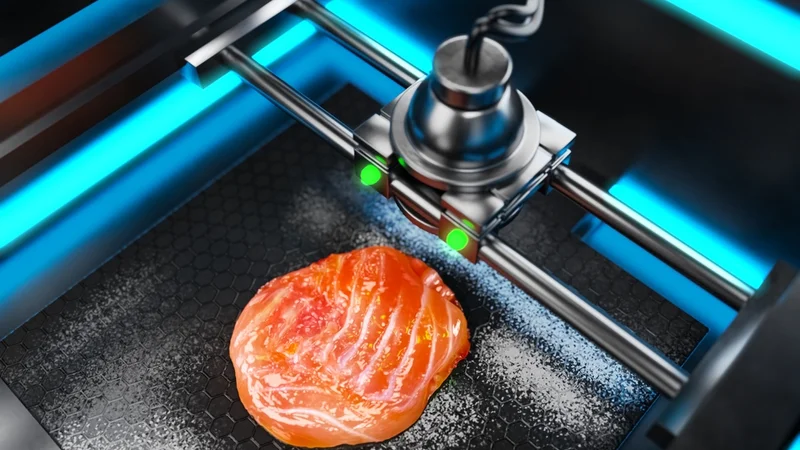
3D printing food takes the logic of additive manufacturing and turns it into something you can eat—building meals, snacks, and ingredients layer by layer from digital designs.
But this is no longer a novelty confined to experimental kitchens. Engineers and food scientists are using 3D printing food to tackle practical challenges: creating texture-modified meals for patients with swallowing difficulties, reducing waste by transforming imperfect produce into printable pastes, and enabling precise, mass customization in nutrition and confectionery. This has made the global food 3D printing market worth $530.97 million.[1]
Under the surface, the technology mirrors the same principles found in polymer and metal additive manufacturing—material rheology, toolpath strategy, thermal control, and post-processing—but with far tighter constraints. Food degrades, supports microbial growth, and must meet strict safety and nutritional standards. That means printers must operate in hygienic, food-grade environments with components designed for thorough cleaning and compliance.
This article explores 3D printing food from an engineering and industry perspective, covering market dynamics and segmentation, core printing technologies, material formulation, hardware and workflow design, key applications, current limitations, and where the field is heading next.
How Is 3D Printing Food Possible?
3D printing food is possible because many edible materials can be engineered to behave like printable pastes or gels—flowing under pressure, then holding their shape once deposited. In essence, the food 3D printing process adapts extrusion-based additive manufacturing to ingredients such as chocolate, dough, purées, proteins, and hydrocolloid-based mixtures.[2]
The process starts with a digital model, which is sliced into layers and translated into a toolpath. A food printer then deposits material through a nozzle, building the structure layer by layer. The key is rheology: the material must be soft enough to extrude, yet stable enough to maintain geometry after deposition. This often requires formulation work—adjusting moisture content, particle size, and adding stabilizers like gums or gels.
To make high-quality food 3D printing viable, several technical conditions must align:
Printability: Controlled viscosity and flow behavior
Shape retention: Ability to hold form after extrusion
Food safety: Hygienic materials and cleanable hardware
Process integration: Compatibility with cooking or finishing steps
What makes this approach powerful is not just automation, but control. It allows precise placement of ingredients, tailoring of textures, and customization at a level that traditional food manufacturing struggles to achieve.
Food Printing Technologies
3D printing food relies on adapting additive manufacturing principles to edible materials, but the way those materials are shaped depends heavily on the printing method. Each approach balances structure, resolution, material constraints, and post-processing requirements differently, from paste deposition to powder-bed systems and surface-level digital decoration.
Extrusion-Based Printing
Extrusion is the dominant approach in food 3D printing. A syringe, cartridge, or screw-driven system forces food material through a nozzle, depositing it along a programmed toolpath derived from a 3D model. The printhead moves across X, Y, and Z axes, building the structure layer by layer. This is the core method used in most commercial food 3D printers, including systems developed by companies such as Natural Machines (Foodini) and byFlow, which target both professional kitchens and culinary R&D environments.
The process is closely related to Fused Deposition Modelling (FDM), but operates with soft, often non-Newtonian food materials and at much lower temperatures. Thermal control remains critical: chocolate must be carefully tempered (around 28–32°C) to maintain crystalline stability, while doughs, purées, and protein pastes may require heating for flow or cooling for structural setting.[3]
Key parameters include nozzle diameter, extrusion pressure, print speed, layer height, and infill strategy. These interact directly with rheology, determining resolution, texture, and structural stability. Pneumatic systems are often used for shear-sensitive materials, offering smoother flow control, while screw-driven systems provide higher consistency for thicker pastes.
Binder Jetting
Binder jetting uses a powder bed—typically sugar, starch, or protein-based powders—where a liquid binding agent is selectively deposited to join particles layer by layer. After each layer is spread, a printhead jets binder only where solid structure is required. Once printing is complete, the object is removed from the loose powder bed, which acts as a temporary support structure.
This approach enables highly intricate geometries, particularly in confectionery applications such as sugar sculptures and decorative elements. One of the best-known commercial examples was the 3D Systems ChefJet, developed for printing complex sugar-based designs for pastry and culinary applications.[4]
Compared to extrusion, binder jetting offers higher geometric resolution and better overhang performance, but is constrained by a narrower material set and the need for post-processing such as drying, sintering, or coating to improve stability and palatability.
Recommended reading: Binder Jetting: A Comprehensive Guide to the Additive Manufacturing Process
Inkjet Printing
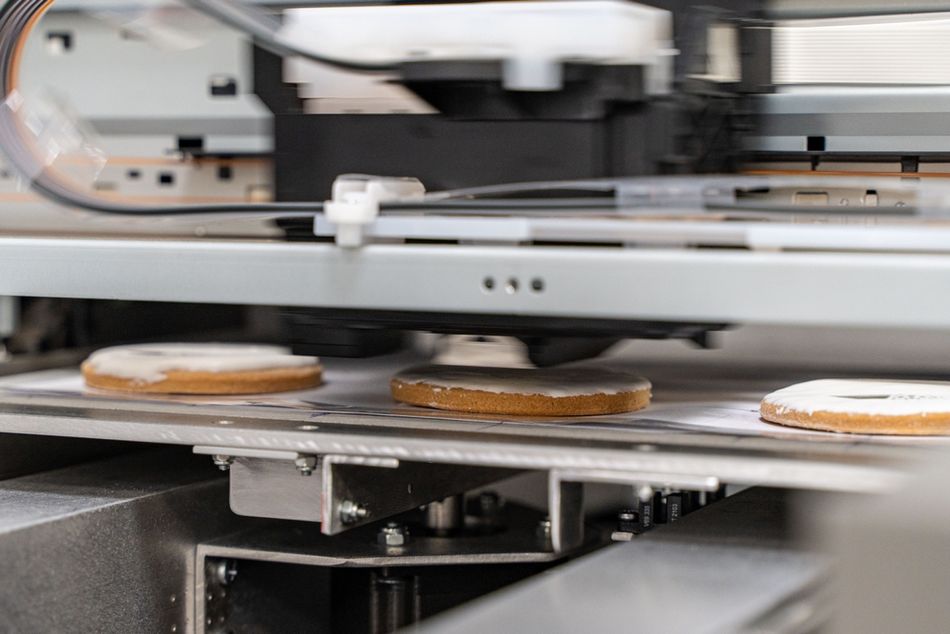
Inkjet printing deposits micro-droplets of edible ink onto food surfaces to create detailed visuals, patterns, or text. It is widely used in bakery and confectionery decoration, printing directly onto cakes, cookies, and chocolates using food-grade CMYK inks.
While not volumetric additive manufacturing, inkjet systems are highly industrialized and integrated into production lines for mass customization. They are valued for speed, precision, and visual fidelity, even if they do not contribute structural food formation.
Materials and Formulation

Food 3D printing works because ingredients can be reformulated into “functional inks.” Instead of optimizing purely for taste or cooking behavior, food scientists must engineer materials that also satisfy the mechanical demands of additive manufacturing—flowing predictably through a nozzle, holding shape immediately after deposition, and remaining stable through subsequent processing.
This makes material design one of the most critical constraints in 3D printing food systems.
Rheology of Food Inks
The success of 3D printing food depends heavily on how a material flows and then stabilizes after deposition. Food “inks” must be engineered to pass through a nozzle under pressure while maintaining enough internal structure to retain their shape immediately after extrusion. This balance typically involves shear-thinning behavior during printing and rapid structural recovery once the stress is removed.
If a formulation is too viscous, it resists flow and can clog the nozzle. If it is too fluid, it spreads uncontrollably and loses geometric definition. Between these extremes lies a narrow processing window governed by rheological design.[5][6]
Key rheological factors include:
Viscosity: Must decrease under shear to allow extrusion, then recover afterward. Typical printable ranges vary widely depending on nozzle size and pressure.
Yield stress: The threshold required for flow; once deposited, the material must exceed this threshold to resist deformation and support layers above.
Thixotropy: The rate at which structure rebuilds after shearing; faster recovery improves shape fidelity and vertical stability.
Elastic modulus: Indicates resistance to deformation under load, affecting sagging and long-term structural integrity.
Food engineers tune these properties by adjusting moisture content, blending hydrocolloids (such as xanthan gum, carrageenan, and methylcellulose), and modifying starch, protein, or fat ratios. Temperature control is also a critical lever for tuning flow and setting behavior.
Edible Ink Categories
A wide range of edible materials can be adapted for 3D printing, each with its own processing constraints and advantages:
Chocolate: The most commercially established material, requiring precise tempering to maintain stable crystal structures and desirable gloss and snap.
Doughs and batters: Wheat and alternative grain systems can be printed and then baked, with hydration and gluten content strongly influencing print stability.
Fruit and vegetable purées: Often combined with stabilizers to improve shape retention; also used in food waste valorization strategies.
Meat-based pastes: Ground or restructured meat formulations can be printed for shaped protein products and are closely linked to alternative protein development. Associated with companies like Novameat.
Sugar and fondant systems: Widely used in confectionery for high-detail structural and decorative applications.
Dairy-based pastes: Products like processed cheese or cream cheese can be formulated for extrusion with adjusted fat and moisture balance.
Protein gels: Emerging plant-based or insect-derived systems designed for alternative protein applications and functional nutrition.
Nutritional Customization
One of the most significant advantages of 3D printing food is the ability to decouple nutrition from mass production constraints. In some systems, multiple ingredient cartridges can be combined within a single print to tailor macronutrient and micronutrient profiles at the serving level.
This enables targeted dietary design—for example, high-protein meals for athletes, sodium-restricted formulations for cardiovascular patients, or vitamin-fortified foods for individuals with deficiencies.
The approach is especially relevant in healthcare and eldercare settings, where texture-modified diets are common but often nutritionally limited. 3D printing offers a pathway to produce soft-textured, visually appealing meals that are also compositionally precise and individualized.
Applications of Food 3D Printing

3D printing food is moving beyond experimental kitchens into domains where precision, customization, and resource efficiency matter more than traditional scale. Across healthcare, sustainability, aerospace, and gastronomy, the technology is being used less as a novelty and more as a tool for rethinking how food is designed, produced, and delivered.
Personalized Nutrition and Healthcare
Texture-modified diets are commonly prescribed for patients with dysphagia (difficulty swallowing), a condition affecting a significant portion of elderly populations and clinical care settings. Traditional puréed meals often suffer from poor visual appeal and inconsistent nutritional content, which can reduce appetite and overall intake.
3D printing food addresses this by reshaping blended ingredients into familiar forms—such as vegetables or proteins—while maintaining soft, safe textures. This improves acceptance while allowing precise control over macronutrients and micronutrients per serving.[7]
Hospitals and eldercare facilities have trialed 3D printed meal systems, where dietitians define nutritional targets and printers execute formulations with high repeatability.
Space Exploration and Military
Space agencies, including NASA, have explored 3D food printing as a solution for long-duration missions.[8] Instead of carrying fully prepared meals, astronauts could store lightweight, shelf-stable ingredient cartridges that are rehydrated and printed into varied dishes on demand. This reduces payload mass, extends shelf life, and improves dietary variety—an important factor for crew morale during extended missions.
Military logistics follow a similar rationale. Distributed printing systems could reduce reliance on large-scale meal supply chains by enabling localized food production from compact, stable inputs tailored to nutritional requirements and operational conditions.
Sustainability and Food Waste Reduction
A substantial share of global food production is lost or wasted, often due to cosmetic standards or supply chain inefficiencies. 3D printing food offers a pathway to upcycle these materials by converting imperfect produce, fruit pulp, and agricultural by-products into printable formulations.
These “reprocessed” ingredients can be structured into appealing, high-value food products rather than being discarded. Research initiatives, including work with misshapen produce streams, demonstrate how waste streams can be transformed into structured snacks and meals.
The same approach extends to alternative proteins, where plant-based, insect-derived, or algae-based ingredients can be engineered into printable pastes that replicate conventional food textures more effectively.
Confectionery and High-End Gastronomy
Confectionery is currently the most commercially mature application of food 3D printing. Chocolate, sugar, and fondant systems are particularly well suited to controlled deposition and solidification, supported by established crystallization and setting behaviors.
In high-end gastronomy, chefs use 3D printing food to create complex geometries, precise portioning, and multi-layered sensory experiences that would be difficult or impossible to achieve manually. Multi-material printing also enables controlled spatial distribution of flavors and textures within a single dish.
Cultured Meat and Alternative Proteins
In the emerging field of cultured meat, 3D printing is being investigated as a structuring method to organize lab-grown cells into fibrous, meat-like architectures.[9] While still largely pre-commercial, this approach combines tissue engineering with food manufacturing to replicate the structural complexity of conventional meat.
Plant-based protein systems also benefit from 3D structuring. Multi-nozzle extrusion and controlled processing conditions can produce more realistic texture gradients, improving the sensory match between alternative and conventional proteins.
Research and Education
Academic laboratories use 3D food printers as experimental platforms to study how formulation, structure, and processing affect texture, flavor release, and nutritional performance. The precise, repeatable deposition process allows researchers to isolate variables more effectively than in conventional cooking systems, making it a valuable tool for food science innovation.
Recommended reading: Food-grade 3D printing: Is PLA Food-Safe?
Notable Companies and Organizations
Organization | Category | Location | Role in 3D Food Printing |
Barilla | Food manufacturer | Italy | Has developed and sold 3D printed pasta in collaboration with research partners for over a decade |
Nestlé | Food manufacturer | Switzerland | R&D in personalized nutrition and early-stage food printing applications |
PepsiCo | Food manufacturer | USA | Participated in additive manufacturing and food system prototyping research |
Natural Machines | Food tech company | Spain | Developer of Foodini food 3D printer for home and professional kitchens |
byFlow | Food tech company | Netherlands | Produces professional food 3D printers for chefs and catering applications |
Print2Taste (Procusini) | Food tech company | Germany | Food printers for chocolate, dough, cheese, and meat-based materials |
BeeHex | Food tech company | USA | Developed 3D printed pizza and 3D cake decorating systems, initially NASA-funded |
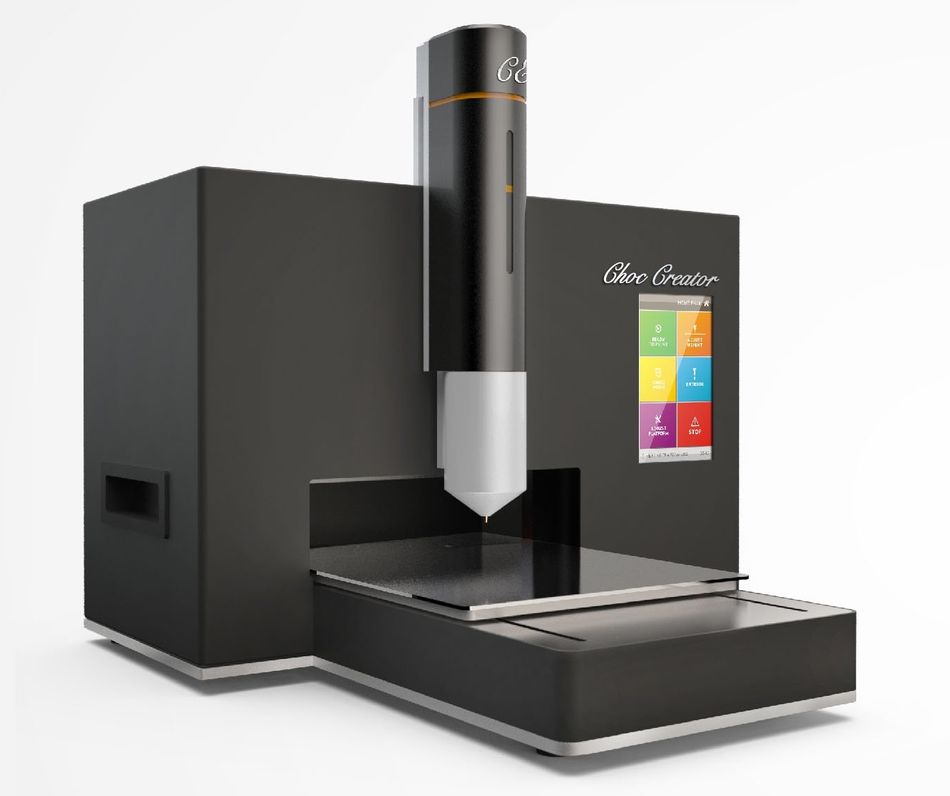
Choc Edge | Food tech company | United Kingdom | Specialized in chocolate 3D printing systems until 2022 closure |
3D Systems | 3D printing company | USA | Developed ChefJet platform for sugar and confectionery printing (discontinued) |
TNO (Netherlands Organisation for Applied Scientific Research) | Research institute | Netherlands | Key research institute in food printing materials and system development |
NASA | Space agency | USA | Funded early research into 3D food printing for space missions |
Future Directions
Several trends are likely to shape the evolution of 3D food printing over the next decade:
Multi-material systems: Improved multi-nozzle printers will enable tighter control over texture, structure, and flavor within a single item, moving toward fully printed meals.
AI-driven optimization: Machine learning will support recipe formulation, toolpath generation, and real-time quality control using sensor feedback during printing.
Bioprinting convergence: Methods from tissue engineering will enhance structured meat production and enable printing of microbial cultures for fermented foods.
4D printing applications: Shape-changing food systems that transform during cooking or consumption may shift from lab prototypes to niche commercial products, with potential efficiency gains in packaging and logistics.
Decentralized production: Food printing in restaurants, hospitals, military settings, and eventually homes could reduce supply chain dependence and enable on-demand customization.
Sustainability integration: Greater use of food waste streams as printable inputs could strengthen circular economy applications.
Regulatory development: Standards for safety, labeling, nutrition, and equipment certification will likely emerge as adoption expands.
Conclusion
3D food printing is gradually shifting from an experimental concept into a practical, though still specialized, tool for food engineers, nutritionists, and manufacturers. Growth is being driven by demand for personalized nutrition, texture-modified healthcare foods, sustainability use cases, and high-end confectionery applications, rather than large-scale replacement of conventional food production.
Early expectations in the 2010s often framed 3D food printing as a near-term revolution in everyday meal production. In practice, progress has been more measured. Constraints around speed, cost, and material performance have limited widespread adoption. Even so, extrusion-based systems and related technologies have proven viable in specific, controlled contexts, particularly where design flexibility and small-batch customization are more important than throughput.
As the field matures, its role is becoming clearer: not a substitute for traditional food manufacturing, but a complementary approach that extends what food design can do. Its most compelling applications remain those where precision, personalisation, and structural complexity provide value that conventional processes cannot easily match.
FAQ
What foods can be 3D printed?
Soft or paste-like foods such as chocolate, cookie dough, mashed potatoes, fruit purées, cheesecake mixtures, cheese, sugar, fondant, and meat pastes work best. These behave like a printable filament and must hold shape after deposition.
How does 3D food printing work?
A digital model is translated into layers, then a printer deposits food material through a nozzle. It is similar to other 3D printing technology, but uses edible pastes instead of plastics.
Is 3D printed food safe?
Yes, if food-grade materials and clean equipment are used. Safety depends on hygiene, storage, and proper cooking or cooling, just like conventional food preparation.
What does a 3D food printer cost?
Basic models start around a few hundred USD. High-end systems used by restaurants, labs, or start-ups can exceed 100,000 USD depending on capability.
Can 3D printing reduce food waste?
Yes. It can reuse surplus ingredients and imperfect produce by turning them into printable food pastes, supporting sustainability and more efficient use of processed foods.
How fast is 3D food printing?
It is relatively slow. Small items like a printed cookie or chocolate piece take minutes, while full meals can take 30–60 minutes or more.
What role does 3D food printing play in healthcare?
It supports customized food for patients with swallowing difficulties. Foods like mashed potatoes or purées can be reshaped into familiar forms while matching nutritional needs.
What is customized food in 3D printing?
It is food tailored to individual nutritional needs, such as protein levels, calories, or vitamins, produced by mixing different ingredients during printing.
Who invented 3D food printing?
Early academic work is often linked to Hod Lipson, who helped demonstrate digital fabrication of food in research environments.
Has NASA used 3D food printing?
NASA funded early research into space-based 3D food printing concepts for long-duration missions, but it is still experimental.
What companies use 3D food printing?
Examples include Barilla, Nestlé, Natural Machines, byFlow, and Redefine Meat, along with several start-ups in food and protein innovation.
What is the future of 3D food printing?
It is likely to grow in niche areas like healthcare, confectionery, and personalized meals, rather than replacing conventional food production.
References
[1] Fortune Business Insights. Food 3D Printing Market Size, Share & Industry Analysis, By Ingredient (Dairy Products, Fruits & Vegetables, Dough, Proteins, Carbohydrates, Others), By End-use Verticals (Commercial, Residential) and Regional Forecast, 2026–2034. Pune: Fortune Business Insights; 2026.
[2] Hussain S, Malakar S, Arora VK. Extrusion-based 3D food printing: technological approaches, material characteristics, printing stability, and post-processing. Food Engineering Reviews. 2022 Mar;14(1):100-19.
[3] Mantihal S, Prakash S, Godoi FC, Bhandari B. Optimization of chocolate 3D printing by correlating thermal and flow properties with 3D structure modeling. Innovative food science & emerging technologies. 2017 Dec 1;44:21-9.
[4] Kelion L. CES 2014: 3D food printers create sweets and chocolates. BBC News [Internet]. 2014 Jan 8.
[5] Montoya J, Medina J, Molina A, Gutiérrez J, Rodríguez B, Marín R. Impact of viscoelastic and structural properties from starch-mango and starch-arabinoxylans hydrocolloids in 3D food printing. Additive Manufacturing. 2021 Mar 1;39:101891.
[6] Barrios-Rodríguez YF, Molina-Montero C, Matas-Gil A, Igual M, Martínez-Monzó J, García-Segovia P. From Rheology to Reality: A Decade of Protein-Based 3D Food Printing Research. Food Engineering Reviews. 2026 Jun;18(2):8.
[7] Xie Y, Liu Q, Zhang W, Yang F, Zhao K, Dong X, Prakash S, Yuan Y. Advances in the potential application of 3D food printing to enhance elderly nutritional dietary intake. Foods. 2023 Apr 28;12(9):1842.
[8] NASA. Deep-space food science research improves 3D-printing capabilities. NASA Spinoff [Internet]. 2019.
[9] K. Handral H, Hua Tay S, Wan Chan W, Choudhury D. 3D Printing of cultured meat products. Critical reviews in food science and nutrition. 2022 Jan 2;62(1):272-81.