What Is 3D Printer Filament? Types, Materials, and How to Choose
What is 3D printer filament? This guide examines polymers, additives, and composites, offering practical tips for digital design and hardware engineers.

Last updated on 03 Jun, 2026. 18 minutes read
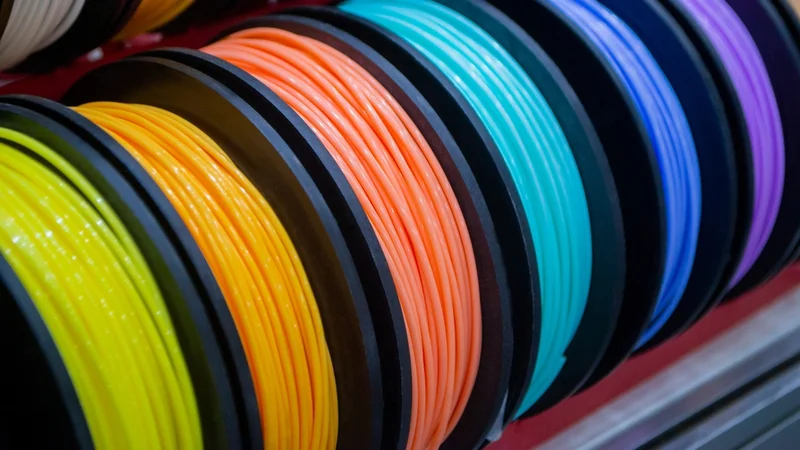
3D printer filament is the thermoplastic feedstock used by FDM or FFF printers: a continuous, precisely sized strand that an extruder pushes into a hotend, where it melts and exits through a nozzle to build a printed object layer by layer.
For beginners, filament may look like ordinary plastic wire on a spool. For engineers, product designers, and serious makers, it is a controlled 3D printing material whose polymer chemistry, additives, diameter tolerance, melt flow, moisture behavior, and thermal properties determine print quality and part performance. Common 3D printer filament types include PLA, ABS, PETG, TPU, nylon, ASA, polycarbonate, soluble support materials such as PVA, and reinforced composites such as carbon fiber filled nylon.
This guide covers all the major questions asked by 3D printing beginners: What is 3D printer filament? What is it used for? What is it made of? And how do you choose between the many varieties?
What Is 3D Printer Filament?
3D printer filament is the material that feeds an FDM or FFF 3D printer. During printing, the extruder grips the filament, pushes it into the hotend, melts it at a controlled print temperature, and deposits it through the nozzle onto the build surface. As each layer cools and bonds to the previous one, the printer gradually forms prototypes, fixtures, models, functional parts, and end-use components.
Note that filament is not the only 3D printing material form. For example, other 3D printer types may use powders, liquid resins, or metal wire to make parts. These 3D printers use other technologies besides extrusion, such as laser sintering or UV light curing. The very first 3D printers, developed in the 1980s, used photopolymer resins.
The most common filament is PLA, or polylactic acid, because it is inexpensive, easy to print, and forgiving on open-frame printers. ABS, PETG, TPU, nylon, ASA, polycarbonate, PEEK, PEI, PVA, HIPS, and many blends and composites extend the material range, allowing users to make parts like durable housings, flexible gaskets, heat-resistant brackets, soluble support material, tooling, automotive parts, and high-strength engineering applications.
Common Filament Types at a Glance
The table below gives representative starting ranges for common filaments. Always follow the manufacturer’s spool label or datasheet first, because additives, colorants, high-speed formulations, filled grades, and printer hardware can shift the best settings.
| Material | Typical print temp | Typical bed temp | Strength | Flexibility | Ease of printing | Best use |
| PLA | 185–235 °C | 50–60 °C | Moderate, stiff, brittle | Low | Very easy | Beginners, visual models, concept prototypes, low-stress printed parts |
| PLA+ / Tough PLA | 190–230 °C | 40–60 °C | Better impact resistance than standard PLA | Low to moderate | Very easy | Functional prototyping, jigs, larger models, everyday parts |
| PETG | 220–260 °C | 70–90 °C | Good toughness and layer adhesion | Moderate | Easy to moderate | Durable brackets, protective housings, moisture-resistant parts |
| ABS | 230–255 °C | 95–110 °C | Good impact resistance and heat resistance | Moderate | Moderate to hard | Enclosures, automotive trim, functional parts, post-processed components |
| ASA | 220–275 °C | 90–110 °C | Similar to ABS, with better UV resistance | Moderate | Moderate to hard | Outdoor parts, automotive components, weather-resistant housings |
| TPU / TPE | 200–260 °C | 40–85 °C | Tough and abrasion resistant | High | Moderate | Gaskets, seals, phone cases, wearables, vibration damping |
| Nylon / PA | 240–285 °C | 70–115 °C | High toughness and wear resistance | Moderate | Hard | Gears, hinges, mechanical fasteners, tooling, durable engineering parts |
| Polycarbonate / PC | 250–300 °C | 100–115 °C | High impact strength and thermal stability | Low to moderate | Hard | Heat-resistant housings, machine guards, lighting parts, structural parts |
| Carbon fiber composites | 225–290 °C | 40–120 °C | High stiffness, grade-dependent strength | Low | Moderate to hard | Lightweight brackets, jigs, fixtures, tooling, dimensionally stable parts |
| PVA / BVOH | 195–215 °C | About 60 °C | Low, support-only | Low | Moderate | Water-soluble support material for complex geometries |
| HIPS | 225–255 °C | 100–110 °C | Moderate | Low | Moderate | Breakaway or limonene-soluble supports with ABS |
| PEEK / PEI | 340–430 °C | 120–150 °C or higher | Very high | Low | Very hard | Aerospace, medical, chemical-resistant, high-temperature applications |
Core Polymers Used in Filaments

Modern 3D printing relies on a wide variety of polymers, each offering specific mechanical, thermal, and processing characteristics. These range from low-cost, beginner-friendly thermoplastics like PLA, which are ideal for hobbyists, all the way to high-performance engineering plastics like PEEK, which offer extraordinarily high strength.
Polylactic Acid (PLA)
PLA is a biodegradable polyester made from renewable feedstocks such as cornstarch, sugarcane, and cassava. Lactic acid produced through fermentation is converted into lactide and polymerized into long aliphatic chains. The polymer is naturally transparent, readily pigmented, and contains no aromatic groups.
PLA prints at relatively low temperatures—typically 185–235 °C—produces fine detail, and has a mild, sweet odor during extrusion. It is stiff but brittle, softens around 60 °C, and is sensitive to heat and UV exposure. These traits make it easy to use but limit its suitability for structural parts.
Applications include concept models, art pieces, low-stress fixtures, and biomedical prototypes. Because of its poor heat tolerance and brittleness, it should not be used for load-bearing or outdoor components.
Recommended reading: What is PLA Filament? Composition, Advantages, and Applications.
Acrylonitrile Butadiene Styrene (ABS)
ABS is a terpolymer created by polymerizing acrylonitrile, styrene, and butadiene into a single network. Adjusting the ratios of these monomers allows manufacturers to tune stiffness, toughness, and chemical resistance. This balance gives ABS its reputation as a versatile engineering polymer.
Printing temperatures commonly fall between 230–255 °C, and a heated build plate helps prevent warping. ABS provides strong mechanical performance, good thermal stability, and can be post-processed using acetone vapor for a smooth finish. It does release noticeable fumes during printing, so adequate ventilation is advisable.
Applications include functional prototypes, durable housings, automotive components, and consumer products such as toy construction bricks. ABS is also easy to drill, tap, and machine after printing.
Recommended reading: ABS vs PLA: Which Filament Should You Use?
Polyethylene Terephthalate Glycol-Modified (PETG)
PETG is produced by modifying PET with glycol, which disrupts crystallization and improves toughness. This modification lowers the melting point, enhances impact resistance, and helps the polymer remain clear and slightly flexible.
PETG prints at roughly 220–260 °C, adheres well between layers, and typically requires only a moderate heated bed. It offers greater durability than PLA and lower warping than ABS, maintains strength in humid environments, and can be sterilized. Its tendency toward stickiness can make support removal more difficult.
Applications include bottles, protective housings, transparent components, and parts that must resist chemicals or moisture.
Recommended reading: PETG vs PLA: How Do They Compare?
Nylon (Polyamide)
Nylon filaments belong to the polyamide family and are produced through condensation polymerization or ring-opening polymerization, depending on the grade. The resulting long chains of amide-linked units give nylon its distinctive toughness, abrasion resistance, and semi-flexibility.
Nylon prints at around 240–285 °C and benefits from an enclosed printer to reduce draft-related warping. It absorbs moisture readily and must be thoroughly dried to avoid surface bubbling, poor adhesion, or inconsistent extrusion. Fiber-reinforced grades become significantly stiffer and hold tolerances more consistently.
Applications include gears, hinges, mechanical fasteners, jigs, cable ties, and structural components requiring high wear resistance. Reinforced versions are used for tooling, lightweight brackets, and parts requiring excellent strength-to-weight ratios.
Thermoplastic Polyurethane (TPU) and Other Elastomers
TPU is formed from alternating hard segments and soft polyol segments, arranged as a block copolymer whose composition determines flexibility and hardness. Small amounts of additives may be included to reduce tackiness and improve flow through the extruder.
TPU prints at approximately 200–230 °C and performs best in direct-drive systems, where filament compression is minimized. It offers excellent abrasion resistance, strong elasticity at low temperatures, and good chemical resistance, though slower print speeds are essential to prevent under-extrusion or stretching.
Applications include phone cases, gaskets, seals, wearable components, vibration-damping parts, and flexible medical or assistive devices.
Polycarbonate (PC)
Polycarbonate is produced by polymerizing bisphenol-based monomers with a carbonate-forming reagent. The resulting polymer chains contain rigid aromatic rings and strong carbonate linkages, giving PC its exceptional impact strength and thermal stability.
PC prints at high temperatures—typically 250–300 °C—and requires an enclosed, heated chamber to prevent cracking or delamination. It maintains strength up to roughly 110 °C and resists many chemicals, while also offering natural optical clarity. Some formulations avoid bisphenol-based monomers for applications requiring reduced chemical sensitivity.
Applications include industrial machine guards, lighting components, high-temperature housings, gears, and impact-resistant structural parts.
Other Engineering Thermoplastics
PEEK and PEI (ULTEM): Ultra-high-performance polymers with melting points above 340 °C, offering outstanding chemical resistance, mechanical strength, and thermal stability. Used in aerospace, medical, and industrial applications where performance is critical.
Polypropylene (PP): Lightweight and chemically resistant but difficult to print due to warping and low bed adhesion.
High-Impact Polystyrene (HIPS): Commonly used as a dissolvable support material in dual-extrusion systems.
Polyvinyl Alcohol (PVA): Water-soluble filament used for complex supports that dissolve after printing.
Composite Filaments

Composite filaments enhance standard thermoplastics by incorporating materials such as carbon fiber, glass fiber, aramid fiber, metal powders, or wood flour. These added constituents modify stiffness, strength, density, texture, or appearance, giving the filament capabilities far beyond those of the base polymer alone.
Carbon Fiber Reinforced Filaments
Chopped carbon fiber filaments contain short carbon fibers mixed directly into a polymer base such as PLA, PETG, ABS, or nylon. The fibers increase stiffness, heat resistance, and dimensional stability by creating a rigid fiber–polymer composite.
Continuous carbon fiber systems deposit long strands of carbon fiber during printing; the continuous reinforcement produces dramatically higher strength but requires dual-nozzle hardware. In both cases, the mechanical gains come from the carbon fibers themselves.
Glass Fiber and Other Fiber Composites
Glass fiber composites contain strands or chopped segments of glass that stiffen the polymer and improve heat resistance, especially in nylon matrices. Aramid fiber composites contain aramid fibers that contribute impact toughness and crack resistance. Wood or cork fiber materials contain fine organic fillers—wood flour or cork particles—that give the filament its grain-like appearance and warm texture.
Metal-Filled Filaments
Metal-filled filaments contain finely milled metal powders—commonly copper, bronze, brass, or stainless steel—dispersed in a polymer binder. These powders increase density, produce a metallic surface that can be polished, and enable sintering when present in high concentrations. The metallic character of the filament comes directly from the embedded metal particles.
Wood-Filled Filaments
Wood-filled filaments contain finely ground wood flour or cellulose fibers blended into PLA or another polymer. These organic fillers give prints a natural grain, a matte texture, and the ability to be sanded or stained. All visual and tactile “wood-like” qualities come from the wood particles themselves.
Blends
Blended filaments contain two distinct polymers combined to achieve performance characteristics that neither material can deliver on its own. These blends are typically engineered so the base polymer maintains printability, while the second polymer meaningfully shifts properties such as heat resistance, impact strength, or flexibility. The interaction between the two polymers—whether partially miscible, co-continuous, or present as dispersed phases—determines the final mechanical behavior.
One widely used family is ABS–PC blends, which merge the ease of printing and impact resistance of ABS with the high stiffness and thermal stability of polycarbonate. These materials are popular for enclosures, mechanical housings, and functional parts that experience elevated temperatures. Nylon blends that combine polyamide with elastomers or semi-crystalline engineering polymers are also common, improving flexibility, reducing warping, or enhancing fatigue resistance.
Functional Filaments
Functional filaments are engineered with special additives—such as conductive particles, magnetic powders, elastomers, soluble polymers, or waxy binders—that give them properties well beyond those of standard plastics.
Conductive materials: Contain carbon black, graphene, or metal flakes dispersed throughout the polymer. These conductive particles create pathways for electrical flow, enabling touch sensors, low-current circuits, and ESD-safe components.
Magnetic filaments: Contain iron powder or other ferromagnetic particles mixed into a polymer binder. The magnetic response comes directly from these powdered metals, allowing prints that attract or repel magnets.
Flexible materials: Contain elastomeric blocks—such as TPU or other TPE formulations—made of soft polyol segments and flexible polymer chains. These soft segments give the filament its elasticity, shock absorption, and abrasion resistance.
Support materials: Contain a variety of additives that allow the support material—typically deposited via a second extruder—to be broken down easily, leaving only the main build material behind.
PVA: Contains polyvinyl alcohol, a water-soluble polymer that dissolves in plain water.
BVOH: Contains butenediol vinyl alcohol copolymer, which dissolves faster and leaves cleaner surfaces.
Breakaway supports: Contain brittle, low-adhesion polymers designed to fracture cleanly without dissolving.
Castable materials: Contain waxy polymers or burnout-friendly binders that vaporize cleanly during heating. These materials leave minimal ash, enabling lost-wax casting for jewelry, dentistry, and precision metal fabrication.
Unusual Filament Ingredients

While most filaments rely on conventional polymers and familiar additives, a handful of unusual formulations push FDM materials into unexpected territory.
Coffee-filled PLA, for example, uses spent coffee grounds blended into the polymer to create a dark, matte finish with a subtle aroma; several specialty filament makers have produced small-batch runs for design studios and eco-focused projects. Algae-based PLA, made using microalgae biomass, offers a distinctive green tint and has been explored in research settings as a biodegradable, carbon-sequestering option. Beer-based and wine-based filaments have also appeared, incorporating dehydrated brewery or winery waste to add texture and pigmentation without relying on synthetic colorants.
Stone-filled PLA—using powdered marble, granite, or limestone—creates a heavy, ceramic-like feel suitable for architectural models and art pieces. Other niche variants include hemp-filled PLA for a natural fiber texture and glow-in-the-dark materials that use strontium aluminate to store and emit light.
Additives: Fine-Tuning Filament Performance
Additives allow manufacturers to adjust the behavior of a filament beyond the capabilities of the base polymer. These compounds are mixed into the resin during compounding, where even small amounts can meaningfully influence print quality, durability, and appearance. Common additive categories include:
Plasticizers: Increase flexibility, reduce brittleness, and improve melt flow in rigid polymers.
UV stabilizers: Absorb or neutralize ultraviolet radiation to slow discoloration, surface cracking, and embrittlement.
Flame retardants: Reduce flammability for applications requiring compliance with fire-safety standards.
Colorants and pigments: Provide consistent coloration and aesthetic control across batches.
Antioxidants: Protect the polymer from thermal oxidation during melt processing and extended printing cycles.
Impact modifiers: Increase toughness and reduce brittleness, especially helpful in materials like PLA or polystyrene.
Reinforcing agents: Carbon fiber, glass fiber, or mineral fillers increase stiffness, strength, and dimensional stability.
Functional additives: Materials such as conductive particles, antimicrobial agents, or optical modifiers impart specialized behavior.
How to Choose the Right Filament
Selecting 3D printer filament starts with the part’s job, not the material name. A display model, a load-bearing bracket, a flexible seal, and an outdoor enclosure all need different filament properties, even if they can all be printed on the same machine.
Choose by Project Requirement
For visual models, design reviews, desk objects, architectural models, and fast prototypes, PLA filament is usually the best first choice. It prints cleanly, requires relatively low temperatures, and produces fine surface detail with minimal warping. PLA is also available in matte, silk, translucent, wood-filled, metal-filled, and high-speed formulations, giving it broad aesthetic range.
For functional parts that need more durability than PLA but still need easy printing, PETG is often the next step. PETG combines good layer adhesion, chemical resistance, moisture resistance, and impact resistance with lower warping than ABS. It is a practical option for brackets, containers, guards, tool organizers, and printed parts exposed to handling or occasional stress.
For higher heat resistance, ABS and ASA are stronger candidates. ABS filament works well for durable housings, mechanical prototypes, and parts that may be sanded, drilled, tapped, or acetone-smoothed. ASA is similar but adds better UV resistance, making it a stronger option for outdoor and automotive applications. Both benefit from a heated bed, controlled cooling, and preferably an enclosure.
For flexible parts, TPU filament or another TPE is the usual choice. Flexible filaments are used for gaskets, seals, hinges, impact pads, grips, wearables, and vibration-damping components. They print best at slower speeds, especially on direct-drive extruders.
For mechanical parts subject to wear, nylon filament is a strong option. Nylon has excellent toughness, abrasion resistance, and fatigue behavior, but it absorbs moisture readily and should be dried before printing. For higher stiffness, carbon fiber or glass fiber reinforced nylon is common in tooling, fixtures, brackets, and lightweight functional parts.
Choose by Mechanical Needs
Material names are only a starting point. Mechanical properties also depend on print orientation, layer height, infill, wall count, nozzle temperature, cooling, moisture level, annealing, and post-processing.
If stiffness matters, PLA, carbon fiber filled PLA, carbon fiber filled PETG, glass fiber filled nylon, and polycarbonate blends may be appropriate. If impact resistance matters, PETG, ABS, ASA, nylon, TPU, and PC generally outperform standard PLA. If wear resistance matters, nylon and reinforced nylon are usually better than PLA or PETG. If flexibility matters, TPU and other TPE grades are designed for elastic deformation.
For high strength applications, consider both tensile strength and layer adhesion. A strong polymer printed with poor interlayer bonding may fail sooner than a lower-strength polymer printed with optimized settings. This is especially important for hooks, clips, snap fits, hinges, gears, and loaded brackets.
Recommended reading: Strongest 3D Printer Filament: Choosing Between PC, Nylon, TPU, and Others
Choose by Printer Compatibility
Not every printer can process every type of filament. Before buying a spool, check four hardware limits: maximum nozzle temperature, maximum bed temperature, enclosure availability, and nozzle material.
Open-frame desktop printers are usually well suited to PLA, PLA+, PETG, and many TPU grades. ABS, ASA, nylon, and polycarbonate often require higher temperatures and an enclosure to prevent warping, cracking, and delamination. PEEK and PEI require specialized high-temperature machines with hotends, beds, and chambers far beyond typical hobby printers.
Nozzle choice matters for composites. Carbon fiber, glass fiber, glow-in-the-dark, ceramic, metal-filled, and some wood-filled filaments can be abrasive. Brass nozzles may wear quickly, causing over-extrusion, poor dimensional accuracy, and larger-than-expected line widths. Hardened steel, coated copper, tungsten carbide, or ruby-tipped nozzles are preferred for abrasive materials.
Filament path also matters. TPU and other flexible filaments can buckle inside long Bowden tubes, so direct-drive extruders are usually easier to tune. PVA and nylon are moisture-sensitive and often need dry storage or active drybox feeding.
Choose by Cost and Workflow
PLA and PETG are usually the most economical choices for general use. ABS and ASA are moderately priced, but the enclosure and ventilation requirements may increase total workflow cost. Nylon, polycarbonate, carbon fiber composites, and high-temperature polymers are more expensive, but they can reduce the need for machining, molding, or outsourcing when the part requires engineering performance.
For production work, consider more than spool price. Scrap rate, drying time, failed prints, nozzle wear, support material cost, post-processing labor, and print speed often matter more than the cost per kilogram. High-speed PLA and high-flow PETG formulations have become more common in 2026 because modern CoreXY and input-shaping printers can move faster than older desktop machines. Recent research on high-speed FFF/FDM thermoplastics found that high-speed materials, combined with optimized hardware and motion control, can reduce printing time substantially while preserving mechanical integrity in well-tuned conditions.
Uses and Applications of 3D Printer Filament
3D printing filament is used wherever thermoplastic parts can be valuable at low to medium volume. In product development, filament supports quick prototypes, ergonomic studies, form-and-fit checks, jigs, fixtures, and tooling. In education and maker spaces, PLA and PETG help beginners turn CAD models into physical objects without expensive molds. In engineering environments, nylon, ABS, ASA, polycarbonate, and composites are used for brackets, housings, gears, guides, covers, cable management, inspection fixtures, and short-run functional parts.
Applications also extend into healthcare models, dental casting patterns, robotics, drones, automotive interior components, architectural models, electronics enclosures, lab fixtures, and custom assistive devices. The same 3D printing technology can produce a decorative printed object from silk PLA, a flexible gasket from TPU, a dissolvable support structure from PVA, and a carbon fiber reinforced nylon fixture for production tooling.
Recommended reading: 3D Print Supports: A Guide for Engineers
How Filament Is Manufactured
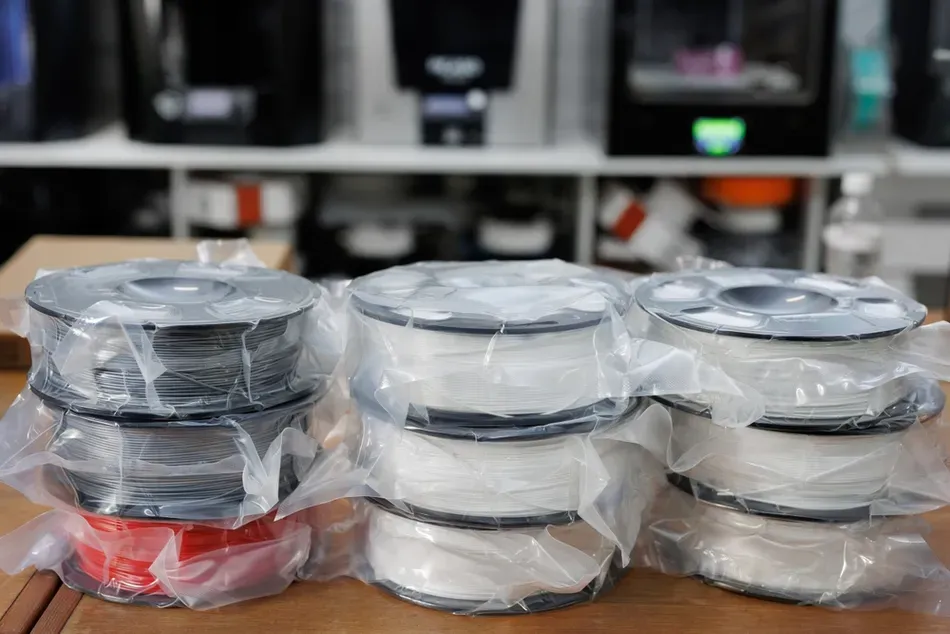
Before exploring extrusion mechanics, it helps to understand why filament exists in the first place. Traditional plastics manufacturing methods—such as injection molding or extrusion blow molding—use generic pellets designed for high-pressure shaping or forming hollow parts. Filament, however, is a purpose-built feedstock: a continuous, precisely dimensioned strand engineered for predictable melting, smooth feeding, and stable flow in a 3D printer’s hot end.
Turning raw pellets into filament transforms an ordinary material into a controlled, highly uniform product with tuned additives and mechanical characteristics tailored specifically for printing.
Extrusion Basics
Most filament is produced using screw extrusion. Plastic pellets enter a hopper and move into a heated barrel containing a rotating screw divided into three zones.[1]
Feed Zone. A deep screw channel conveys and compacts the pellets while gently preheating them.
Compression (Transition) Zone. The channel depth narrows, increasing pressure and shear. Pellets melt, mix thoroughly, and release trapped air, forming a uniform melt.
Metering Zone. A shallow, constant-depth channel completes homogenization and builds the pressure needed to push the melt through a die at a steady rate.
Heaters along the barrel create a controlled temperature profile that prevents premature melting and reduces polymer degradation. After leaving the die, the strand is cooled and pulled at a fixed speed to set its final diameter. Laser gauges continuously monitor thickness, and automated control systems adjust the puller to maintain tight tolerances.
Extrusion during filament production, which involves forming the raw material into uniform strands, should not be confused with extrusion during 3D printing, which involves pushing those strands through the hotend, out of the nozzle, and into the final 3D shape.
Coloring and Additive Compounding
Filament is rarely made from pure polymer alone. Manufacturers commonly blend pellets with a masterbatch—a concentrated mixture of pigments or functional additives dispersed in a compatible carrier resin. Using a small percentage of masterbatch produces uniform color or targeted performance without the handling challenges of powdered additives. However, masterbatch composition and concentration can affect material performance.[2]
Additional ingredients may include plasticizers to increase flexibility, UV stabilizers to slow sun-induced degradation, flame retardants for regulatory compliance, antioxidants and impact modifiers for toughness and melt stability, and reinforcing materials such as carbon or glass fibers to increase stiffness and heat resistance. These additives affect print behavior; for example, fiber-reinforced filaments can accelerate nozzle wear, and plasticizers can influence dimensional accuracy by shifting the glass transition temperature.[3]
Filament Diameter and Spool Sizes
Two diameters dominate desktop and industrial printing: 1.75 mm and 2.85 mm (often referred to as 3 mm). The thinner 1.75 mm size offers precise flow control and is widely used in consumer printers, though it can be more prone to buckling in long-tube extruder setups. The thicker 2.85 mm format is stiffer and feeds more reliably in those systems, making it popular in certain industrial environments. Spool dimensions—typically around 200 mm outer diameter with a 52–58 mm hub—must also match the printer’s holder or mounting system.
Recycling Used Filament
Recycling filament has become an important part of sustainable 3D printing. Failed prints, support structures, and purge waste can be chopped, dried, and re-extruded using either home extrusion equipment or industrial recycling systems. Because repeated heating can reduce molecular weight and strength, recycled filament often performs best when blended with fresh pellets.[4] Mixed-color scraps are commonly turned into a single dark color to maintain consistency.
Some manufacturers also operate collection programs that reprocess post-consumer or post-industrial waste into new spools. While home recycling can close the loop for prototyping materials, maintaining consistent mechanical properties and print reliability remains the main challenge.[5]
Environmental Considerations and Sustainability

As 3D printing usage grows, the environmental impact of filament production, use, and disposal has become an increasingly important design factor. Sustainability depends on feedstock origin, recyclability, emissions during printing, and realistic end-of-life pathways. Different polymers present different challenges: some are compostable only under industrial conditions, others are recyclable but energy-intensive to produce, and many emit particulates during extrusion. A clear understanding of these factors helps engineers select materials that balance performance with environmental responsibility.
Renewable and Biodegradable Materials
PLA is one of the few renewable thermoplastics used in FDM printing, produced from plant-based feedstocks such as cornstarch or sugarcane. In industrial composting facilities—where heat, humidity, and aeration are controlled—it breaks down into lactic acid. However, PLA does not reliably degrade in home compost bins or landfills, so appropriate disposal relies on industrial composting or recycling programs.
Other filaments, such as PETG, are petrochemical-based but fully recyclable. PET-derived materials can be reprocessed mechanically or chemically, reducing demand for virgin monomers. Polycarbonate is also recyclable but depends more heavily on fossil-derived feedstocks. To lower carbon footprint, many manufacturers now offer recycled PET (rPET) and recycled PLA formulations.
Emissions and Safety
Extrusion-based printing releases ultrafine particles and volatile organic compounds (VOCs), with emission levels varying by polymer and additives. ABS emits styrene and other VOCs that can irritate the respiratory system, while PLA produces fewer harmful volatiles but still generates measurable particles. Using enclosed printers equipped with HEPA and activated-carbon filtration, along with adequate room ventilation, significantly reduces exposure. Some specialty filaments incorporate additives that minimize odor or bind particulates, improving safety for classrooms, studios, and home workshops.
Conclusion
3D printer filament is more than a colored plastic strand. In fused deposition modeling, each spool reflects precise polymer chemistry and extrusion control. Common filament types—PLA filament, PETG filament, ASA, nylon, polycarbonate, and various flexible filaments—are made by melting and compounding pellets, adding colorants or additives, and extruding the material into a consistent diameter for reliable 3D printed parts. Differences in viscosity, heat behavior, and tensile strength shape how each material performs during the printing process.
What goes into each unique filament determines its strength, stability, and environmental resistance. PLA is easy to use, PETG offers toughness and good adhesion, ASA provides UV durability, and flexible filaments enable bendable or shock-absorbing parts. Some materials may be marketed as food-safe under controlled conditions, while others excel in chemical or outdoor environments.
As new filament types appear—from reinforced blends to recycled materials—engineers can benefit from knowing how additives, base polymers, and processing methods affect print outcomes. Matching material properties to loading conditions, temperature, and part function leads to more predictable performance in fused deposition modeling.
FAQ
What is 3D printer filament made of?
Most filaments are thermoplastic polymers such as PLA, ABS, PETG, nylon, TPU, or polycarbonate. These materials are blended with colorants and functional additives, then melted and extruded into a consistent diameter for use in FDM printers.
How is filament manufactured?
Filament is made through screw extrusion: pellets and additives melt inside a heated barrel, are mixed by the rotating screw, pushed through a die, cooled in a water bath, measured with laser gauges, and finally spooled.
What is the difference between PLA and ABS?
PLA is plant-derived, easy to print, and suitable for low-temperature applications. ABS is petroleum-based, stronger and more heat-resistant, but requires a heated bed and good ventilation.
Why do some filaments require hardened nozzles?
Abrasive fillers—such as carbon fiber, glass fiber, or metal powders—can quickly wear brass nozzles. Hardened steel, coated copper, or ruby-tipped nozzles resist this abrasion more effectively.
Can I recycle or compost 3D printing filaments?
PLA can be industrially composted or mechanically recycled where facilities exist. PETG and polycarbonate are recyclable, while ABS and nylon should be sent to specialized recycling streams. Composite filaments with fibers or metal powders are more difficult to recycle.
What are the best filaments for functional engineering parts?
ABS, PETG, polycarbonate, and nylon are common choices for strong, durable components. Carbon- or glass-fiber-reinforced nylon is used for high-stiffness applications, while TPU is preferred for flexible parts.
How do additives improve filament performance?
Additives adjust flexibility, UV stability, flame resistance, toughness, and color. Reinforcing fillers, such as carbon fiber or minerals, increase stiffness, while impact modifiers improve toughness.
Are any filaments food-safe?
Some PLA, PETG, and nylon formulations may be labeled food-safe, but actual safety depends on additives, printing conditions, and post-processing. Grooves and layer lines can trap bacteria, so food-contact use requires caution.
Which filaments are best for outdoor use?
ASA is widely used outdoors due to its UV resistance. PETG and polycarbonate also perform well in sunlight and fluctuating temperatures, while PLA typically degrades more quickly.
References
[1] Ahmad MN, Ishak MR, Mohammad Taha M, Mustapha F, Leman Z. A review of natural fiber-based filaments for 3D printing: Filament fabrication and characterization. Materials. 2023 May 29;16(11):4052.
[2] Ahmed SI, Shamey R, Christie RM, Mather RR. Comparison of the performance of selected powder and masterbatch pigments on mechanical properties of mass coloured polypropylene filaments. Coloration technology. 2006 Oct;122(5):282-8.
[3] Wasti S, Triggs E, Farag R, Auad M, Adhikari S, Bajwa D, Li M, Ragauskas AJ. Influence of plasticizers on thermal and mechanical properties of biocomposite filaments made from lignin and polylactic acid for 3D printing. Composites Part B: Engineering. 2021 Jan 15;205:108483.
[4] Mishra V, Ror CK, Negi S, Kar S, Borah LN. Development of sustainable 3D printing filaments using recycled/virgin ABS blends: processing and characterization. Polymer Engineering & Science. 2023 Jul;63(7):1890-9.
[5] Filamentive. A Practical Guide to Recycling 3D Print Waste into Filament. Filamentive [Internet]. Apr 25, 2025 [cited 2025 Nov 27].
in this article
1. What Is 3D Printer Filament?2. Common Filament Types at a Glance3. Core Polymers Used in Filaments4. Composite Filaments5. Blends6. Functional Filaments7. Unusual Filament Ingredients8. Additives: Fine-Tuning Filament Performance9. How to Choose the Right Filament10. Uses and Applications of 3D Printer Filament11. How Filament Is Manufactured12. Environmental Considerations and Sustainability13. Conclusion14. FAQ15. References