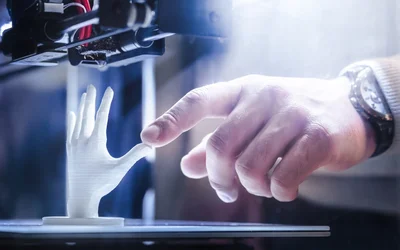
What is 3D printing? This article goes over the basics of 3D printing, otherwise known as additive manufacturing, covering its engineering principles and applications.
What is 3D printer filament made of? This guide examines polymers, additives, and composites, offering practical tips for digital design and hardware engineers.
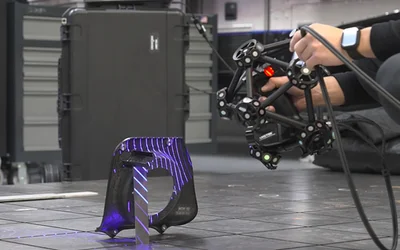
With SCANOLOGY's KSCAN-X 3D scanner, wind turbine manufacturers can redesign blade core materials faster and more accurately than ever—cutting revision time from days to just 30 minutes.
Smarter technology, stronger performance.
Learn everything you need about the full adder circuit. From binary addition theory to low-power hardware implementations and modern ASIC/FPGA design flows, this technical article equips digital design engineers, hardware engineers with practical insights and current research trends.
Explore how a transistor works from first principles through practical circuit design. This in depth guide explains BJT and FET operation, switching and amplification modes, design calculations, modern market trends, and FAQs, ideal for digital design engineers, hardware engineers, and students.
EPB, short for Electric Parking Brake, is an electric parking system, which replaces the traditional handbrake lever and cables, but safer, as the braking effect will not be affected by the force of drivers.
Latvian company SFM, a provider of transformer tanks, has been using Creaform MetraSCAN BLACK 3D scanner with VXelements software for 2 years, to provide high-quality 3D measurement reports for its products.
Ever wondered how robotic arms achieve precise movement in manufacturing, healthcare, or logistics? It’s all about smart design — from sturdy components and kinematics to advanced control systems. Discover how these elements work together to deliver accuracy, flexibility, and real-world efficiency.
Classified Cycling, which develops innovative gear shifting technology for the bicycle industry, has raised 22 million euros in a funding round led by UK-based Active Partners. With the fresh capital, Classified will particularly accelerate its product development for e-bikes and establish partnerships, the company said in a press release.
When you get a piece of sheet metal, it tends to be soft and weak, and can be bent easily—comparing with the metal blocks. But if it is so weak, why product developers are still applying the sheet metal to the auto parts, or design it into enclosure, housing, bracket and much more? The fact is that the sheet metal parts can be strengthened accordingly, so that they can play their roles in different applications. In this article, we talk about some of the ways you can bolster the sheet metal parts.
Endurance is the ability to withstand hardship and adversity while maintaining a prolonged stressful effort. This ability is particularly crucial in the high-performance sport of endurance racing.
Electroforming is an additive manufacturing process specialized for the production of high precision metal parts. Its uniqueness is that you can grow metal parts atom by atom, providing extreme accuracy and high aspect ratios. Typical precision of a electroformed part goes down to 1 to 2 μm, which is beyond what most other manufacturing technologies can reach.
The popularity of wearable electronics has induced demand for their parts, including power sources such as triboelectric nanogenerators (TENGs). Such power sources must be both stretchy and high-performance, holding up under various deformation conditions over hours of use.
The automotive industry has always been an outstanding representative of high-end manufacturing, thanks to its high degree of technical complexity and integrated project management. RPWORLD is a reliable supplier/subcontractor for Tier I and Tier II projects.
Marketing engineering products and services requires a strategic distribution of content in various forms. Using a combination of tech articles, e-books, newsletters, social posts, events, podcasts, and other sponsored content can significantly boost brand awareness.