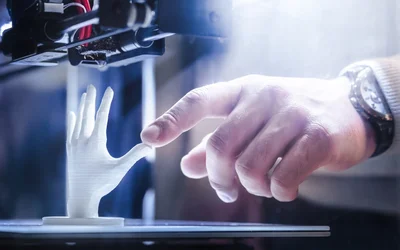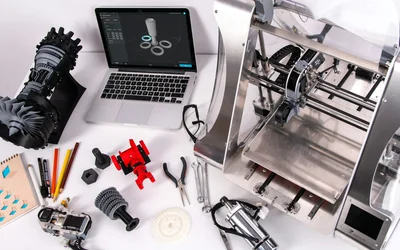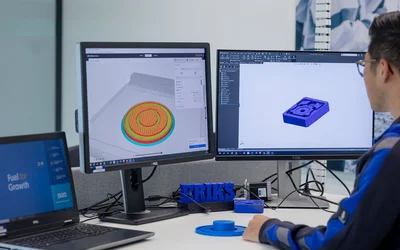


What is 3D printing? This article goes over the basics of 3D printing, otherwise known as additive manufacturing, covering its engineering principles and applications.
What is 3D printer filament made of? This guide examines polymers, additives, and composites, offering practical tips for digital design and hardware engineers.
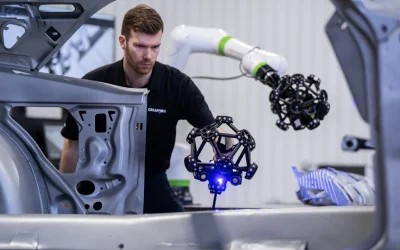
With SCANOLOGY's KSCAN-X 3D scanner, wind turbine manufacturers can redesign blade core materials faster and more accurately than ever—cutting revision time from days to just 30 minutes.
Smarter technology, stronger performance.
Learn everything you need about the full adder circuit. From binary addition theory to low-power hardware implementations and modern ASIC/FPGA design flows, this technical article equips digital design engineers, hardware engineers with practical insights and current research trends.


Explore how a transistor works from first principles through practical circuit design. This in depth guide explains BJT and FET operation, switching and amplification modes, design calculations, modern market trends, and FAQs, ideal for digital design engineers, hardware engineers, and students.
Using a new 3D printing technique, researchers at ETH Zurich have developed special ceramic structures for a solar reactor. Initial experimental testing show that these structures can boost the production yield of solar fuels.
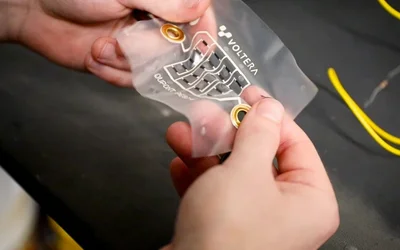
If electronic textiles (e-textiles) are to have a sustainable future and at scale, then a transition is needed to unlock innovative wearable e-textiles that fit a sustainable circular economy – adopting what has been termed as the 4R design concept: repair; recycle; replace; reduce.
Unraveling the Soldering Conundrum: A Thorough Analysis of Lead and Lead-Free Solder, Their Effects on Electronics Manufacturing, Health, the Environment, and Practical Insights for Informed Decision-Making
BigRep’s large-format 3D printers and 3D printing filaments are suited to high-performance engineering applications. To meet the diverse range of needs of these applications, BigRep’s filament range spans several materials with vastly different uses.
BigRep has a diverse material portfolio, comprising filaments optimized for its large-format 3D printers. The filaments are engineered to meet a variety of needs, whether you’re looking for a low-cost prototyping material like PLA, or an engineering-grade thermoplastic that can withstand more rugged use like HI-TEMP CF. In this article, we’re taking a closer look at one of BigRep’s most popular materials, Pro HT.
In this article we’re covering all you need to know about BigRep PLA, an easy-to-use filament that has been engineered to address the specific conditions and challenges of large-scale 3D printing. We’ll be looking at the material’s benefits, material properties, best practices, application areas, and more.
Advances in the 3D printing of living tissue – a field known as bioprinting – puts within reach the possibility of fabricating whole organs from scratch and implanting them in living beings. A multidisciplinary team from Stanford received a federal contract to do just that.
Thermoplastic Elastomer (TPE) offers a unique balance of flexibility and durability in 3D printing. Utilizing Selective Laser Sintering, it's ideal for various industrial applications, from footwear to machinery dampening.
This article offers an in-depth view of AMR robots, their underlying technology, and applications crucial in today's rapidly evolving technological landscape.
ABS is one of the most widely used thermoplastics in FDM 3D printing. Here we look at how to navigate ABS 3D printing in terms of slicer settings, post-processing, and more.