Voltage Regulator Design and Selection: Linear vs Switching, LDOs, and Practical Considerations
Understanding how voltage regulators maintain constant voltage, comparing linear, LDO, and switching types, and providing engineering guidelines for selecting and integrating regulators into complex systems.

18 Mar, 2026. 12 minutes read
Key Takeaways
A voltage regulator is a device or circuit that keeps its output voltage constant despite variations in input voltage or load current.
There are two main categories of regulators: linear regulators, which dissipate excess voltage as heat and provide low noise, and switching regulators, which use energy-storage elements and high-frequency switching to achieve higher efficiency.
Critical specifications include input and output voltage range, output current capability, dropout voltage, efficiency, line and load regulation, quiescent current, and transient response.
LDO regulators minimise the voltage difference between input and output and are useful for noise-sensitive, low-power applications; switching regulators are suited for high-efficiency power conversion and large voltage differentials.
Thermal management, PCB layout, filtering, and selecting appropriate passive components are essential to ensure stability, efficiency, and reliability of regulated power supplies.
Introduction
Voltage regulation is fundamental to modern electronics. Every digital system, from microcontrollers and sensor modules to telecommunications infrastructure and automotive control units, requires stable supply rails. Variations in supply voltage can cause logic errors, reduce analogue accuracy, or permanently damage semiconductor devices. A voltage regulator is designed to automatically maintain a constant output voltage regardless of fluctuations in the input voltage or load current. By controlling power delivery and filtering disturbances, regulators protect sensitive components, improve system longevity, and enable predictable operation.
This article reviews the theory and practice of voltage regulation for professional hardware engineers and advanced students. It begins by defining voltage regulators and explaining the negative feedback control loop at the heart of most regulator designs. The article then compares linear and switching regulators, including low-dropout (LDO) variants, summarises key specifications and design trade-offs, and provides quantitative examples.
Understanding Voltage Regulation
Basic Principle
A voltage regulator creates and maintains a fixed output voltage independent of input voltage and load changes. Simple regulators can be built from a resistor in series with a diode or Zener diode, exploiting the diode's logarithmic current-voltage characteristic to provide approximate regulation.
For precise control, modern regulators employ negative feedback. The output voltage is continuously sensed and compared to a reference voltage, and the regulation element is adjusted to minimise the error. High open-loop gain improves regulation accuracy but may reduce stability; careful compensation ensures a fast yet stable response.
Control Loop Elements
Most active regulators, whether linear or switching, share four fundamental components: a pass transistor (BJT or MOSFET), an error amplifier, a voltage reference, and a feedback network.
The feedback network divides the output voltage to a sample value that is compared with the reference. If the output deviates, the error amplifier drives the pass device to adjust its resistance (in linear regulators) or duty cycle (in switching regulators), restoring the desired voltage.
Key Specifications
Designers must evaluate several parameters when selecting a regulator.
Voltage Range: The input voltage range and output voltage range determine the allowable supply variation and regulated outputs.
Current Range: The output current rating defines the maximum load current without violating thermal limits or triggering current protection.
Line Regulation: Line regulation quantifies how well the regulator maintains output when the input voltage changes, while load regulation measures output stability under varying load current. Quiescent current is the internal current drawn with no load; low quiescent current is important in battery-powered systems.
Transient Response: Transient response describes how quickly the regulator responds to sudden changes in load or input, and power supply rejection ratio (PSRR) indicates how effectively input ripple is attenuated.
Load Regulation: Measures the change in output voltage when the load current changes. Good load regulation ensures that the output stays within specified tolerance as the load varies.
Dropout Voltage: It is the minimum input-output differential needed to maintain regulation; low-dropout regulators can operate with differences as small as 100 mV.
Efficiency: It is the ratio of output power to input power. For linear regulators, the efficiency approximates Vout/Vin, so a 5 V to 3 V conversion yields ~60% efficiency, whereas switching regulators can exceed 95% efficiency.
Linear Voltage Regulators
Series and Shunt Linear Regulators
A linear regulator controls the voltage drop across a pass element operating in its linear region. The two fundamental topologies are series and shunt regulators. In a series regulator, the pass transistor sits between the input and output, adjusting its resistance to drop excess voltage; in a shunt regulator, the pass device diverts current to ground to maintain the output.
Series regulators offer better efficiency and are prevalent in integrated circuits, whereas shunt regulators are simple and are often built from a Zener diode and resistor for low-current applications.
Operation of Series Regulators
In a series regulator, the error amplifier compares the output voltage (via the feedback network) with a precise reference. If the output voltage falls, the amplifier increases the gate/base drive to reduce the pass transistor's resistance, allowing more current to flow and raising the output. Conversely, if the output rises, the drive is reduced, increasing resistance and dropping more voltage.
The regulator thus continuously modulates the voltage drop to maintain a stable output. Series regulators can be designed for fixed or adjustable outputs. The ubiquitous 78xx/79xx series provides fixed positive/negative voltages from 2.5 V to 35 V and up to 2 A output current.
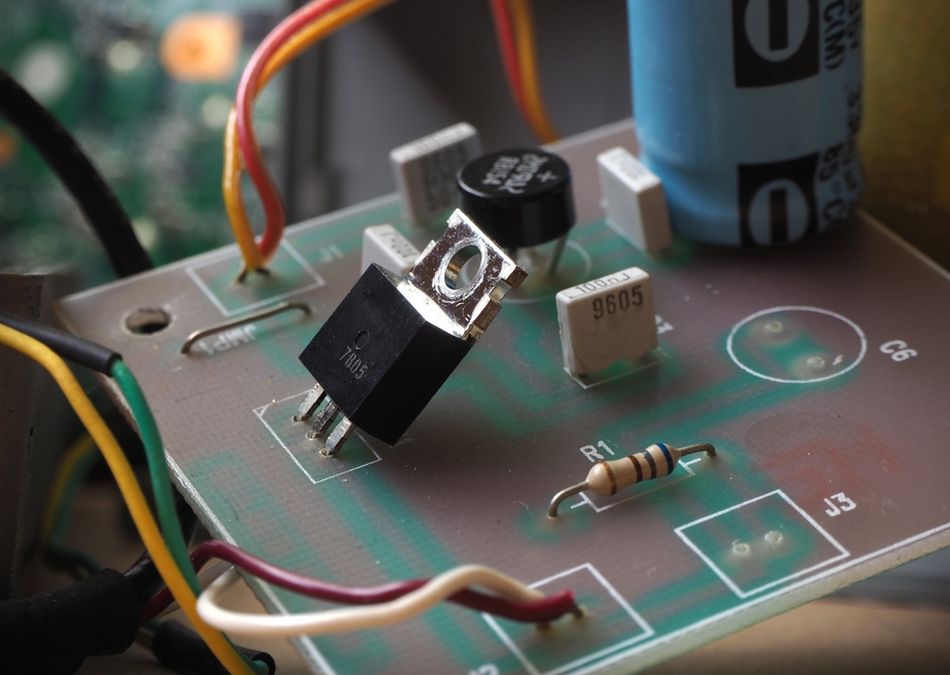
Adjustable regulators like the LM317 allow outputs from 1.25 V to 37 V using an external resistor divider and can supply up to 1.5 A.
Shunt Regulators and Zener Diode Regulation
Shunt regulators are often used for simple, low-current applications. A Zener diode connected in reverse bias maintains a nearly constant voltage across itself; a resistor in series with the diode limits current.
When the input voltage rises, the diode conducts more, shunting excess current to maintain the output voltage across the load. This topology is inefficient for larger currents but provides a quick response and is commonly used for voltage references and low-current supplies.
Recommended Reading: How Does a Zener Diode Work? Theory, Operation & Practical Applications
Low-Dropout (LDO) Regulators
Traditional linear regulators require the input voltage to exceed the output by at least 2 V to maintain regulation. Low-dropout (LDO) regulators employ PNP BJTs or P-channel MOSFETs as pass devices to reduce this headroom, allowing operation with input-output differentials down to 100 mV. LDOs are ideal for battery-powered or noise-sensitive circuits where minimal voltage loss and low output ripple are crucial.
They are widely used to step down from battery voltages (e.g., 3.7 V lithium-ion) to core voltages for microcontrollers and radio transceivers.
Suggested Reading: What is LDO: Theory, Parameters, and Practical Implementation for Engineers
Performance Characteristics of Linear Regulators
Noise and PSRR: Linear regulators provide excellent low-frequency noise performance because the pass device operates in the linear region and there is no high-frequency switching. PSRR values can exceed 60 dB in the tens of kilohertz range, making them suitable for analogue and RF circuits.
Transient Response: The absence of switching allows a fast control loop, giving linear regulators a quick response to load changes.
Efficiency and Heat: Efficiency is low when the difference between input and output voltage is large; the excess power is dissipated as heat. For example, with a 5 V input and 3 V output, efficiency is limited to 3/5 = 60%. Heat sinks or thermal pads are required for high-current linear regulators, and thermal shutdown may be necessary to protect the device.
Quiescent Current: Linear regulators draw bias current for internal operation; typical values range from tens of microamperes for LDOs to several milliamperes for older designs. Low quiescent current is important for battery-powered devices.
Selecting a Linear Regulator
When choosing a linear regulator, engineers should:
Determine the output voltage and current: Identify the required load voltage and maximum current draw. Ensure the regulator's current rating is adequate and the dropout voltage allows operation across the input voltage range.
Check the input voltage: Verify that the minimum input voltage is at least the output voltage plus dropout voltage under worst-case conditions.
Assess power dissipation: Calculate the worst-case power dissipation (Ploss = (Vin - Vout) x Iout). If the result exceeds the regulator's thermal limits, use a heat sink or switch to a switching regulator.
Evaluate noise and PSRR requirements: For analog or RF circuits, choose a regulator with high PSRR and low output noise.
Consider package and layout: Select a package that suits the available PCB area and provides adequate thermal resistance. Keep feedback trace lengths short and use proper bypass capacitors.
Switching Voltage Regulators
Overview and Operation
Switching regulators achieve voltage conversion through high-frequency switching and energy storage in inductors and capacitors. The regulator toggles a transistor on and off, transferring discrete packets of energy to the output.
Duty cycle control, combined with filtering, yields the desired average output voltage. Switching regulators maintain high efficiency because the pass transistor operates in either the fully on or fully off state, minimising conduction and switching losses.
Common Topologies
Switching regulators can step down, step up or invert voltages. The most common topologies include:
Buck (step-down) converters: The output voltage is lower than the input, given by Vout = D x Vin (where D is the duty cycle). Buck converters are widely used in digital logic and processor power supplies.
Boost (step-up) converters: These increase the input voltage according to Vout = Vin / (1 - D), enabling 3.3 V supplies from 1.8 V batteries.
Buck-boost converters: Provide output voltages either above or below the input; useful when the input can cross the output level. A single inductor design combines buck and boost operation.
Inverters: Create a negative output voltage from a positive input, often used to supply op-amps.
Suggested Reading: DC to AC Inverter Circuits – Theory, Design and Practical Implementation
Control Methods
Switching regulators employ various control schemes to regulate voltage and maintain stability:
Voltage-mode control: Compares the output voltage to a reference and modulates the duty cycle. Compensation networks tailor loop response.
Current-mode control: Senses inductor current as a feedback variable, providing inherent over-current protection and improved transient response.
Hysteretic (bang-bang) control: Uses an upper and lower voltage threshold to turn the switch on and off, resulting in a fast response but less predictable switching frequency.
Constant on-time or constant off-time control: Maintains a fixed on or off period, adjusting switching frequency based on load conditions to improve light-load efficiency.
Advantages and Disadvantages
Advantages:
High efficiency: Because the pass device switches between saturation and cut-off, efficiency can exceed 95%.
Wide input/output range: Switching topologies can step voltages up or down, allowing use with a broad range of supply rails.
Compact size: Modern regulators operate at high switching frequencies (hundreds of kilohertz to several megahertz), allowing small inductors and capacitors and reducing PCB area.
Disadvantages:
Complexity: Designs require careful selection of inductors, capacitors, diodes and FETs, as well as compensation networks for loop stability.
Electrical noise: High-frequency switching generates electromagnetic interference (EMI) and output ripple. Proper filtering and PCB layout are essential to meet noise specifications.
Cost: Switching regulators generally cost more than linear alternatives, partly because of additional components and complex control circuits.
Designing a Switching Regulator
When designing or selecting a switching regulator:
Define the input and output requirements: Determine the minimum and maximum input voltages, desired output voltage, and load current range.
Select the topology: Choose buck, boost, buck-boost or inverter based on whether the output is greater than, equal to, or less than the input.
Choose switching frequency: Higher frequencies reduce passive component sizes but increase switching losses and EMI; typical frequencies range from 100 kHz to 2 MHz.
Size the inductor and output capacitor: Use formulas based on desired current ripple and voltage ripple. For example, the inductor value in a buck converter is L = (Vin - Vout) x D / (fs x I), where fs is the switching frequency, and I is the inductor current ripple.
Design compensation: Select compensation components to meet stability criteria and achieve fast transient response.
Consider thermal performance: Even high-efficiency regulators dissipate some power. Evaluate thermal resistance, ensure adequate copper area and airflow, and verify that junction temperatures remain within limits.
Filter and layout for EMI: Use input and output filters, minimise high-di/dt loops, and follow layout guidelines to reduce switching noise and meet electromagnetic compatibility requirements.
Application Examples
Digital systems: Microprocessors and FPGAs often use multi-phase buck regulators to provide high currents at low voltages (e.g., 1 V at tens of amperes). High switching frequencies allow small components and fast transient response.
Battery-powered devices: Portable electronics use boost or buck-boost converters to generate stable rails from single-cell Li-ion batteries. Efficiency and quiescent current are critical to maximise battery life.
Automotive: Wide-input buck converters handle 12 V and 24 V battery transients while delivering regulated 5 V or 3.3 V rails. Regulators must meet automotive EMC and temperature requirements.
Industrial and avionic systems: Isolated converters and inverting regulators create negative rails for op-amps or instrumentation amplifiers.
Recommended Reading: How Switching Regulators Work: A Deep Dive for Power Engineers
Comparing Linear and Switching Regulators
Parameter | Linear Regulators | Low-Dropout Regulators | Switching Regulators |
Efficiency | Efficiency ~ Vout/Vin. For a 5 V to 3 V drop, efficiency is ~60%. | Similar to linear regulators but with a smaller input-output differential; still limited by Vout/Vin. | Can exceed 95% by operating the switch in saturation and cut-off. |
Dropout Voltage | Typically 2 V or more above the output. | As low as 100 mV. | N/A (depends on topology; boost and buck-boost can operate even when Vin < Vout). |
Noise and PSRR | Very low output noise and high PSRR; suitable for sensitive analogue circuits. | Low noise and good PSRR similar to linear regulators. | Higher ripple; requires filtering and careful layout. |
Complexity | Simple; minimal external components. | Slightly more complex due to PNP or PMOS pass devices. | Requires inductors, capacitors, diodes, compensation network and careful layout. |
Size | Large heat sinks may be needed for high currents. | Slightly smaller than conventional linear regulators because of reduced thermal dissipation. | Smaller inductors/capacitors at high switching frequencies; can achieve compact designs. |
Cost | Generally low. | Slightly higher than standard linear regulators. | Higher due to additional components and control circuitry. |
Applications | Low-noise analogue circuits, reference voltage generation, simple point-of-load regulation. | Battery-powered devices requiring minimal voltage overhead, noise-sensitive systems. | High-efficiency conversion in portable, automotive, industrial and telecommunications systems. |
Practical Design Considerations
Thermal Management
Linear regulators dissipate power equal to (Vin - Vout) x Iout. Without adequate thermal management, the regulator may reach its junction temperature limit and shut down or fail. Heat sinks, copper planes, and forced air cooling help dissipate heat.
Noise Reduction and Filtering
Switching regulators produce ripple and high-frequency noise. Filtering using input and output capacitors, inductors, and ferrite beads reduces ripple. Place capacitors close to the regulator pins and use short, wide traces to minimise inductance. For sensitive analogue circuits, consider adding a post-regulation LDO to achieve low noise.
Inrush Current and Startup
When a regulator is first energised, the capacitors charge and the regulator's internal circuitry starts up. The inrush current can exceed steady-state currents, potentially stressing power supplies and connectors. Mitigate inrush currents with soft-start circuits, current limiting or pre-charge resistors.
PCB Layout and Component Selection
Keep the feedback network close to the regulator to minimise noise pickup.
Use short traces for high-di/dt loops (input switch, inductor, and diode) in switching converters to minimise EMI.
Place input and output capacitors adjacent to the regulator pins and connect them to ground with short, low-impedance paths.
For multi-phase regulators, ensure equal current sharing by matching the layout of each phase.
Select inductors with appropriate current ratings and low core losses; choose capacitors with low equivalent series resistance (ESR) to maintain stability.
Protection Features
Many regulators include over-current protection, thermal shutdown and sometimes reverse-voltage or reverse-current protection. These features prevent damage when the load is shorted, the input voltage exceeds safe limits, or the output is accidentally driven by another source.
Recommended Reading: Regulated vs. Unregulated Converters – When to Choose Which?
Applications and Case Studies
Microcontrollers and Digital Logic: Most microcontrollers operate from 3.3 V or 1.8 V rails. A simple LDO can power low-current logic or sensor modules, while high-current processors require a switching buck converter.
Analogue and RF Circuits: Low-noise requirements drive the use of linear or LDO regulators. Choosing a regulator with high PSRR and low output noise ensures that the amplifier or oscillator performance is not compromised.
Battery-Powered Consumer Electronics: Mobile devices, wearables, and IoT sensors require efficient regulation to maximise battery life. High-efficiency switching converters supply the main rail, followed by LDOs for noise-sensitive subsystems.
Automotive and Industrial Equipment: Automotive electronics must tolerate wide input voltage transients (e.g., 3 V to 36 V) and temperature extremes. Step-down buck regulators with robust protection and high EMI immunity are commonly used.
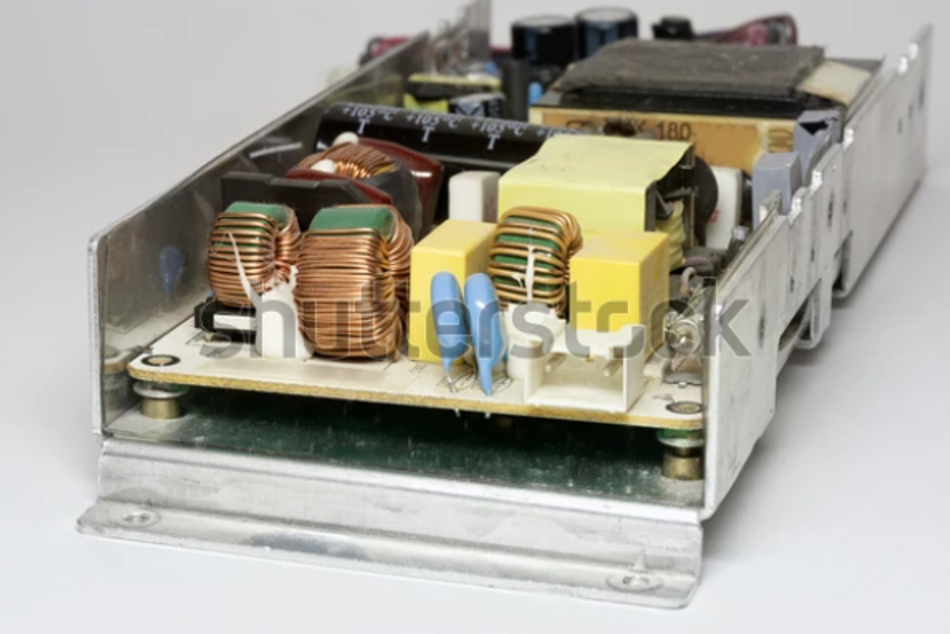
Power Distribution and Generators: On a larger scale, automatic voltage regulators in generators measure terminal voltage, compare it to a set point, and adjust excitation current to keep output voltage constant.
Emerging Trends and Future Directions
Digital Control and PMBus: Digital regulators integrate microcontrollers to control the power stage, enabling real-time monitoring, adaptive voltage scaling and programmable responses.
Multi-Phase and Integrated Power Modules: Multi-phase buck regulators distribute current across several phases to reduce inductor size and improve transient response.
Energy Harvesting and Ultra-Low-Power Regulators: Regulators optimised for micropower applications feature sub-microampere quiescent current.
Wide-Bandgap Semiconductors: Gallium nitride (GaN) and silicon carbide (SiC) transistors allow switching at higher frequencies with lower losses.
Suggested Reading: Where GaN can, it should, and GaN can in more and more places
Conclusion
Voltage regulators are indispensable building blocks in modern electronic systems. They maintain a stable output voltage despite variations in input supply or load, protecting sensitive components and ensuring reliable operation. Linear regulators offer simplicity and low noise but suffer from poor efficiency when the input-output differential is large. LDOs reduce the dropout voltage, making them suitable for battery-powered and noise-sensitive circuits. Switching regulators provide high efficiency and flexible voltage conversion but require careful design to manage complexity and noise.
FAQ
What does a voltage regulator do?
A voltage regulator maintains a constant output voltage regardless of changes in input voltage or load current. It senses the output, compares it to a reference and adjusts a pass element to correct deviations.
How are linear regulators different from switching regulators?
Linear regulators control the drop across a transistor operating in its linear region, dissipating excess power as heat. They offer simplicity and low noise but poor efficiency for large input-output differences. Switching regulators use high-frequency switching and energy-storage elements to convert voltages with high efficiency.
What is dropout voltage and why is it important?
Dropout voltage is the minimum difference between the regulator's input and output required to maintain regulation. Standard linear regulators typically need 2 V or more headroom, whereas low-dropout regulators can operate with only ~100 mV difference.
How do I choose the right voltage regulator for my application?
First determine your input voltage range, desired output voltage and load current. Calculate the maximum power dissipation and decide whether efficiency or noise is the priority. For small voltage differences and noise-sensitive circuits, choose a linear or LDO regulator; for high efficiency or when stepping up voltages, use a switching regulator.
Why use an LDO instead of a standard linear regulator?
LDO regulators achieve very low dropout voltages (often <100 mV), allowing regulation when the input voltage is only slightly above the output. They are beneficial in battery-powered devices where every millivolt counts.
What are the common causes of voltage regulator failure?
Failure can result from exceeding maximum input voltage or output current ratings, inadequate heat dissipation, improper PCB layout, or excessive electrical noise.
Can linear and switching regulators be used together?
Yes. A common practice is to use a high-efficiency switching converter to generate an intermediate voltage and then a low-noise LDO to supply sensitive analogue sections.
References
Wikipedia contributors, "Voltage regulator," Wikipedia: The Free Encyclopedia. en.wikipedia.org
Keysight Technologies, "The Engineers Guide to Voltage Regulators." keysight.com
Monolithic Power Systems, "Voltage Regulator Types and Working Principle." monolithicpower.com
DigiKey, "What is a Voltage Regulator?" digikey.com
GeeksforGeeks, "Voltage Regulation." geeksforgeeks.org
Texas Instruments, "Understanding the Terms and Definitions of LDO Voltage Regulators." ti.com
in this article
1. Introduction2. Understanding Voltage Regulation3. Linear Voltage Regulators4. Switching Voltage Regulators5. Comparing Linear and Switching Regulators6. Practical Design Considerations7. Applications and Case Studies8. Emerging Trends and Future Directions9. Conclusion10. FAQ11. References