

Protect sensitive electronics by understanding the current limiting resistor, learning how to calculate appropriate values, and applying them in LEDs, transistors, microcontroller inputs and other circuits.
This guide explains how potentiometer pins interact with mechanical rotation, resistive tracks, and load conditions across various circuit configurations. It provides clarity for both low-power electronic designs and high-precision embedded systems.
This technical article explains the theory behind potentiometer schematics. It shows how to implement mechanical and digital potentiometers in practical circuits, tailored for engineers, and students.
Engineering teams can achieve AI-ready design data with five-level maturity model by Keysight. The unified, traceable data accelerates design cycles, boosts IP reuse, and reduces costly re-spins.
Focused laser-like light that covers a wide range of frequencies is highly desirable for many scientific studies and for many applications, for instance quality control of manufacturing semiconductor electronic chips.
Scientists at ITMO have come up with a new way to protect microelectronics devices from counterfeit. The new technology is based on gold and silicon nanoparticles with unique optical properties that make it possible to create unclonable functions with a record information density.
An international team of scientists was first to demonstrate that halide perovskites can serve as a base for nonlinear on-chip optical components. As an example, they can be used to build ultrafast optical chips and transistors, and, potentially, other integrated optical systems.
In the in-depth interview, PI Vice President of Marketing Doug Bailey explains GaN technology and the new possibilities it brings to the power conversion industry.
Researchers have developed a robotic sensor that incorporates artificial intelligence techniques to read braille at speeds roughly double that of most human readers.
QFN packages are leadless and have short interconnects that reduce parasitic elements such as inductance and capacitance. How do they compare to other surface-mount ICs?
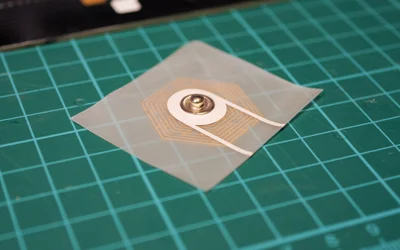
In this episode, we discuss the shortcomings of previous attempts at making flexible wearable sensors and how researchers at CalTech have addressed them to create high performance stress sensor stickers.
This detailed guide will cover the fundamentals of SMT vs SMD, and THT, exploring their working principle, advantages and disadvantages, comparative analysis, and choosing the right one for electronics assembly.

The Quad Flat No-leads (QFN) package is a type of surface-mount technology (SMT) in the electronics industry known for its compact size and high performance. This comprehensive guide explores its benefits (high performance), applications (mobile devices), and challenges (assembly, soldering).

At recent 2023 Consumer Electronics Show (CES), Sony and Honda revealed their first electric vehicle prototype, which is equipped with 45 cameras and sensors, as well as Electric Rearview Mirrors.
In the world of printed electronics, surface energy often comes up around the interactions of materials, specifically when we’re printing conductive inks onto various surfaces (substrates).
The COVID-19 pandemic and advancements in sensor technology have led to the widespread adoption of wearable health monitoring devices, particularly for telemedicine, to facilitate remote patient monitoring.
Researchers at ETH Zurich have developed a sensor that utilises energy from sound waves to control electronic devices. This could one day save millions of batteries.
As cars shift to automated driving, In-Cabin Monitoring Systems (ICMS) are vital for passenger safety and comfort. Incorporating Time-of-Flight cameras and radar sensors enables ICMS to detect occupants and their behaviors promising a safe and personalized automotive experience.