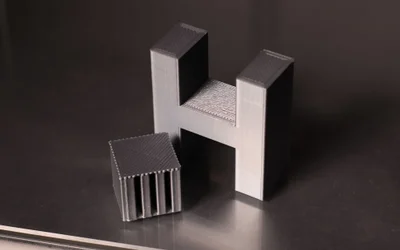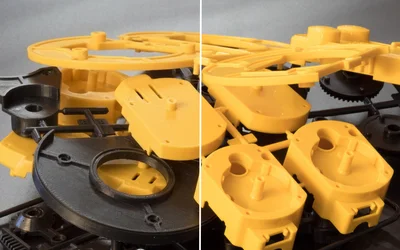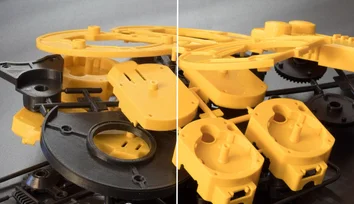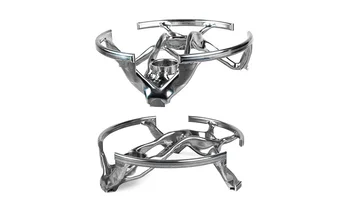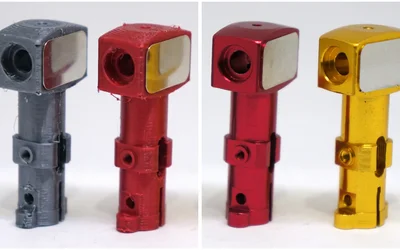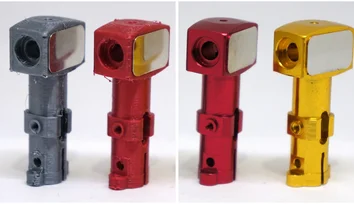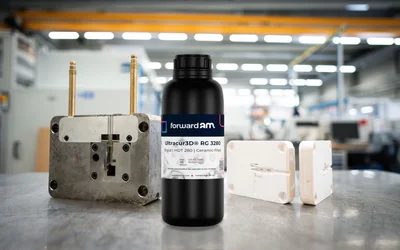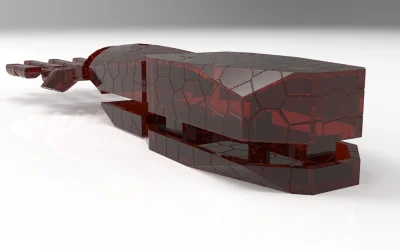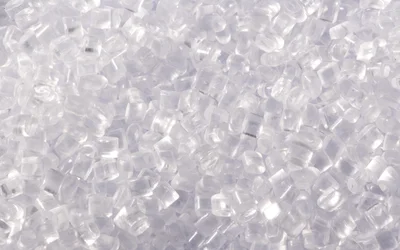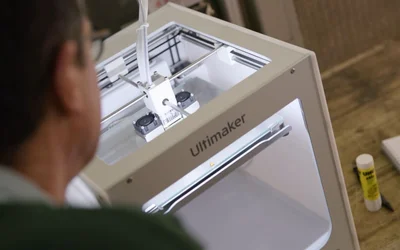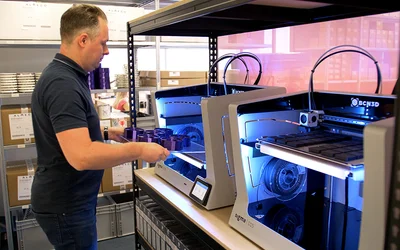
One of the main reasons why manufacturers and designers prefer injection moulding over other processes is its ability to produce a smooth surface finish. Injection moulding is economical when producing large batches, but how about small batches and prototypes? The evident solution is 3D printing.
Laser powder bed fusion, a 3D-printing technique, offers potential in the manufacturing industry, particularly when fabricating nickel-titanium shape memory alloys with complex geometries.
Thermoplastic polyurethane is one of the best flexible 3D printing materials, but TPU print settings differ greatly from rigid material settings and can be difficult to configure.
"MechStyle" allows users to personalize 3D models, while ensuring they're physically viable after fabrication, producing unique personal items and assistive technology.
A new method could enable users to design portable medical devices, like a splint, that can be rapidly converted from flat panels to a 3D object without any tools.
A deep dive into the physics, properties, and practical applications of 3D printing filaments, from everyday polylactic acid to performance composites.
Discover how to print with high-performance filaments like PEEK, PEKK, and ULTEM. Learn about their properties, hardware needs, challenges, and best practices for industrial-grade 3D printing.
Explore how 3D-Fuel's Pro PCTG filament advances additive manufacturing, offering higher impact strength, improved environmental resistance, and reliable printability for functional and industrial 3D printing applications.
3devo's next-generation desktop extruder combines industrial precision with lab-scale simplicity enabling more controlled, higher-performance and data-driven 3D printing material workflows.
One of the main reasons why manufacturers and designers prefer injection moulding over other processes is its ability to produce a smooth surface finish. Injection moulding is economical when producing large batches, but how about small batches and prototypes? The evident solution is 3D printing.
Laser powder bed fusion, a 3D-printing technique, offers potential in the manufacturing industry, particularly when fabricating nickel-titanium shape memory alloys with complex geometries.
Thermoplastic polyurethane is one of the best flexible 3D printing materials, but TPU print settings differ greatly from rigid material settings and can be difficult to configure.
Post-curing is an important step in SLA 3D printing. Knowing how long to cure resin 3D prints and what curing methods to use can help you attain the highest quality parts.
There are many ways to be more sustainable and respectful to our planet. One key way lies within production. How can this process become more sustainable while still being competitive?
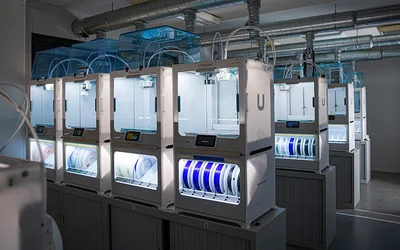
Retraction is a useful feature of FDM 3D printers that helps to prevent common issues like oozing and stringing. Cura retraction settings enable precise control over the retraction process, but the parameters can be confusing to beginners.
Lattice structures are becoming increasingly common in product design. But what are they exactly, and how can you take advantage of them to develop the next generation of high-performing 3D printed products? This article guides you through the basics of lattice structures to get you started.
Modeled in software before being printed on a commercial 3D printer in a single pass, these "lenticular objects" from MIT show different imagery depending on the angle at which they're viewed — for everything from exercise form feedback to secret messaging.
Prints covered in plastic cobwebs? Like many FDM users, you’re probably the victim of 3D printer stringing. Fortunately, stringing can be prevented via printer maintenance and adjustment of slicer settings.
Researchers in Maastricht and Leuven used ProbeFix Dynamic for a pioneering study using dynamic ultrasound imaging and 3D motion tracking in Nordic hamstring curl, single-leg Roman chair, and single-leg deadlift.
Surface imperfections on a 3D print can be frustrating but they’re not insurmountable. Here is how to prevent and fix 3D print blobs and zits by adjusting 3D printer and slicer settings.
Imagine you could create thousands of options for a single design the push of a button and then you just pick the best option! Generative design makes this possible.
In this video we look at the huge number of post-processing options that can improve a DMLS part’s dimensional accuracy, surface finish quality, and mechanical properties.