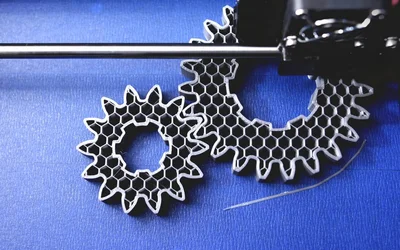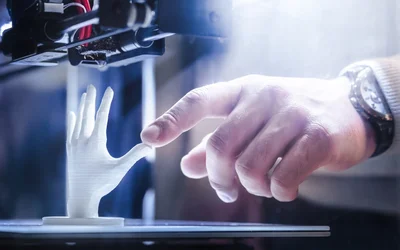

What is 3D printing? This article goes over the basics of 3D printing, otherwise known as additive manufacturing, covering its engineering principles and applications.
What is 3D printer filament made of? This guide examines polymers, additives, and composites, offering practical tips for digital design and hardware engineers.
With SCANOLOGY's KSCAN-X 3D scanner, wind turbine manufacturers can redesign blade core materials faster and more accurately than ever—cutting revision time from days to just 30 minutes.
Smarter technology, stronger performance.
Learn everything you need about the full adder circuit. From binary addition theory to low-power hardware implementations and modern ASIC/FPGA design flows, this technical article equips digital design engineers, hardware engineers with practical insights and current research trends.
Explore how a transistor works from first principles through practical circuit design. This in depth guide explains BJT and FET operation, switching and amplification modes, design calculations, modern market trends, and FAQs, ideal for digital design engineers, hardware engineers, and students.
The global trade in counterfeit is worth up to $1 trillion annually, with electronics accounting for a significant portion of that figure. How do you keep your builds counterfeit-free?
Unlike the traditional production, the on-demand and customized high-mix, low-volume manufacturing services of RPWORLD allows for the design flexibility that mass manufacturing cannot offer. Moreover, the process, tooling and materials being used for low-volume parts sometimes are not as certain as those of mass production parts. That’s why quality assurance is paramount at RPWORLD and it’s one of the core benefits for our customers.
Columbia University devising a way to grow engineered skin in complex, three-dimensional shapes, making it possible to construct, for example, a seamless “glove” of skin cells that can be easily slipped onto a severely burned hand.
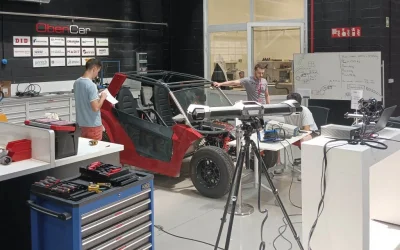
In motorsports, a measurement system must be able to provide accurate information about the condition of a race vehicle very quickly so that engineering teams can optimize both their designs and assemblies.
Large Format Additive Manufacturing can be game-changing in product and process optimization, contributing to fighting climate breakdown. For the project Demo4Green - 𝗥𝗔𝗥𝗲-𝗪𝗔𝗦𝗧𝗘, Caracol used recycled glass fibers and polypropylene to produce a lamination tool for micro wind turbines.
With the high degree of technical complexity and integrated project management, the automotive industry has always been an outstanding representative of high-end manufacturing.
Following the example set by the FIA, M-Sport saw the need to introduce 3D scanning to control the body shell’s accuracy and ensure that the car met regulatory requirements. After all, winning performances often occur by pushing as close to the limit as practical while remaining compliant with regulations. 3D scanning proved to be the technology required to reach this balance.
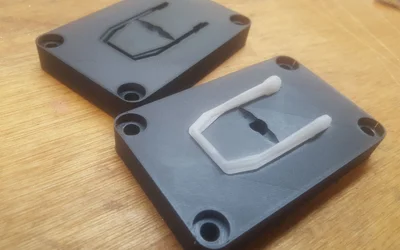
Everyone wants to save money on manufactured parts, so in this video we list ways in which injection moulding costs can be reduced, whether it be cutting unnecessary features or incorporating undercuts.
This article aims to provide a comparative analysis of HASL vs ENIG, providing valuable insights to aid in making informed decisions for PCB design and manufacturing.