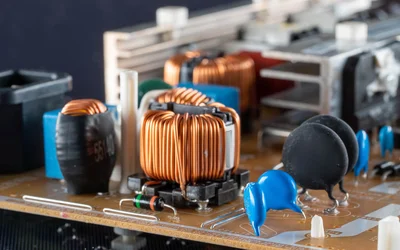

Protect sensitive electronics by understanding the current limiting resistor, learning how to calculate appropriate values, and applying them in LEDs, transistors, microcontroller inputs and other circuits.

This guide explains how potentiometer pins interact with mechanical rotation, resistive tracks, and load conditions across various circuit configurations. It provides clarity for both low-power electronic designs and high-precision embedded systems.
This technical article explains the theory behind potentiometer schematics. It shows how to implement mechanical and digital potentiometers in practical circuits, tailored for engineers, and students.
Engineering teams can achieve AI-ready design data with five-level maturity model by Keysight. The unified, traceable data accelerates design cycles, boosts IP reuse, and reduces costly re-spins.
Focused laser-like light that covers a wide range of frequencies is highly desirable for many scientific studies and for many applications, for instance quality control of manufacturing semiconductor electronic chips.
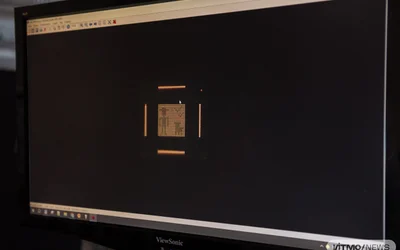
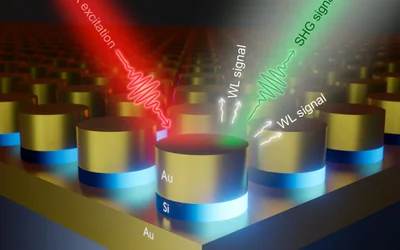
Scientists at ITMO have come up with a new way to protect microelectronics devices from counterfeit. The new technology is based on gold and silicon nanoparticles with unique optical properties that make it possible to create unclonable functions with a record information density.
An international team of scientists was first to demonstrate that halide perovskites can serve as a base for nonlinear on-chip optical components. As an example, they can be used to build ultrafast optical chips and transistors, and, potentially, other integrated optical systems.
In the final episode of Circuit Showdown, three contestants face their toughest challenge yet: integrating an IoT dashboard into their designs. With time running out, the judges are left with a tough decision. Who will rise to the occasion and win the championship?
This article delves into the history and science behind the green color of circuit boards, shedding light on the reasons and advantages that have kept it at the forefront of electronics manufacturing.
Delve into the basics of absolute encoders, its applications, advancements in technologies, calibration techniques, and the advantages over encoder types.
MacroFab's FabIQ aims to disrupt this status quo by leveraging artificial intelligence and a vast database to provide instant, accurate pricing for printed circuit board (PCB) assemblies and panels.
A wearable ‘smart’ choker for speech recognition has the potential to redefine the field of silent speech interface (SSI), say researchers – thanks to embedded ultrasensitive textile strain sensor technology.
AllSpice is a Git-based collaboration platform that transforms hardware development by streamlining project workflows, enhancing design precision, and reducing time to market through established software engineering practices such as Agile and CI/CD.
In Circuit Showdown, contestants must regroup after setbacks as they face a surprise twist in the industrial automation challenge. With only 4 hours to get it all done, their resilience is put to the test.
Circuit Showdown pits three engineering students against each other in a high-pressure design competition. With just four hours to build projects from scratch, they must showcase creativity and technical skills to impress the judges and win $40,000 in prizes.
In this episode, we explore an innovative and sustainable wearable device designed by researchers at the Karlsruhe Institute of Technology to improve posture and we discuss why AI isn’t just a novelty in this product but a core feature that sets it apart from the rest!
The type of sensors you’ll need to connect to your Pi will depend on the particular job your prototype is designed to perform. In manufacturing, the most common processes are concerned with monitoring and control
Development of technology to enable use of hydrogen as a fuel to power turbines, engines, boilers, etc., safely and efficiently is already underway. This first approach is suitable for applications where comparatively large output is required.
Spatial computing is revolutionizing the interaction between the digital world and the physical world, creating immersive experiences where virtual elements blend seamlessly with reality.
'Fashion tech' refers to the use of big data, AI, AR/VR, and IT in customer services; the development of products incorporating functional materials and wearable devices; and the application of electronics and digital technologies in manufacturing, processing, and distribution processes.