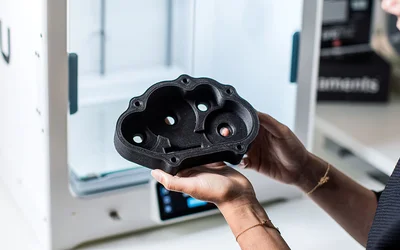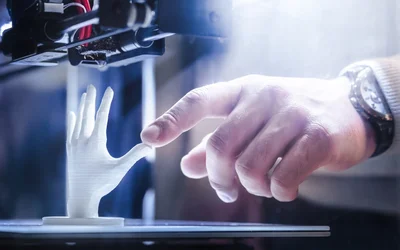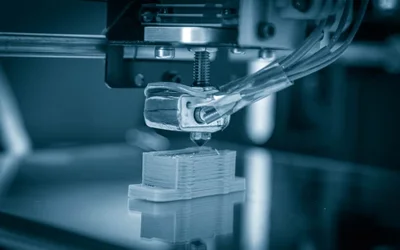
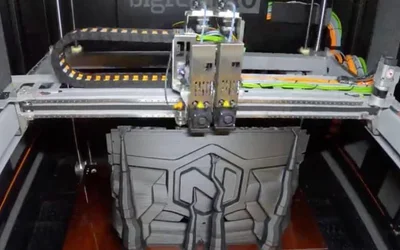
What is 3D printing? This article goes over the basics of 3D printing, otherwise known as additive manufacturing, covering its engineering principles and applications.
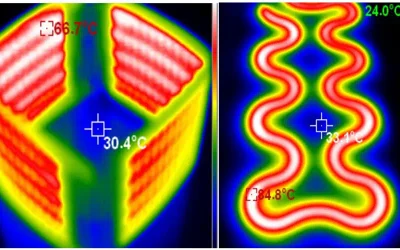
E2IP Technologies manufactures Flexible Heaters using Screen Printing Technology. This is one of the most important segments of printed and additive electronics with applications in cars, homes, and industrial settings.
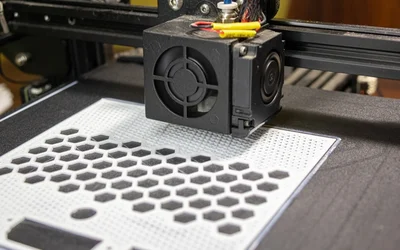
Here’s what to do if you notice clicking noises, under-extrusion, or other print quality issues caused by extruder skipping on the Ender 3 by Creality.
Unwanted lines in 3D prints can show up for many reasons and take different forms. Here we look at the most common types of lines in 3D prints and how to eliminate them.
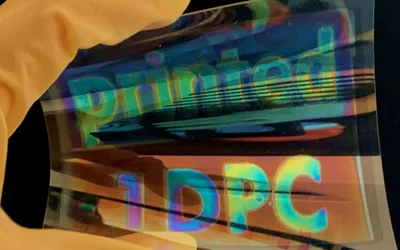
KIT researchers are developing a process with which, for the first time, mirrors with a reflection of more than 99 percent can be printed in variable sizes
As much as we’d like to think that our first ideas are always the best, that isn’t always the case. Making changes to your design is an incredibly important concept and one that is sometimes easy for us all to forget.

The tools created from the collaboration between Stratasys and nTopology enable manufacturers to generate and 3D print custom fixtures with just a couple of clicks.

In this episode, we talk about a research from Penn State that has proven the concept of printing tissue during surgery, a joint effort between MIT & Harvard to develop a hair brushing robot, and a breakthrough in anode free and sodium based batteries coming out of Washington University in St. Louis
Andy Gleadall, Lecturer at Loughborough University develops FullControl GCode Designer in the hope to empower people to do the impossible with scripts and slicers.
This article shares an example of using nTopology to optimize a part and export it as a CAD body, then using Abaqus to calculate the stress intensity factor of cracks that develop perpendicular to the highest tensile principal stress.
PETG vs PLA is a question asked by many newcomers to FFF 3D printing, with both materials offering important benefits. Choosing between them often comes down to the requirements of the project.
In 3D printing, a material’s flexibility refers to how much it will bend when load or force is applied – as well as its ability to return to its original shape after bending. Flexibility is often defined as the flexural modulus (MPa).
Working more efficiently and effectively is a goal of essentially every organization, regardless of sector or industry. Using 3D printing, many companies around the world can do just that in warehouses, assembly lines, and factories, enabling them to achieve results otherwise impossible.
NavVis specializes in developing next-generation technology that enables accurate mapping of indoor spaces. And given that the wearable NavVis VLX system's accuracy had to compete with terrestrial solutions, the scanner’s sensor positioning would be the designers' top priority.
The 3D printing market is expected to reach $13 billion by 2022¹. Progress is being driven by making the technology accessible to anyone, anywhere. But with that can come challenges for an organization adopting 3D printing.
This major software release introduces real-time visualization with GPU acceleration; a technology breakthrough that will fundamentally change how nTop users interact with the software.
Watch this special Ultimaker event and learn about the future of the 3D printing ecosystem. New CEO, Jürgen von Hollen, kicks everything off with exciting news and inspiration on how to use 3D printing to transform your competitive advantage with the Ultimaker platform.