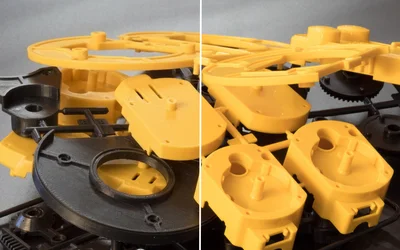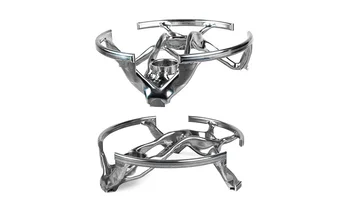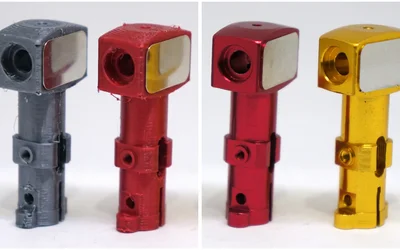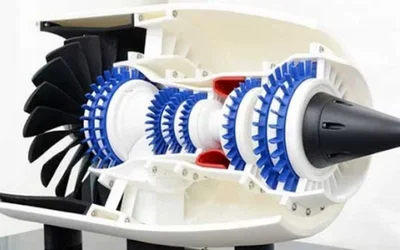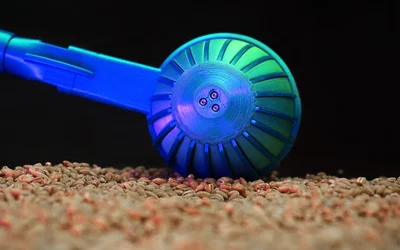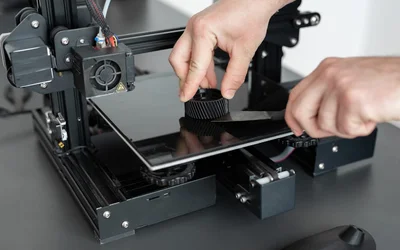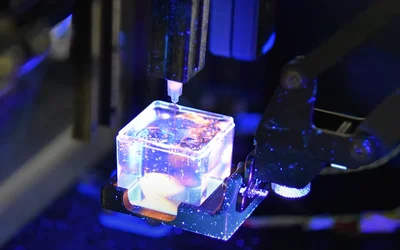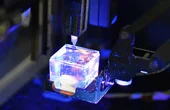
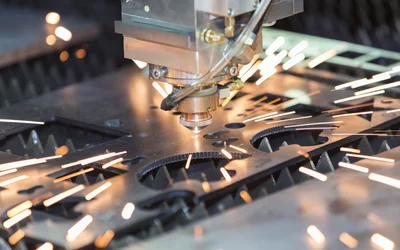
The current advancement in multi-material additive manufacturing technologies has provided unique opportunities to create 3D printed structures with not only complex geometries at several length scales, but arbitrary deposition of multiple materials (i.e., soft or hard) in 3D space.

"MechStyle" allows users to personalize 3D models, while ensuring they're physically viable after fabrication, producing unique personal items and assistive technology.
A new method could enable users to design portable medical devices, like a splint, that can be rapidly converted from flat panels to a 3D object without any tools.
A deep dive into the physics, properties, and practical applications of 3D printing filaments, from everyday polylactic acid to performance composites.
Discover how to print with high-performance filaments like PEEK, PEKK, and ULTEM. Learn about their properties, hardware needs, challenges, and best practices for industrial-grade 3D printing.
Explore how 3D-Fuel's Pro PCTG filament advances additive manufacturing, offering higher impact strength, improved environmental resistance, and reliable printability for functional and industrial 3D printing applications.
3devo's next-generation desktop extruder combines industrial precision with lab-scale simplicity enabling more controlled, higher-performance and data-driven 3D printing material workflows.
The current advancement in multi-material additive manufacturing technologies has provided unique opportunities to create 3D printed structures with not only complex geometries at several length scales, but arbitrary deposition of multiple materials (i.e., soft or hard) in 3D space.
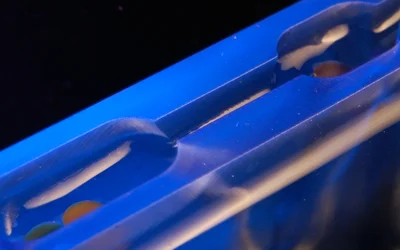
Taking advantage of low-cost, high-resolution desktop resin 3D printers combined with PDMS soft-lithography we have developed an optimised microfabrication pipeline capable of generating a wide variety of customisable devices for cell culture and tissue engineering in an easy, fast reproducible way
Tough PLA is one of the easiest to use, most functional, and most popular materials Ultimaker sells. If you’re not convinced yet, here are some great reasons you should be using it.
For anyone with a 3D printer, a flex filament can provide some unique advantages to your prints. We focus on the most flexible filament available in our portfolio: TPU. Let’s take a look at its properties, how to print it, and the different applications made possible by this material.
Most beginners start their 3D printing journey by downloading 3D models from the internet. But knowing how to make a 3D model for printing using CAD software opens up a world of possibilities.
When setting up your 3D printer for the first time or swapping out components, knowing how to perform E-step calibration is vital for ensuring the right amount of filament gets extruded.
Polyjet is a 3D printing technology that offers great accuracy and uniquely allows you to alter the part’s material properties in different places on the build. For the right part or prototype Polyjet is a great option, but understanding the capabilities and limitations is key.
A young team with a new technology are currently creating a revolution in the world of printed electronics. In their modern, brand-new lab at the High Tech Plaza, they will be developing a device that can deposit any material on any substrate at a very rapid pace.