What is 3D printer filament made of? This guide examines polymers, additives, and composites, offering practical tips for digital design and hardware engineers.
Discover how to print with high-performance filaments like PEEK, PEKK, and ULTEM. Learn about their properties, hardware needs, challenges, and best practices for industrial-grade 3D printing.
Explore how 3D-Fuel's Pro PCTG filament advances additive manufacturing, offering higher impact strength, improved environmental resistance, and reliable printability for functional and industrial 3D printing applications.
3devo's next-generation desktop extruder combines industrial precision with lab-scale simplicity enabling more controlled, higher-performance and data-driven 3D printing material workflows.
Is 3D printing the future of construction? Can it really become an alternative to traditional construction techniques in the future? That’s what we are going to see!
In the near future, 3D bioprinting will allow medical professionals to engineer and 3D print patient-specific organs for organ transplants in a few hours.
Fueled by computational modeling and the ability to synthesize data and leverage it within a design, coupled with technology to create complex geometries, industries are able to deliver more cost efficient parts without sacrificing performance.
Mass customization: production strategy aimed at satisfying customer needs while preserving the efficiency of mass production. At .Zero here's how we view mass customization, and how we are using nTop Platform helps us achieve it successfully.
AM lattices often have a down skin surface roughness different from the up skin one. The workflow shown below enables the design of a virtual “CAD with Designed Surface”. The latter has a surface roughness closer to the actual AM lattice, measured using X-ray Computed Tomography.
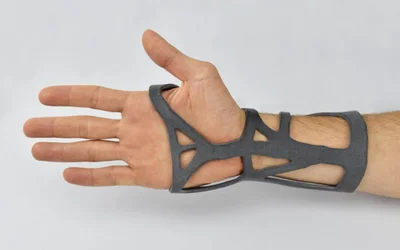
The presumption at the beginning of this project was that medical aids like orthosis and splints should not only reflect anatomical parameters and ergonomics but also the lifestyle, preferences, and taste of the user.
In our latest 3D printing podcast episode, we talk to Danielle Glasbergen-Benning, who is an Application Development Specialist for DSM Additive Manufacturing.
In our first episode, we visit L’Oréal headquarters in Clichy, France to chat with Matthew Forester, the company’s Additive Manufacturing Technical Manager.
Our third episode is an interview with key members of the Ultimaker team, who share their knowledge and insight into the evolving role of FFF 3D printing, in both manufacturing and design.