Featured
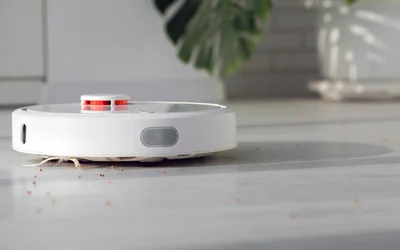
ToF is a vital tool for autonomous systems, industrial automation applications, and additional domains.
ToF is a vital tool for autonomous systems, industrial automation applications, and additional domains.
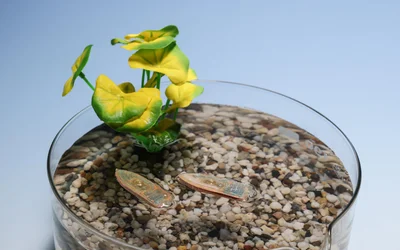
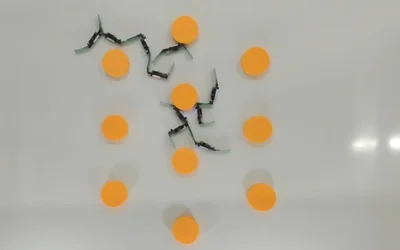
An edible robot made by EPFL scientists leverages a combination of biodegradable fuel and surface tension to zip around the water's surface, creating a safe - and nutritious - alternative to environmental monitoring devices made from artificial polymers and electronics.
This comprehensive article dives deep into the world of robotics, exploring the history, types, engineering components, applications, and future trends of robots, offering readers an in-depth understanding of how these remarkable machines work and shape our lives.
16 minutes read.
21 minutes read.
16 minutes read.
23 minutes read.
19 minutes read.
27 minutes read.


University
At the Harvard John A. Paulson School of Engineering and Applied Sciences (...
42 Posts

Robotics & Automation
READY Robotics is a robotics software company that vastly simplifies robot ...
24 Posts

Automation Machinery Manufacturing
We are a company in flying robotics, specializing in Non-destructive inspec...
23 Posts
Everyone, guess how fast is it?
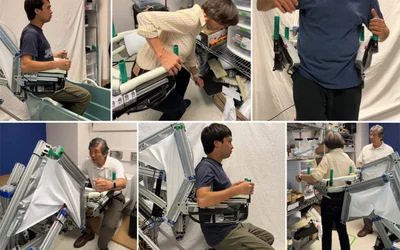
The new design could assist the elderly as they age in place at home.
The hospitality industry can leverage the gender characteristics of service robots to influence customers' decisions, according to new research from a team in the Penn State School of Hospitality Management.
Service robots have evolved from simple automated machines to intelligent adaptive systems that can navigate unpredictable environments and interact with humans.
Engineers at Princeton and North Carolina State University have combined ancient paper folding and modern materials science to create a soft robot that bends and twists through mazes with ease.
A research team from ETH Zurich and the University of Zurich (UZH) has developed a novel approach to treating spinal cord injuries: controllable microrobots deliver stem cells directly to the site of an injury, where they promote nerve cell regeneration.
Cornell engineers have developed a robotic collective that behaves less like a machine and more like a material that flows, reshapes and adapts to its environment without centralized control.
From hospital wards to crop fields, from microscopic swarms to biohybrid machines powered by fungi, robotics research at Cornell spans an astonishing range of scale, application and ambition.
ToF is a vital tool for autonomous systems, industrial automation applications, and additional domains.
Unlock unlimited sports potential
An edible robot made by EPFL scientists leverages a combination of biodegradable fuel and surface tension to zip around the water's surface, creating a safe - and nutritious - alternative to environmental monitoring devices made from artificial polymers and electronics.

3 minutes read
Explore how advanced computer vision technology transforms quality control in metal manufacturing and why it represents the industry's future.
In this episode, we explore the innovative fusion of robotics and culinary arts through the creation of RoboCake—an edible robotic wedding cake developed by researchers from EPFL

10 minutes read
A new method helps convey uncertainty more precisely, which could give researchers and medical clinicians better information to make decisions.
Service robots have evolved from simple automated machines to intelligent adaptive systems that can navigate unpredictable environments and interact with humans.
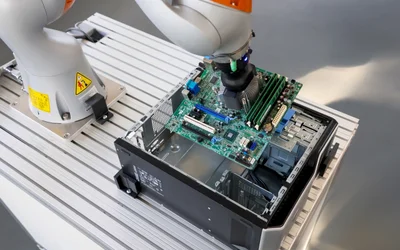
The Fraunhofer Institute for Factory Operation and Automation IFF (Fraunhofer IFF) is working to overcome challenges to e-waste disposal.
Studying a leaping, body-bending parasite thinner than a human hair led Georgia Tech engineers to create a soft robot that can hop forward and backward.

4 minutes read
A new approach could enable intuitive robotic helpers for household, workplace, and warehouse settings.
Unitree H1 Deep Reinforcement Learning In-place Flipping Parameters: Weight: about 50kg Height: about 1.8m Actuator: electric motor

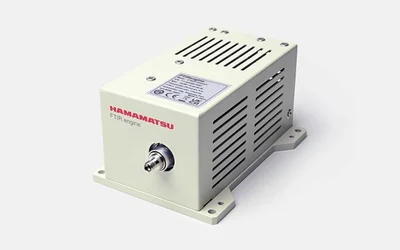
Hamamatsu Photonics introduces the FTIR Engine C16511-01, a state-of-the-art near-infrared spectrometer designed for rapid and accurate data acquisition in demanding industrial environments.
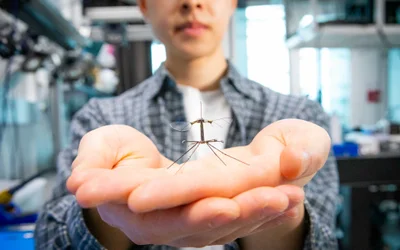
Microrobot gets crane fly-inspired legs for soft touchdowns

4 minutes read
Safe autonomy in various vehicle systems and in uncertain conditions.

4 minutes read
Could a robotic platform like the Ranger Mini be put to use helping someone with mobility issues?
6 minutes read