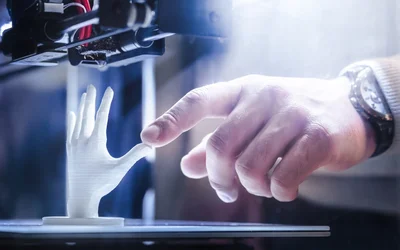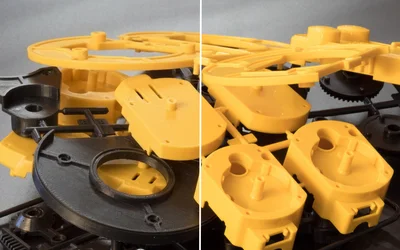


What is 3D printing? This article goes over the basics of 3D printing, otherwise known as additive manufacturing, covering its engineering principles and applications.

What is 3D printer filament made of? This guide examines polymers, additives, and composites, offering practical tips for digital design and hardware engineers.
With SCANOLOGY's KSCAN-X 3D scanner, wind turbine manufacturers can redesign blade core materials faster and more accurately than ever—cutting revision time from days to just 30 minutes.
Smarter technology, stronger performance.
Learn everything you need about the full adder circuit. From binary addition theory to low-power hardware implementations and modern ASIC/FPGA design flows, this technical article equips digital design engineers, hardware engineers with practical insights and current research trends.
Explore how a transistor works from first principles through practical circuit design. This in depth guide explains BJT and FET operation, switching and amplification modes, design calculations, modern market trends, and FAQs, ideal for digital design engineers, hardware engineers, and students.
Polycarbonate, a versatile thermoplastic known for its transparency, and impact resistance, is used in various industries for manufacturing parts through injection molding processes. However, despite its advantageous properties, polycarbonate injection molding comes with its own set of challenges.
INTAV SRL is an Italian company with more than 30 years of experience in designing and manufacturing luminous and acoustic warning devices for emergency, rescue, and operative vehicles.
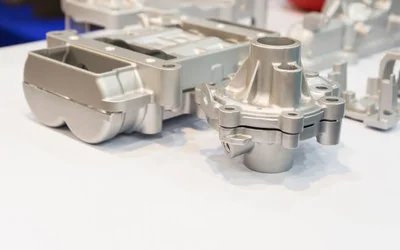
Electroforming enables engineers to produce complex, high-precision metal parts. This article helps engineers assess if Electroforming is a suitable solution and how to proceed with successfully transferring engineering design into high-quality components step by step.
Lightweight and inexpensive, miniaturized mass filters are a key step toward portable mass spectrometers that could identify unknown chemicals in remote settings.
Working on custom car projects Caracol has seen how large 3D printed mock-ups can help accelerate product development in the automotive industry, from concept design to fitting and production.
Researchers report that they have developed a new composite material designed to change behaviors depending on temperature in order to perform specific tasks. These materials are poised to be part of the next generation of autonomous robotics that will interact with the environment.
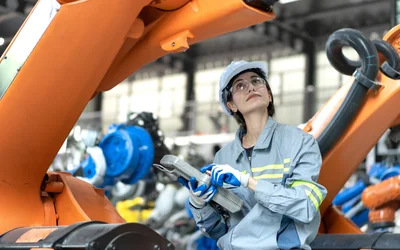
Working in a greenhouse is both strenuous and time-consuming. The picking robot from ETH spin-off Floating Robotics takes on particularly repetitive tasks, thereby alleviating the strain on human pickers. It is currently undergoing testing at Beerstecher AG in Hinwil.
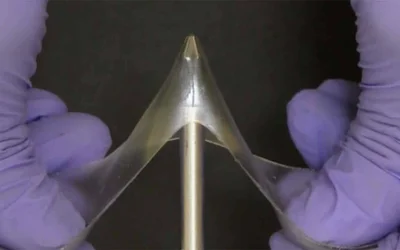
In this episode, we discuss an additive manufacturing breakthrough from MIT that enables inkjet printers to print soft materials that were deemed unsuitable before, print more accurately, and print ~660 times faster than comparable printer technologies!
The use of the Go!SCAN SPARK and VXmodel leads to significant improvements in the internal processes when carrying out projects at the Swiss company Sutter AG.