This article explores TPU vs GPU differences in architecture, performance, energy efficiency, cost, and practical implementation, helping engineers and designers choose the right accelerator for AI workloads today!
The landscape of IoT development is evolving rapidly, and staying ahead requires more than just technical know-how, it demands a strategic shift in how we approach building connected devices.
Discover how no-code/low-code platforms are transforming embedded development by enabling rapid prototyping and deployment with minimal coding. Explore tools like LabVIEW, Node-RED, and XOD that simplify IoT, automation, and industrial system design.
Teams that are looking at alternative programming languages have two options today: Ada and Rust. Both languages raise the bar in terms of safety and security
Join Prof. Fei Chen as he explores advanced bimanual manipulation and teleoperation techniques shaping the future of intelligent human-like robots in this expert-led robotics session.
The ETH spin-off Flink Robotics wants to revolutionize the handling of packages. Its founders Moritz Geilinger and Simon Huber have developed software that allows robots to work together and quickly take on new tasks.
As a cornerstone of artificial intelligence (AI), machine learning enables smart systems to perform increasingly complex cognitive tasks without requiring explicit instructions. One interesting application of modern machine learning is for high-accuracy gesture detection for portable devices.
Hyperganic, a company based in Munich, Germany, develops a software platform that uses artificial intelligence for the advanced design and engineering of highly complex components, structures and entire machines.
Whenever the word blockchain comes up, most people think of financial technology and cryptocurrencies. That's only the tip of this revolutionary iceberg, which is capable of much more than just bitcoin transactions.
In recent years, we have experienced the success of modern machine learning (ML) models. Many of them have led to unprecedented breakthroughs in a wide range of applications, such as AlphaGo beating a world champion human player or the introduction of autonomous vehicles.
Love is Blind's AI/data scientist Cameron Hamilton speaks with Rachel Gordon of MIT's Computer Science and Artificial Intelligence Laboratory on his AI company, finding love on the hugely popular Netflix show, and where he sees the future of digital dating.
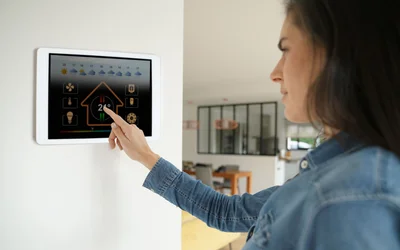
As the world becomes increasingly automated, the IoT (Internet of Things) is already transforming our domestic and business lives. Nowhere is this more apparent than in the use of AI and robotics in the manufacturing industry, with all the benefits offered by Industry 4.0.
If you’re unfamiliar with the term, GPS Waypoint Navigation is the ability to provide a robot with a set of GPS waypoints (i.e., a set of latitude / longitude pairs), and have the robot autonomously navigate from its current location to each of the defined waypoints.
For robots to keep up with the pace of technological innovation, machine learning has become paramount. While robots are already effective at alleviating the manual operation of routine tasks, an intelligent robot should also be able to process their commands with future actions in mind.
We are announcing the release of our state-of-the-art off-policy model-free reinforcement learning algorithm, soft actor-critic (SAC). This algorithm has been developed jointly at UC Berkeley and Google, and we have been using it internally for our robotics experiment.
Like its predecessor, JackRabbot 2 is learning how to navigate safely through spaces occupied by people, following the rules of human etiquette. What it learns could help it move comfortably among us in the future.