Featured
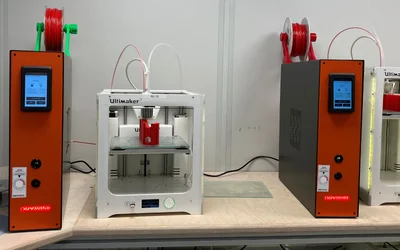
Applying Innovative Solutions to Improving Processes in Car Manufacturing – Ford Werke GMBH
This Report shows how tools like artificial intelligence, digital twins, and on-demand manufacturing are no longer emerging concepts, but are already delivering measurable impact across the product lifecycle.
Applying Innovative Solutions to Improving Processes in Car Manufacturing – Ford Werke GMBH
Article #4 of The Engineer’s Guide to 3D Printing with Wear-Resistant Plastic Materials.
Lightweight and inexpensive, miniaturized mass filters are a key step toward portable mass spectrometers that could identify unknown chemicals in remote settings.
An engineer’s guide to understanding the state of the art in metal 3D Printing
15 minutes read.
22 minutes read.
11 minutes read.
18 minutes read.
12 minutes read.
16 minutes read.


Entertainment
The Next Byte Podcast is hosted by two young engineers - Daniel and Farbod - who select the most interesting tech/engineering cont...
165 Posts
ADDITIV Medical 2026 will bring together more than 500 medical professionals
Choosing between 3D printing and injection molding is one of the key decisions in product development—especially in case of prototyping.
Explore how the right finishes and coatings can improve aerospace parts by boosting durability, extending service life, enhancing environmental resistance, and delivering the performance and appearance required for demanding applications.
The choice between 3D printing and CNC machining is the most common decision regarding manufacturing methods that must be made before placing the first order for prototypes. The correct answer depends on tolerance requirements, material specifications, component geometry, and schedule.
Discover how iAM Marketplace simplifies industrial additive manufacturing by unifying materials, validation services, and multi-brand technologies into one open ecosystem for efficient AM sourcing.
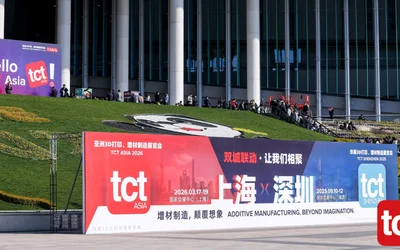
This article discusses what attendees can expect from TCT Asia 2026, including its conference format, focus areas, and the experts contributing to industry-specific discussions.
This article discusses the exhibitors, products, and industrial trends defining additive manufacturing across the Asia-Pacific region at TCT Asia 2026.
This article discusses how the Asia-Pacific region is advancing additive manufacturing and the role of TCT Asia as the leading 3D printing and additive manufacturing event in the Asia-Pacific.
Applying Innovative Solutions to Improving Processes in Car Manufacturing – Ford Werke GMBH

3 minutes read
Article #4 of The Engineer’s Guide to 3D Printing with Wear-Resistant Plastic Materials.
Lightweight and inexpensive, miniaturized mass filters are a key step toward portable mass spectrometers that could identify unknown chemicals in remote settings.
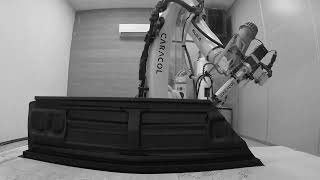
Working on custom car projects Caracol has seen how large 3D printed mock-ups can help accelerate product development in the automotive industry, from concept design to fitting and production.

New report: Examining the pivotal role of additive manufacturing in manufacturing, packaging, and transportation
Researchers report that they have developed a new composite material designed to change behaviors depending on temperature in order to perform specific tasks. These materials are poised to be part of the next generation of autonomous robotics that will interact with the environment.

2 minutes read
The technique represents an important step in engineering skin grafts, drug testing

3 minutes read
This article is aimed at providing an overview of surface finishes for 3D printed parts and helping you select the right option for your applications.

5 minutes read
In this episode, we discuss an additive manufacturing breakthrough from MIT that enables inkjet printers to print soft materials that were deemed unsuitable before, print more accurately, and print ~660 times faster than comparable printer technologies!

11 minutes read
Pensa recently added the Method XL 3D printer to its repertoire of 3D printers. Method XL joins its predecessors, Method and Method X, to give the team of designers and engineers a seamless 3D printing process aimed at boosting prototyping and R&D and scaling production.

4 minutes read
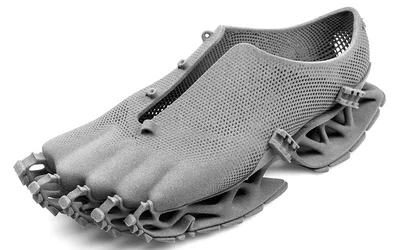
Thermoplastic Elastomer (TPE) offers a unique balance of flexibility and durability in 3D printing. Utilizing Selective Laser Sintering, it's ideal for various industrial applications, from footwear to machinery dampening.
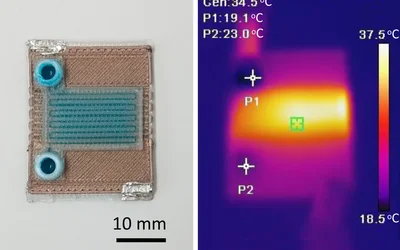
The one-step fabrication process rapidly produces miniature chemical reactors that could be used to detect diseases or analyze substances.
Article #3 of The Engineer’s Guide to 3D Printing with Wear-Resistant Plastic Materials.
Researchers have trained an artificial intelligence to design the structure of so-called metamaterials with desired mechanical properties for a wide range of applications.

4 minutes read
Designing waterproof enclosures for electronics is a blend of choosing the right materials, like ABS, and paying attention to details.