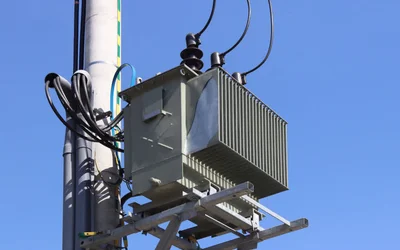
Modern electronics and renewable energy systems depend on DC to AC inverters that convert a DC source into a clean sinusoidal AC output. This technical article explains the theory behind inverter circuits, their types, architectures, and practical design tips.

As lithium-ion batteries power more vehicles and energy systems, the risk of thermal runaway grows. Honeywell's BES LITE detects electrolyte vapors at the first vent stage, enabling rapid intervention to prevent failures, protect assets, and ensure safety compliance.

New technology from Reeja Jayan in the department of mechanical engineering at Carnegie Mellon University extends battery life cycle by 10x, reduces charging time, and improves operating safety.
This article is a detailed exploration of crystalline vs amorphous solids, covering atomic order, materials properties, semiconductors, and how they translate into practical semiconductor, hardware and digital design applications.
These devices could pack three times as much energy per pound as today's best EV batteries, offering a lightweight option for powering trucks, planes, or ships.
Development of technology to enable use of hydrogen as a fuel to power turbines, engines, boilers, etc., safely and efficiently is already underway. This first approach is suitable for applications where comparatively large output is required.
With the U.S. government’s goal to reduce emissions from transportation as part of a net-zero climate goal by 2050, efficient and reliable batteries are a necessity.
According to the Global EV Outlook from IEA, the EV stock reaches 145 million in 2030, accounting for 7% of the road vehicle fleet. However, one of the main challenges facing EVs is the battery, which determines the performance, range, safety, and cost of the vehicle.
In the blink of an eye, the unruly, superheated plasma that drives a fusion reaction can lose its stability and escape the strong magnetic fields confining it within the donut-shaped fusion reactor.
Many consider geothermal to be an around-the-clock clean energy resource, but according to a Princeton-led study in collaboration with startup Fervo Energy, operating new geothermal plants flexibly could provide the best value for the grid.
Rechargeable batteries are an important part of many modern-day technologies. Researchers, manufacturers and end-user companies are always looking to improve the efficiencies of batteries, making them safer, smaller, and more lightweight to fit in the requirements of new technologies
Energy materials facilitate the conversion or transmission of energy. They also play an essential role in how we store energy, reduce power consumption, and develop cleaner, efficient energy solutions.
Battery performance is crucial for the successful operation of IoT devices, particularly in remote or inaccessible locations. They rely on battery power to sustain their operation over extended periods, and maximizing battery life directly impacts longevity, maintenance costs, and user experience.
As the world looks to phase out fossil fuels in favor of cleaner, renewable energy sources, more effort is being put into improving existing renewable technologies and creating devices that can harness renewable energy sources in new ways.
Researchers at ETH Zurich have developed a sensor that utilises energy from sound waves to control electronic devices. This could one day save millions of batteries.
Princeton researchers have created an artificial intelligence (AI) tool to predict the behavior of crystalline materials, a key step in advancing technologies like batteries and semiconductors.
The findings could help engineers methodically find the best molecules to increase the lifespan of perovskite solar cells, rather than relying on time-consuming trial and error.
Polymer-air batteries often face challenges related to stability, kinetics and conductivity. In response, Dr. Jodie Lutkenhaus has developed a method to use a polymer as an anode in these batteries.