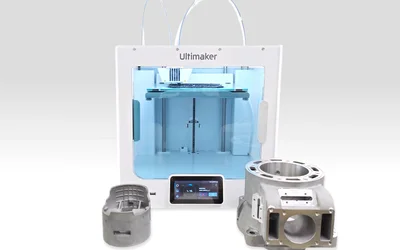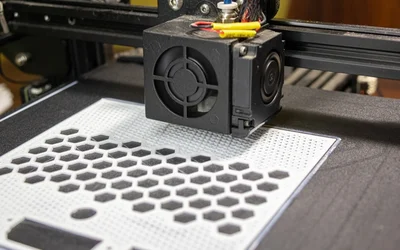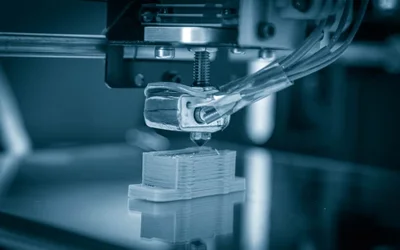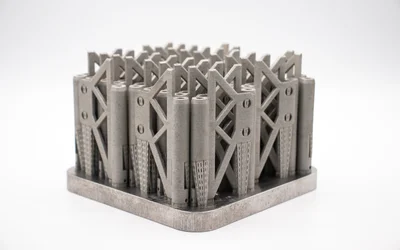
What is 3D printing? This article goes over the basics of 3D printing, otherwise known as additive manufacturing, covering its engineering principles and applications.
E2IP Technologies manufactures Flexible Heaters using Screen Printing Technology. This is one of the most important segments of printed and additive electronics with applications in cars, homes, and industrial settings.
Here’s what to do if you notice clicking noises, under-extrusion, or other print quality issues caused by extruder skipping on the Ender 3 by Creality.
Unwanted lines in 3D prints can show up for many reasons and take different forms. Here we look at the most common types of lines in 3D prints and how to eliminate them.
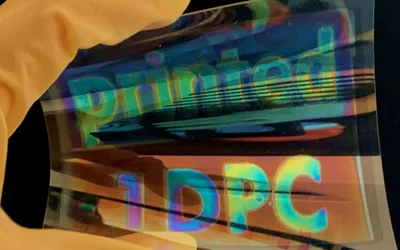
KIT researchers are developing a process with which, for the first time, mirrors with a reflection of more than 99 percent can be printed in variable sizes
The Right-to-Repair movement is making waves, pushing for greater access to spare parts and repair options. However. many companies are uncertain about how to meet this growing demand. One promising solution lies in the potential of 3D printing.
This article delves into the foundational concepts of encoders, their various types, recent advancements, seamless integration with modern systems, and how they are revolutionizing industries.
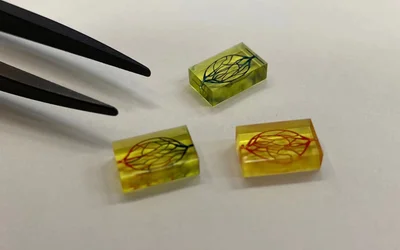
Resin-based 3D printing is often the preferred method for parts with intricate designs, as well as small or miniature parts or those with fine features. In this design tip, we explore the key benefits this process has.
As we advance into the age of electric vehicles, new technologies continue to drive competition in the global automotive industry. As always, manufacturing companies are racing each other to produce quality vehicles and still make their profits.
3D printing has revolutionized small-scale production, but choosing the right material remains a significant challenge due to the vast array of options. Replique’s Material Hub addresses this issue, simplifying and optimizing the material selection process.
MAN Truck & Bus is embracing Replique’s production platform to manufacture spare parts on-demand. Starting with the production of bronze manifolds for the cooling water supply of a marine engine, MAN aims to undertake further projects in the future to reduce costs and further optimize their service.
3D printing plays a crucial role in STEAM education by providing a tangible way for students to experience the interconnectedness of various disciplines and develop a wide range of skills.
In the dynamic landscape of automotive manufacturing, innovation has focused mostly on delivering greater efficiency, automation, sustainability, and flexibility. Large Format 3D printing is a cutting-edge technology that promises to reshape how vehicles are prototyped, manufactured and customized.
3D printing from pellets meets robotics to deliver tangible benefits on parts and applications across sectors. With no limits in scale, shape or material, Caracol's LFAM technology enhances efficiency through continuity, flexiblity, and sustainability to your production.
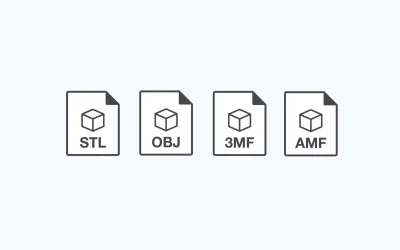
A concise guide to the different file formats available for 3D printing technologies, including STL, OBJ, AMF, 3MF, and what their role is in the AM process.
This article summaries all the factors to take into account when choosing between Injection Molding and 3D Printing, from design complexity to surface finish.
Researchers at MIT used a Voltera NOVA to successfully print field electron emitters with a high-concentration carbon nanotube ink. The research has exciting implications for small satellites.
Build time, finishing time, supports, and part volume are all a variety of factors that can affect the pricing of a part. By factoring these considerations into your design, you can minimise the cost of your parts and improve overall part quality.
PCBs printed onto flexible substrates demonstrate huge potential across a range of industries. But what are the materials used to make these printed devices?
Companies are always seeking to streamline processes, enhance precision, and reduce the risk of human error. So much so that more manufacturers are turning to 3D printing to create custom jigs and fixtures, making them one of the most powerful applications for additive technology.