Featured
Benton Calhoun SM '02 PhD '06 and David Wentzloff SM '02 PhD '07 are co-founders of Everactive, which uses wireless sensing to provide continuous remote monitoring for the industrial internet of things.

Benton Calhoun SM '02 PhD '06 and David Wentzloff SM '02 PhD '07 are co-founders of Everactive, which uses wireless sensing to provide continuous remote monitoring for the industrial internet of things.
Benton Calhoun SM '02 PhD '06 and David Wentzloff SM '02 PhD '07 are co-founders of Everactive, which uses wireless sensing to provide continuous remote monitoring for the industrial internet of things.
In this episode, we talk about the benefits of an artificial nose, how to turn wastewater into energy while filtering it, and a proposal from ETH Zurich to change how we think about drought insurance.
In this episode, we talk about a research from Penn State that has proven the concept of printing tissue during surgery, a joint effort between MIT & Harvard to develop a hair brushing robot, and a breakthrough in anode free and sodium based batteries coming out of Washington University in St. Louis
The motor control center puts the starters, protection and controls for many electric motors into one lineup of cabinets. This guide explains what it is, how it is built, how it differs from switchgear and a VFD, and what current standards expect for safety and maintenance.
17 minutes read.
13 minutes read.
13 minutes read.
17 minutes read.
16 minutes read.
16 minutes read.


Electrical and Electronic Manufacturing
Drop-in power cords that improve battery performance.
18 Posts

University
KIT is one of the biggest research and education institutions worldwide and...
17 Posts

University
For almost two centuries DTU, Technical University of Denmark, has been ded...
16 Posts
Developers report equivalent capacity, first-cycle efficiency, fast charging, and an estimated 130 kg less direct CO₂e per tonne of coated graphite.
A solid oxide fuel cell converts fuel directly into electricity through a ceramic electrolyte that conducts oxygen ions at high temperatures. This guide covers the electrochemistry, the material choices, where the efficiency really comes from, and the degradation mechanisms.
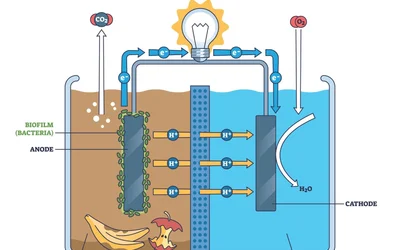
A microbial fuel cell turns the metabolism of living bacteria into an electrical current. This guide covers the electrochemistry, microbiology, materials, real performance numbers from pilot plants, and the economics that still keep the technology out of mainstream power generation.
A PEM fuel cell converts hydrogen and oxygen into electricity at around 80 degrees C, with water and heat as the only products. This guide covers electrochemistry, layer materials, efficiency limits, and cost and durability to help you understand the practical applications of this technology.
This article explains how load cells work, the main types, what accuracy specs and OIML/NTEP classes mean, and best practices for sizing, wiring, and installation.
Benton Calhoun SM '02 PhD '06 and David Wentzloff SM '02 PhD '07 are co-founders of Everactive, which uses wireless sensing to provide continuous remote monitoring for the industrial internet of things.
In this episode, we talk about the benefits of an artificial nose, how to turn wastewater into energy while filtering it, and a proposal from ETH Zurich to change how we think about drought insurance.

In this episode, we talk about a research from Penn State that has proven the concept of printing tissue during surgery, a joint effort between MIT & Harvard to develop a hair brushing robot, and a breakthrough in anode free and sodium based batteries coming out of Washington University in St. Louis
One-of-a-kind tool helped solve anode puzzle that thwarted previous attempts
In this episode, we talk about MIT’s lobster inspired armor, wireless charging of electric vehicles, and a joint effort between RE2 Robotics and the US Department of Energy Solar Energy Technologies Office to reduce the set up time/cost of solar farms.
A change in form enables a discrete and distributed network of power storage.

6 minutes read
The thin-film lithium-ion batteries used in microdevices such as portable and medical electronics may supply a good amount of power relative to their mass, but do not provide enough power for many devices due to their limited size.
Article 4 of the Power Conversion Series. Shunt resistors combined with a current-sense module can deliver highly accurate battery management systems in high-energy applications.

6 minutes read
Article 3 of the Power Conversion Series. Battery Management Systems (BMS) monitor essential safety factors in high-energy battery packs.
8 minutes read
Article 2 of the Power Conversion Series. Rechargeable batteries provide untethered power, enabling convenience, dependability, and mobility. Unplug and recharge and learn how rechargeable battery technology makes life better.
11 minutes read
By studying different types of electric cars, batteries, charging profiles, and habits of users, scientist have suggested a rational model for charging electric vehicles with minimal load on the electric grid.

5 minutes read
In this episode, we talk about Nissan’s new 50% thermally efficient internal combustion engine, the first 3D printed home for sale in the United States, and how NYPD is adding Boston Dynamic Spot robots to the police force.
In this episode, we talk about cutting vehicle emissions testing using IoT devices, creating shape memory textiles from recycled wool, and an initiative to develop hydrogen fuel cell powered airplanes.
Vast majority of active particles in battery holds no share, instead, current is concentrated in ‘hot spots’ dictated by electrochemical phase transformation
Article 5 of our Energy Storage Series: Reducing cost is during the final stages of battery manufacturing can assist the migration to electric vehicles.
5 minutes read