Featured
Similar to visual data, collecting and curating sound data that accurately reflects real-world scenarios is a major hurdle in training effective machine learning models.

Similar to visual data, collecting and curating sound data that accurately reflects real-world scenarios is a major hurdle in training effective machine learning models.
Similar to visual data, collecting and curating sound data that accurately reflects real-world scenarios is a major hurdle in training effective machine learning models.
When it comes to the IoT and smart environments, designers have a big job. They must integrate wireless connectivity with strict security measures.
‘Industry 4.0’—the next stage of the Industrial Revolution—leans heavily on the Industrial Internet of Things (IIoT) to support large scale automation of traditional manufacturing practices.
What a programmable automation controller is, how PACs are built and programmed, and how to choose between a PLC and a PAC.
15 minutes read.
13 minutes read.
17 minutes read.
16 minutes read.
14 minutes read.

Semiconductors
Nordic Semiconductor is a fabless semiconductor company specializing in wireless technology that powers the IoT.
181 Posts

High Tech
High Tech Campus Eindhoven is Europe's smartest square km and has the ultim...
49 Posts

University for science and technology
Freedom and individual responsibility, entrepreneurial spirit and open-min...
43 Posts

Higher Education
Work together. Create smart machines. Serve society. University of Michiga...
40 Posts
How Embedded Systems, AI, and Human-Centered Design Are Driving the Future of Robotics
Learn why teams still lose half their development time to test and fix, and what changes when you get real visibility into the target.
From simple sensor control to connected, intelligent devices, embedded systems often outgrow a single MCU. Pairing an MCU with Linux adds power and flexibility, but also introduces communication challenges, dual development workflows, and increasing software complexity.
This article explores how automated CI/CD pipelines replace fragile manual build processes with reproducible, auditable workflows that improve compliance, reduce defects, and accelerate development in regulated embedded systems
Mario Mauerer, maxon's Global Business Development Manager, Robotics, discusses what it takes for robotic deployments to be successful in complex real-world environments.
Join Prof. Fei Chen as he explores advanced bimanual manipulation and teleoperation techniques shaping the future of intelligent human-like robots in this expert-led robotics session.
'Link-bots' can move, explore, cooperate without sensing or computation
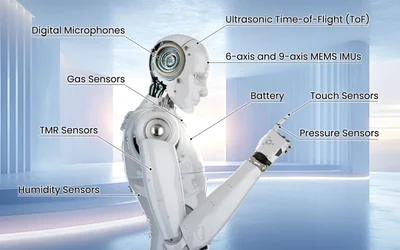
This article is part 4 of a 4-part article series on TDK's advanced robotics.
Similar to visual data, collecting and curating sound data that accurately reflects real-world scenarios is a major hurdle in training effective machine learning models.

2 minutes read
When it comes to the IoT and smart environments, designers have a big job. They must integrate wireless connectivity with strict security measures.

5 minutes read
‘Industry 4.0’—the next stage of the Industrial Revolution—leans heavily on the Industrial Internet of Things (IIoT) to support large scale automation of traditional manufacturing practices.

4 minutes read
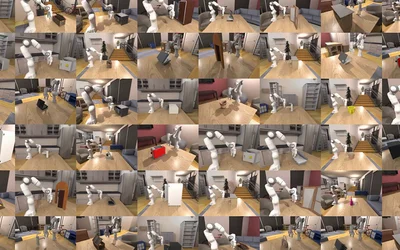
For robots, simulation is a great teacher for learning long-horizon (multi-step) tasks — especially compared to how long it takes to collect real-world training data.
An expert in global positioning technologies looks ahead to expand GPS’s capabilities to the moon and, perhaps, beyond.

21 minutes read
To access information and services quickly and reliably, companies across all sectors are more invested in connectivity, which entails faster, more reliable networks and better encryption and security.
4 minutes read
MIT CSAIL researchers developed an AI-driven approach to “low-discrepancy sampling,” a method that improves simulation accuracy by distributing data points more uniformly across space.
High-frequency circuits-like those utilized in microcells and DAS-are more sensitive to PCB material selection, fabrication, and assembly.

8 minutes read
In Circuit Showdown, contestants must regroup after setbacks as they face a surprise twist in the industrial automation challenge. With only 4 hours to get it all done, their resilience is put to the test.
Circuit Showdown pits three engineering students against each other in a high-pressure design competition. With just four hours to build projects from scratch, they must showcase creativity and technical skills to impress the judges and win $40,000 in prizes.
A new method called Clio enables robots to quickly map a scene and identify the items they need to complete a given set of tasks.
The term "smart building" refers to buildings with a building management system that automatically manages and controls various types of energy used in the building, such as lighting, air-conditioning, and water heating, using technologies such as IoT and AI.

6 minutes read
Beyond 5G (5th generation and later mobile communications system: hereinafter “B5G”) / 6G (6th generation mobile communications system) is expected to be applied and spread in popularity as a new form of information communications infrastructure from the 2030s.
5 minutes read
The "smart home" is a near future housing concept that utilizes advanced information processing technologies to improve the efficiency and prosperity of life.
9 minutes read
Recap of the Third Annual Showcase of Smart Mobility

9 minutes read