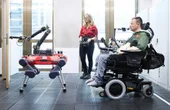
Columbia Engineering wins a new grant from the National Oceanic and Atmospheric Administration to develop AI-system for sustainable waterways and ocean health
This article delves into the key difference between PLC and DCS, providing a clear framework for choosing the appropriate technology for specific applications, and finally decoding the automation divide.
Explore IoT security solutions with insights into the threat landscape, secure architectures, and best practices for engineers building resilient connected systems.
This article explores how automated CI/CD pipelines replace fragile manual build processes with reproducible, auditable workflows that improve compliance, reduce defects, and accelerate development in regulated embedded systems
Join Prof. Fei Chen as he explores advanced bimanual manipulation and teleoperation techniques shaping the future of intelligent human-like robots in this expert-led robotics session.
The ETH spin-off Flink Robotics wants to revolutionize the handling of packages. Its founders Moritz Geilinger and Simon Huber have developed software that allows robots to work together and quickly take on new tasks.
Columbia Engineering wins a new grant from the National Oceanic and Atmospheric Administration to develop AI-system for sustainable waterways and ocean health
This article delves into the key difference between PLC and DCS, providing a clear framework for choosing the appropriate technology for specific applications, and finally decoding the automation divide.
Agriculture has been a vital part of human history for over 12,000 years, marking a significant transition from hunting and gathering. Although the exact reasons for this shift are not clear, one theory suggests it was driven by the need for a more efficient way to obtain food.
Imagine an industrial plant where machines autonomously predict maintenance needs and optimize operations. Such efficiency is powered by IoT architecture. This guide breaks down the layers of IoT, from sensors collecting data to intelligent apps providing insights.
Whether you are in a lab or operating remotely, you need appropriate test resources, with the emphasis on accuracy, flexibility, portability and affordability.
The moonshot of many roboticists is cooking up the proper hardware and software combination so that a machine can learn “generalist” policies (the rules and strategies that guide robot behavior) that work everywhere, under all conditions.
Nordic supports cellular IoT asset tracking applications by supplying an end-to-end cellular IoT platform which brings simplicity, stability and cost efficiency to cellular IoT design, manufacture and deployment.
Even if you’re not very familiar with deep learning, you’ve probably heard about it and how it can, among
other things, help automate the driving experience, increase manufacturing efficiency and change the consumer
shopping experience.