Modbus RTU vs TCP: A Comprehensive Comparison of Industrial Protocols
Understanding the differences between Modbus RTU and Modbus TCP/IP is essential for designing reliable and scalable control systems. This indepth guide compares the serial and Ethernet variants of the Modbus protocol, explains their strengths and weaknesses, and provides practical advice for engine

Last updated on 31 Oct, 2025. 14 minutes read

Head Engineer monitoring plant data using SCADA, through HMI
Key Takeaways
Modbus RTU and Modbus TCP share the same protocol, with identical core commands and register models, differing only in framing, communication media, and network setup.
Modbus RTU utilizes serial communication (RS-232/RS-485) with a two-byte CRC for error checking, providing simplicity, determinism, and low cost, but at the expense of limited speed and scalability.
Modbus TCP wraps the same messages inside TCP/IP packets with an MBAP header, using Ethernet error detection to provide higher data rates and flexible network topologies.
Neither protocol includes built-in security, but the new Modbus Security spec adds TLS encryption and certificate authentication while requiring extra protections like VPNs and network segmentation.
Choosing between RTU and TCP depends on factors like speed, device count, distance, integration complexity, and cost, with hybrid gateway solutions enabling combined use of both protocols.
Introduction
Modbus is one of the most enduring communication protocols in industrial automation. Created by Modicon (now part of Schneider Electric) in 1979, the protocol was designed to allow programmable logic controllers (PLCs) to exchange data with external devices. Modbus has since become an open, royalty‑free standard and is ubiquitous in manufacturing, building automation, smart grids and the Industrial Internet of Things (IIoT). Its simplicity, deterministic behaviour and widespread support make it attractive for engineers designing control systems, data acquisition modules and hardware devices.
The protocol comes in multiple variants, the most common being Modbus RTU and Modbus TCP. Although they share the same data model and function codes, their communication media and framing differ significantly. RTU uses serial links (RS‑232, RS‑485 or RS‑422), while TCP packages Modbus messages into Ethernet frames.
What is the Modbus protocol?
Client–Server Architecture and Registers
Modbus follows a client‑server (formerly master–slave) model. A single client initiates requests, and one or more servers respond. Communication is polling‑based; servers never send unsolicited messages. Up to 247 servers can exist on a network, each identified by an address (1–247). The protocol defines a simple data model with four primary register types:
Register type | Access | Typical use |
Coils | Read/write | On/off outputs, e.g., motor control |
Discrete inputs | Read only | Digital inputs, such as limit switches |
Holding registers | Read/write | Analogue values or configuration parameters |
Input registers | Read only | Measured analogue values (e.g., temperature) |
The function codes (1–127) specify operations such as reading coils (FC 1), reading holding registers (FC 3), writing a single coil (FC 5) or writing multiple registers (FC 16). Both RTU and TCP use the same function codes and data model; the difference lies in how these messages are encapsulated and transported.
Message framing and PDU
A Modbus request or response can be broken down into two parts:
Protocol Data Unit (PDU): Contains the function code and data fields. This is identical across all Modbus variants.
Application data unit: Adds transport‑specific header and trailer fields.
In Modbus RTU, a frame begins with a silent interval of at least 3.5 character times, followed by the device address, function code, data, and a two‑byte cyclic redundancy check (CRC) for error detection.
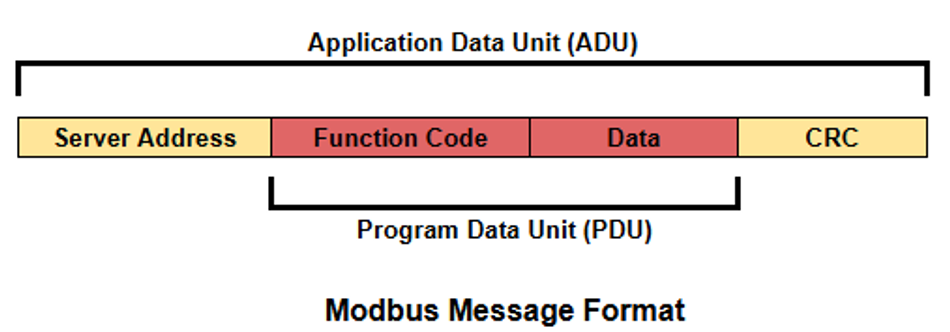
Modbus RTU
Physical layers: RS‑232, RS‑485 and RS‑422
Modbus RTU is a binary serial protocol. Historically, it used RS‑232 links; however, the limited range (about 10 ft at 38.4 kbaud) makes RS‑232 suitable only for short distances.
The introduction of RS‑485 greatly expanded Modbus RTU's applicability: it supports multi‑drop communication (multiple devices on the same bus), increases the range up to 4,000 ft (≈1,200 m), and allows baud rates up to 115.2 kbaud. RS‑422 is similar but supports full‑duplex communication.
Modern RS‑485 transceivers allow up to 32 servers on the bus without repeaters; repeaters can increase this to 247 devices. A typical RS-485 network employs a daisy-chain topology, where devices are connected in series on a twisted-pair cable. The network must be terminated with 120 Ω resistors at each end to minimize reflections.
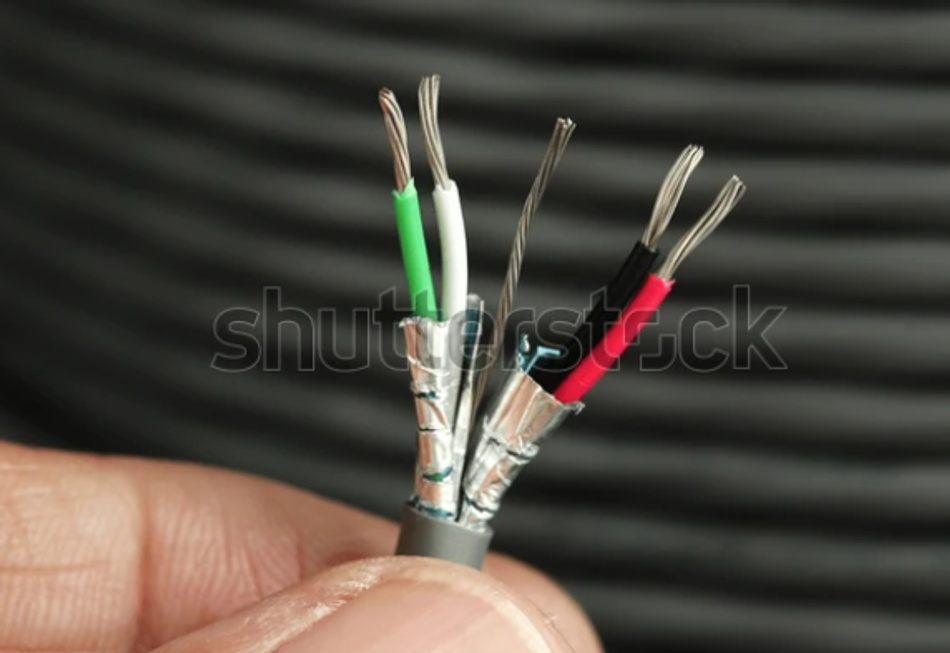
Shielded twisted‑pair cable (e.g., Belden 3105A) helps reduce electromagnetic interference. The line must be properly grounded, and cable runs should avoid parallel routing with high‑voltage power lines.
Frame Structure and Error Detection
RTU frames include the following fields:
Address (1 byte): Identifies the server (1–247).
Function code (1 byte): Specifies the operation (read/write). User‑defined codes (128–255) are possible.
Data (0–252 bytes): Contains register addresses, quantity and values.
CRC (2 bytes): A 16‑bit cyclic redundancy check computed over the entire frame (excluding the CRC field). The receiver recomputes the CRC and discards the message if the values do not match.
The start and end of a frame are indicated by a silent interval of at least 3.5 character times (equivalent to ~3.5 bit times). Any gap shorter than this is treated as part of the frame. This simple framing method makes RTU easy to implement but imposes strict timing requirements on the host firmware.
Advantages of Modbus RTU
Simplicity and determinism. RTU's binary encoding is compact and easy to parse; deterministic polling and half‑duplex communication mean response times are predictable. This is valuable in real‑time control systems where timing must be bounded.
Low hardware cost. RS‑485 transceivers are inexpensive; microcontrollers can implement RTU without an Ethernet controller or IP stack, reducing the bill‑of‑materials cost. Many legacy devices still use RS‑485, making RTU ideal for retrofits.
High noise immunity. Differential signalling and twisted‑pair cabling make RS‑485 robust in electrically noisy environments. Proper shielding and termination further improve noise rejection.
Physical security. Serial cables are difficult to access remotely, reducing exposure to cyber‑attacks.
Limitations of Modbus RTU
Limited speed and bandwidth. RS‑485 communication typically operates from 1.2 kbaud to 115.2 kbaud. This is adequate for small data payloads but insufficient for high‑frequency sampling or large data sets.
Limited distance and device count. Without repeaters, RS‑485 networks support only 32 devices and distances up to 1 200 m. Repeaters increase capacity but add latency and cost.
Fixed polling scheme. Only one client (master) can initiate communication at a time; servers cannot spontaneously send data. This can introduce delays when many devices share the bus.
No inherent security. RTU provides no encryption or authentication; if an attacker gains physical access to the cable, they can eavesdrop or inject messages. Additional physical and procedural controls are necessary.
Suggested Reading: Understanding Baud Rate: Why is it Important?
Practical Implementation Tips
Termination and biasing: Place 120 Ω resistors at the ends of the RS‑485 bus and use bias resistors to establish a known idle state. Many RS‑485 transceivers integrate biasing; verify your design.
Isolation: Use opto‑isolators or isolated transceivers to prevent ground loops and protect circuits from high common‑mode voltages.
Polling interval: Choose a polling rate that balances data freshness and bus utilization. Too frequent polling can saturate the bus; too infrequent polling increases latency.
Address management: Assign unique device addresses and document them clearly. Avoid addresses 0 and 255, which are reserved.
Coding libraries: Libraries like libmodbus (C/C++) or PyModbus (Python) simplify implementation. For example, reading holding registers in Python:
from pymodbus.client import ModbusSerialClient
client = ModbusSerialClient(
    method='rtu', port='/dev/ttyUSB0', baudrate=9600, timeout=1)
client.connect()


# read 4 holding registers starting at address 100
response = client.read_holding_registers(address=100, count=4, unit=1)
print(response.registers)
client.close()
This code opens a serial connection, reads four registers, and prints their values. Error handling and retries should be added for production use.
Further Reading: Modbus RTU: A Comprehensive Guide to Understanding and Implementing the Protocol
Modbus TCP
Ethernet and IP layers
Modbus TCP (often called Modbus TCP/IP) adapts the Modbus protocol for Ethernet networks. It encapsulates the Modbus PDU within TCP/IP packets and introduces a Modbus Application Protocol (MBAP) header. The MBAP header contains:
Transaction identifier (2 bytes): Matches requests and responses.
Protocol identifier (2 bytes): Always set to 0 to indicate Modbus.
Length field (2 bytes): Number of bytes following the header.
Unit identifier (1 byte): Equivalent to the RTU address, used by gateways to route messages.
Because TCP/IP handles error detection and retransmission via checksums and sequence numbers, Modbus TCP omits the CRC field found in RTU. Ethernet frames include a Frame Check Sequence (FCS) (CRC‑32), IP uses a header checksum, and TCP includes its own 16‑bit checksum and automatic retransmission on error. Consequently, Modbus TCP communication is reliable without adding application‑layer error checks.
Network Topologies and Addressing
Modbus TCP uses standard Ethernet and supports 10 Mb/s, 100 Mb/s, 1 Gb/s or higher data rates. It can run over copper (Cat‑5/Cat‑6), fibre optics or wireless networks. Devices connect to switches or routers in a star, tree, ring or mesh topology. Each device has a unique IP address, making network management straightforward.
The protocol is connection‑oriented: the client opens a TCP socket to the server’s IP address (default port 502). Multiple concurrent client connections can be established, allowing multiple clients to access the same server simultaneously (subject to the server’s capacity). Response times are typically tens of milliseconds, much faster than serial communication.
Advantages of Modbus TCP
High throughput and scalability. Ethernet supports orders‑of‑magnitude higher bandwidth than serial links. Many devices can share the network without collisions thanks to modern switches and full‑duplex communication.
Flexible topologies. Star and mesh topologies simplify wiring and allow easy network expansion.
Remote access. TCP/IP enables communication over wide‑area networks and the Internet. Devices can be monitored or controlled from remote locations. This is essential in distributed systems such as smart grids and building automation.
Easy integration. Because Modbus TCP runs on the standard TCP/IP stack, it integrates seamlessly with existing IT infrastructure. Off‑the‑shelf Ethernet switches and routers reduce installation cost.
Support for multiple clients. Unlike RTU’s single‑client limitation, TCP allows several clients to simultaneously access a server, enabling advanced HMI/SCADA systems.
Limitations of Modbus TCP
Higher hardware cost and complexity. Devices require an Ethernet PHY/MAC, larger buffers, and a TCP/IP stack, increasing hardware resources and software complexity. This may be impractical for low‑cost microcontrollers.
Security vulnerabilities. Ethernet networks are more exposed to cyber‑attacks. Modbus TCP offers no native encryption or authentication. Without proper segmentation and security controls, attackers can eavesdrop or send unauthorized commands. A Modbus Security specification adds TLS encryption and certificate‑based authentication, using port 802 and X.509 certificates, but adoption remains limited.
Real‑time performance considerations. TCP/IP introduces variable latency due to congestion, routing and retransmission. For deterministic control, some applications prefer dedicated real‑time Ethernet protocols like EtherCAT or PROFINET. Modbus TCP is considered connectionless; it lacks cyclic data exchange and therefore is less predictable than real‑time fieldbuses.
Broadcast limitations. Ethernet broadcast storms or misconfigured networks can affect Modbus TCP performance. Careful network design and quality‑of‑service (QoS) settings are necessary in critical applications.
Practical implementation tips
Network infrastructure: Use industrial‑grade switches and routers with QoS settings. Avoid unmanaged switches in mission‑critical systems.
IP addressing: Assign static IP addresses to devices or use DHCP with reservations. Document addresses to avoid conflicts.
Port configuration: Modbus TCP uses port 502. When using Modbus security, open port 802 and deploy TLS certificates on clients and servers.
Segmentation and firewalls: Isolate the control network from the corporate network. Deploy firewalls, VPNs and intrusion detection systems to protect against remote attacks.
Software libraries: Libraries like libmodbus or PyModbus support Modbus TCP. For example, reading holding registers over TCP in Python:
from pymodbus.client import ModbusTcpClient
client = ModbusTcpClient('192.168.1.100', port=502)
client.connect()
# read 4 holding registers starting at address 100
response = client.read_holding_registers(address=100, count=4, unit=1)
print(response.registers)
client.close()
Combine with RTU via gateways: Protocol converters can translate between TCP and RTU. This allows modern Ethernet‑based systems to communicate with legacy serial devices.
Further Reading: Modbus TCP: A Comprehensive Guide to the Protocol and Its Applications
Comparative Analysis: Modbus RTU vs Modbus TCP
The following table summarizes the key differences between the two protocols based on the factors discussed:
Feature | Modbus RTU | Modbus TCP |
Communication medium | Serial (RS‑232/RS‑485) | Ethernet/IP |
Data rates | 1.2 kbaud – 115.2 kbaud | 10 Mb/s – 1 Gb/s or higher |
Maximum distance | ~1200 m (4 000 ft) without repeaters | 100 m per segment for copper; effectively unlimited with switches/routers |
Topology | Daisy chain/multi‑drop | Star, tree, ring, mesh |
Number of servers | 32 per bus; up to 247 with repeaters | Limited by IP address space; typically hundreds or thousands |
Message framing | Device address, function code, data and CRC | MBAP header + PDU; no CRC |
Error detection | 16‑bit CRC at application layer | Ethernet FCS, IP and TCP checksums |
Security | No native encryption; physical security only | No native encryption; optional TLS (Modbus Security) |
Implementation complexity | Simple hardware; minimal software stack | Requires Ethernet PHY and TCP/IP stack |
Determinism | Predictable and deterministic due to polling | Less deterministic; subject to network congestion |
Use cases | Local control, legacy systems, cost‑sensitive applications | Distributed systems, remote monitoring, high‑bandwidth applications |
Suggested Reading: Industrial Communication Protection for RS-485 and Ethernet
Performance and timing
The performance difference between RTU and TCP is striking. On a serial RTU network, each transaction typically takes hundreds of milliseconds because the client must wait for silent intervals and slow baud rates.
In contrast, Modbus TCP uses Ethernet’s high bandwidth and can complete a request–response cycle in tens of milliseconds. The faster turnaround time makes TCP suitable for high‑speed process control or situations where many registers must be read or written frequently.
Scalability and network management
RTU networks are constrained by the 32‑device limit of RS‑485 transceivers and the complexity of daisy‑chain wiring. Expanding an RTU network requires careful planning, signal repeaters, and additional cabling.
Modbus TCP networks scale more gracefully: connecting another device often means plugging it into a switch port. IP addressing simplifies device management and allows centralised configuration.
However, large TCP networks require network administration expertise to configure routing, VLANs, and QoS policies.
Cost considerations
Hardware costs for RTU are low because serial transceivers and microcontrollers are inexpensive. Cabling cost increases with the number of devices because each bus is limited in length, and devices must be located physically close.
On the other hand, Ethernet hardware is slightly more expensive but benefits from economies of scale in IT infrastructure. Utilising existing Ethernet cabling can reduce installation costs for Modbus TCP networks.
Maintenance costs differ as RTU networks may require field visits for troubleshooting, whereas TCP networks allow remote diagnostics.
Security comparison
Neither protocol includes native encryption or authentication. RTU benefits from being physically isolated; an attacker needs physical access to the serial cable to intercept messages. However, once the cable is accessible, messages can be spoofed because there is no cryptographic protection.
TCP’s exposure to corporate networks and the Internet makes it more vulnerable to remote attacks. Modbus Security adds TLS encapsulation and certificate‑based authentication to mitigate these risks, but this increases processing overhead and complexity.
Integration and interoperability
RTU is ideal for integrating legacy devices with serial ports. In retrofits, engineers often add an RTU‑TCP gateway, which translates serial messages to TCP and vice versa, enabling existing devices to communicate over Ethernet.
Modern microcontrollers can implement both interfaces, allowing flexible deployment. For new designs, Modbus TCP may be preferable due to easier integration with IT systems and remote connectivity..
Real‑world applications
Modbus RTU remains dominant in industrial automation and process control. Small factories use RTU to connect PLCs with sensors and actuators for tasks such as temperature regulation, motor speed control, and fluid level monitoring. Its deterministic behaviour is crucial for time‑sensitive control loops. RTU is also found in oil and gas equipment, water treatment plants, and legacy building automation systems.
Modbus TCP excels in building automation, smart grids, and data centre management.

It can integrate HVAC, lighting, and security systems over existing Ethernet infrastructure, enabling centralized monitoring and control.
In smart grids, Modbus TCP communicates between generation, transmission, and distribution equipment to coordinate power flows.
The ability to operate over long distances makes TCP suitable for geographically dispersed installations.
Security and the Modbus Security specification
Modbus's original design did not anticipate cybersecurity threats. As a result, both RTU and TCP provide no built‑in protection against message interception, spoofing or replay attacks. In response, the Modbus Organization released the Modbus/TCP Security specification in 2018.
The specification wraps Modbus payloads in Transport Layer Security (TLS), providing encryption, message integrity, and certificate‑based authentication. TLS uses X.509v3 certificates to verify the identities of clients and servers and enables role‑based access control by storing authorization information in certificate extensions. The secure version uses port 802 instead of the traditional port 502.
While secure Modbus improves confidentiality and integrity, it has downsides: it increases bandwidth consumption and processing requirements. Additionally, it does not protect the physical layer; sensors can still be tampered with before data reaches the TLS tunnel.
Suggested Reading: 3 Key Elements of IoT Network Security
Practical design guidelines for engineers
Choosing between RTU and TCP
When deciding which Modbus variant to use, consider the following questions:
How many devices and what distances? If the system includes only a few devices in close proximity (within a building or control panel), RTU may suffice. For distributed systems spanning multiple buildings or long distances, TCP is advantageous.
What bandwidth and latency are required? Applications that need to read or write large amounts of data quickly (e.g., energy management, data logging) benefit from TCP’s high bandwidth. Deterministic control loops requiring predictable timing may prefer RTU.
How important is integration with IT infrastructure? If the system must interface with enterprise networks, databases or cloud services, TCP provides easier integration. RTU may be appropriate for isolated control loops or when using microcontrollers without Ethernet support.
What are the security requirements? If remote access is needed, plan for VPNs, TLS or secure gateways. Serial RTU offers inherent physical security but can still be compromised if attackers gain cable access.
Budget and hardware constraints. Cost‑sensitive applications or low‑power devices may favour RTU. Projects with sufficient budget and hardware resources can adopt TCP for better scalability.
Future scalability. Consider whether the system will expand to include more devices or remote sites. TCP networks scale more easily, while RTU networks require careful planning and may need additional gateways.
Combining RTU and TCP
In many industrial systems, the optimal solution is a hybrid network. For example, a plant may use Modbus RTU to connect sensors and actuators on the factory floor, while a Modbus TCP gateway collects data from each RTU segment and forwards it to a supervisory control and data acquisition (SCADA) system over Ethernet. This approach preserves the simplicity and determinism of RTU at the device level and leverages the flexibility of TCP for higher‑level monitoring and integration.
Best practices for reliable communication
Documentation: Maintain clear documentation of device addresses, network topology and register mappings. This helps diagnose problems quickly.
Signal integrity: Use proper termination, biasing, and shielding. Keep cable runs short and avoid running RS‑485 cables near high‑voltage lines.
Network segmentation: Separate control networks from corporate networks. Use VLANs or dedicated switches and routers.
Monitoring and diagnostics: Implement logging and error counters in firmware. Consider integrating diagnostics like SNMP (Simple Network Management Protocol) or OPC UA for advanced monitoring.
Testing: Use protocol analyzers or Modbus test tools during commissioning. Simulate network errors to ensure robust error handling.
Future outlook and industry trends
The Modbus protocol remains relevant despite the emergence of modern industrial Ethernet protocols like EtherNet/IP and PROFINET. Its simplicity and openness ensure continued adoption. However, several trends are shaping its future:
Client migration–server terminology -The Modbus Organization has replaced the terms master and slave with client and server to reflect modern terminology and avoid cultural insensitivities.
Integration with IIoT platforms - Devices increasingly support cloud connectivity, MQTT gateways, and OPC UA servers. Modbus remains a popular field‑level protocol, but higher‑level integration often uses more sophisticated protocols.
Secure Modbus adoption - As awareness of industrial cyber‑security grows, more vendors will implement TLS‑enabled Modbus or offer secure gateways. Engineers should plan for certificate management and key distribution.
Edge computing and smart sensors - More sensors incorporate onboard processing and Ethernet connectivity, shifting the balance towards Modbus TCP. However, ultra‑low‑power devices still rely on serial communication.
Wireless Modbus - Wireless Modbus TCP or serial‑over‑radio solutions enable communication where cabling is impractical. They are increasingly used in oil fields, agriculture, and remote infrastructure.
Alternative protocols - For applications requiring deterministic high‑bandwidth communication, protocols like EtherCAT, PROFINET or OPC UA PubSub may be chosen over Modbus. Nevertheless, Modbus remains a valuable tool for simple control loops and data acquisition.
Suggested Reading: What Is PROFIBUS?
Conclusion
Modbus has served the automation industry for over four decades, evolving from simple serial communication to Ethernet‑based networking. Modbus RTU remains valuable where determinism, simplicity, and low cost are paramount. Modbus TCP shines in distributed systems that require high throughput, easy integration, and remote access. Despite its age, the protocol continues to adapt—evidenced by secure Modbus and hybrid architectures—ensuring its relevance in the era of IIoT and digital transformation.
Choosing the right protocol requires balancing speed, scalability, security, and budget. For engineers and students, understanding the nuances between Modbus RTU and Modbus TCP is a foundational skill that will inform hardware design, firmware development, and system integration decisions. Whether you are retrofitting legacy equipment or building the next generation of smart devices, Modbus offers a flexible, proven solution that can be tailored to meet your needs.
Frequently asked questions (FAQ)
1. How many devices can be connected on a Modbus RTU network?
A Modbus RTU network can support up to 32 servers (devices) on a single RS‑485 bus due to transceiver limitations. By using repeaters, the network can be extended to 247 devices, including the client, though practical limits (cable length, noise and latency) often reduce this number.
2. Can Modbus RTU and Modbus TCP coexist in the same system?
Yes. Gateways or protocol converters can translate between Modbus RTU and Modbus TCP. This allows legacy serial devices to communicate over Ethernet and enables hybrid networks where local control uses RTU while supervisory systems use TCP.
3. Is it possible to convert an existing Modbus RTU system to Modbus TCP?
Conversion is possible but requires replacing serial infrastructure with Ethernet. Devices must support Modbus TCP or be connected through a gateway. Upgrading may involve firmware changes, new network equipment and potentially higher hardware costs.
4. Why does Modbus TCP not include a CRC field like Modbus RTU?
Error detection in Modbus TCP is handled by the underlying Ethernet and IP layers. The Ethernet frame uses a Frame Check Sequence (FCS) and the IP and TCP headers include checksums. Therefore, an additional application‑layer CRC would be redundant. In contrast, Modbus RTU uses a CRC because serial protocols lack these lower‑layer checks.
5. Which protocol is faster: Modbus RTU or Modbus TCP?
Modbus TCP is significantly faster. RTU baud rates are typically 1.2 kbaud to 115 kbaud, resulting in transaction times of hundreds of milliseconds. Modbus TCP operates at Ethernet speeds (tens of megabits per second), yielding response times in tens of milliseconds.
6. Is Modbus secure?
Neither Modbus RTU nor Modbus TCP include built‑in encryption or authentication. Modbus Security (TLS) adds encryption and certificate‑based authentication, but adoption is limited. Engineers should implement network segmentation, VPNs, firewalls and physical security to mitigate risks.
7. Why is Modbus still used when there are newer protocols?
Modbus endures because it is simple, open and widely supported. Implementing a Modbus client or server requires minimal code and resources, making it ideal for small embedded devices. Many industrial instruments still use Modbus, and interoperability with existing equipment drives continued use. New protocols may offer higher performance or richer features, but they often require more complex hardware and licensing.
References
DPS Telecom, "Key differences: Modbus TCP vs RTU," DPS Telecom. Available: https://www.dpstele.com/modbus/index.php
Datexel, "Modbus RTU vs Modbus TCP: What are the differences?" Datexel. Available: https://www.datexel.com/modbus-rtu-vs-modbus-tcp-what-are-the-differences.html
Real Time Automation, "Modbus – Glad You Asked!," Real Time Automation. Available: https://www.rtautomation.com/rtas-blog/modbus-glad-you-asked-part-3/
Schneider Electric Blog, "Modbus Security – New Protocol to Improve Control System Security," Schneider Electric Blog. Available: https://blog.se.com/industry/machine-and-process-management/2018/08/30/modbus-security-new-protocol-to-improve-control-system-security/.
gridX Knowledge Base, "Modbus protocol," gridX. Available: https://www.gridx.ai/knowledge/modbus-protocol
InHand Networks Blog, "Modbus RTU vs Modbus TCP/IP," InHand Networks. Available: https://www.inhand.com/en/support/blogs/modbus-rtu-vs-modbus-tcp-ip/.
Modbus Organization, "Modbus Organization Replaces Master," Modbus Organization. Available: https://www.modbus.org/.
Renke, “What is RS485 - Wiring, Communication and Difference,” Renkeer. Available: https://www.renkeer.com/what-is-rs485/
in this article
1. Key Takeaways2. Introduction3. What is the Modbus protocol?4. Modbus RTU5. Modbus TCP6. Comparative Analysis: Modbus RTU vs Modbus TCP7. Security and the Modbus Security specification8. Practical design guidelines for engineers9. Future outlook and industry trends10. Conclusion11. Frequently asked questions (FAQ)12. References