Lithium-Ion Battery Fires: Science and Safety Guide
This article explains lithium-ion battery fires, thermal runaway risks, prevention steps, safe handling, storage, and recycling guidance.

02 Jul, 2026. 16 minutes read
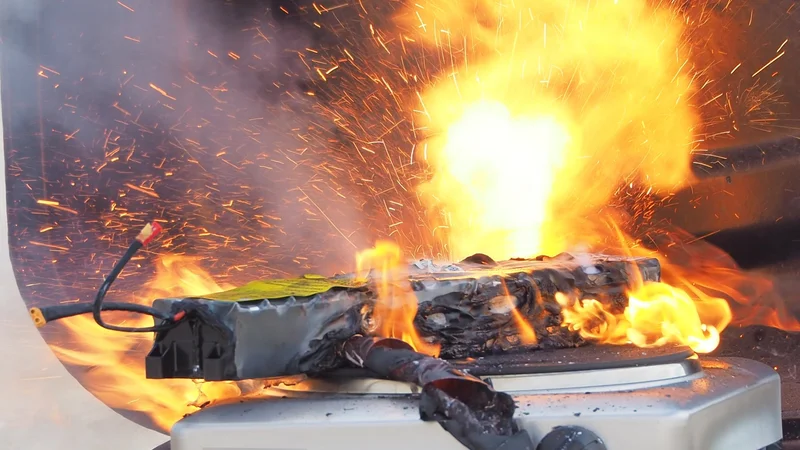
Lithium-Ion Battery Fire
Key Takeaways
Thermal Runaway Mechanism – Lithium-ion battery fires are usually the visible result of thermal runaway, a self-heating failure mode in which internal heat generation exceeds heat dissipation.
Primary Failure Triggers – Incidents are initiated by overcharging, short-circuit faults, overheating, high temperatures, physical damage, mechanical damage, water intrusion, aging, and manufacturing defects.
Electrolyte and Venting Hazards – The electrolyte is typically a flammable formulation based on organic solvents. During failure, cells can vent flammable and toxic gases, including carbon monoxide, hydrogen, hydrocarbons, electrolyte vapor, and potentially hydrogen fluoride.
Early Warning Signs – Visible and audible indicators of failure include bulging, unusual heat, odor, hissing, popping, smoke, leakage, cracking, deformation, and abnormal charging behavior.
Emergency Suppression Protocol – The safest public response is to isolate, evacuate, and call the fire service. Trained responders often use large amounts of water for cooling because visible flame suppression alone may not stop the internal reaction.
Lifecycle Prevention Framework – Mitigation is an engineering lifecycle problem: cell quality, BMS design, thermal management, certified chargers, storage controls, transport controls, and battery recycling practices all matter.
Introduction
Lithium-Ion battery fires are uncommon, but when they occur, they can escalate quickly across electric vehicles, e-bikes, laptops, mobile devices, power tools, energy storage systems, warehouses, aircraft cabins, and recycling facilities. The same qualities that make lithium-ion batteries valuable — high energy density, fast power delivery, rechargeability, and compact design — also create serious risks when cells are damaged, misused, poorly manufactured, or exposed to abuse. Unlike a simple metal fire, lithium-ion battery fires involve interconnected electrochemical, thermal, gas-generation, and combustion processes.
The single cell may overheat, develop an internal short circuit, suffer separator failure, vent flammable gases, ignite surrounding materials, and propagate heat to neighboring cells. Understanding lithium-ion battery fires therefore requires both scientific insight and practical safety judgment. This guide explains thermal runaway, prevention strategies, emergency response, handling, transport, storage, and end-of-life practices to help engineers and safety teams manage lithium-ion battery fires with clarity and control across real installations.
The Science: What Happens During Thermal Runaway?
The lithium-ion cell contains a negative electrode (usually a graphite anode in many commercial cells), a positive electrode (cathode), a porous separator, an electrolyte, current collectors, and a casing or pouch. During normal operation, lithium ions shuttle between the anode and cathode via the electrolyte, while electrons flow through the external circuit. The separator prevents direct electrical contact between electrodes while allowing ionic transport.
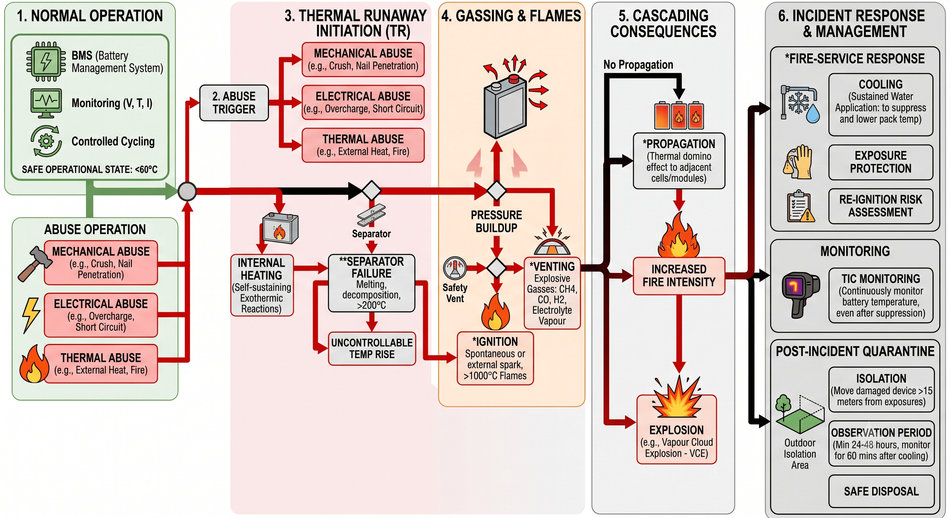
Thermal runaway begins when internal heat generation exceeds the ability of a cell to reject heat. Modern review defines thermal runaway as an uncontrollable, self-accelerating process marked by rapid temperature rise, pressure buildup, gas release, decomposition of cell materials, and possible venting, rupture, explosion, or fire. The common initiating abuse categories are mechanical abuse, electrical abuse, and thermal abuse.
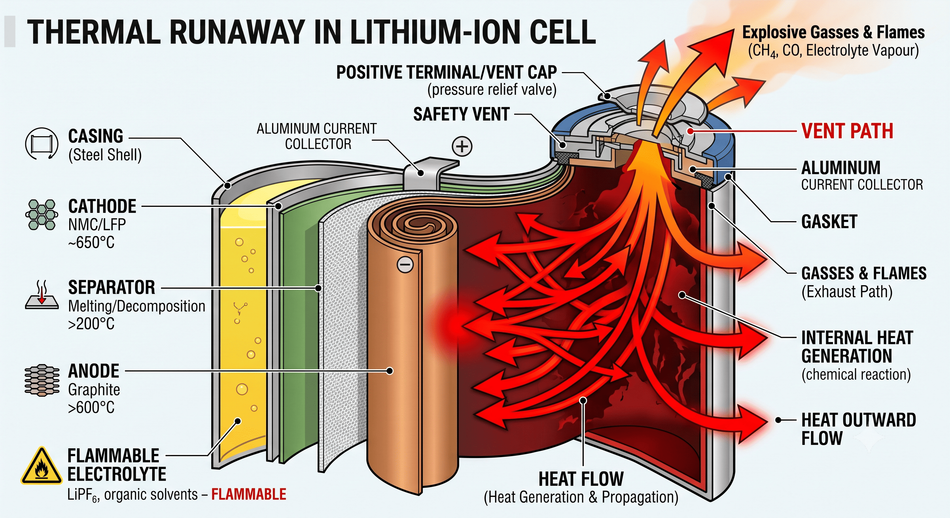
The failure sequence depends on chemistry, state of charge, cell form factor, age, and abuse mode, but a simplified progression is useful:
Heat Accumulation or Localized Fault: Heat may come from overcharging, external heating, an internal short circuit, high-resistance connections, crushed electrodes, contamination, dendrites, or an external fire.
SEI Decomposition: The solid electrolyte interphase on the anode can begin to decompose at elevated temperatures. Metastable SEI components decompose and release heat at about 57 °C, with significant heat release around 80 °C and peak heat production around 100 °C.
Anode-Electrolyte Reactions: As the SEI breaks down, lithiated anode material can react with the electrolyte, accelerating heat and gas generation. The same review describes anode-electrolyte reactions in the approximate 80 °C to 120 °C range as a driver of self-sustained heating.
Separator Shrinkage or Melting: Commercial polyethylene and polypropylene separators are widely used, with approximate melting points of 130 °C and 170 °C, respectively. If the separator shrinks or fails, the anode and cathode can come into direct contact, creating internal short circuits and rapid Joule heating.
Electrolyte Decomposition and Venting: The flammable electrolyte can vaporize and decompose. Pressure rises until the cell vents or ruptures. The resulting gas mixture may be combustible and toxic.
Cathode Decomposition and Oxygen Release: Some cathode materials become unstable at high temperatures or a high state of charge. Layered oxide cathodes can release oxygen and heat during decomposition, while lithium iron phosphate (LFP) generally has higher thermal stability than many cobalt- or nickel-rich layered oxides.
Propagation: Heat, flame, hot particles, and vented gas can ignite adjacent cells, nearby batteries, cables, plastics, packaging, furniture, or other combustible materials.
The gases matter as much as the flames. These events pose fire, explosion, and toxicity hazards due to flammable and noxious off-gases, and the gas volume and composition vary with chemistry, form factor, and state of charge.
Recommended Reading: Battery Thermal Management for EV Battery Packs
Root Causes: Overcharging, Short Circuit, Overheating, and Damage
Lithium-ion battery fires are rarely spontaneous in the literal sense. They usually follow a latent defect, an abusive condition, a charger mismatch, thermal exposure, poor system integration, or a failed protective function. Lithium-ion cells contain both chemical hazards, such as flammable electrolyte, and electrical hazards, including stored energy that can be released rapidly under fault conditions. Once a cell is short-circuited, physically damaged, overcharged, overheated, or poorly manufactured, internal reactions can accelerate, leading to thermal runaway. [1]
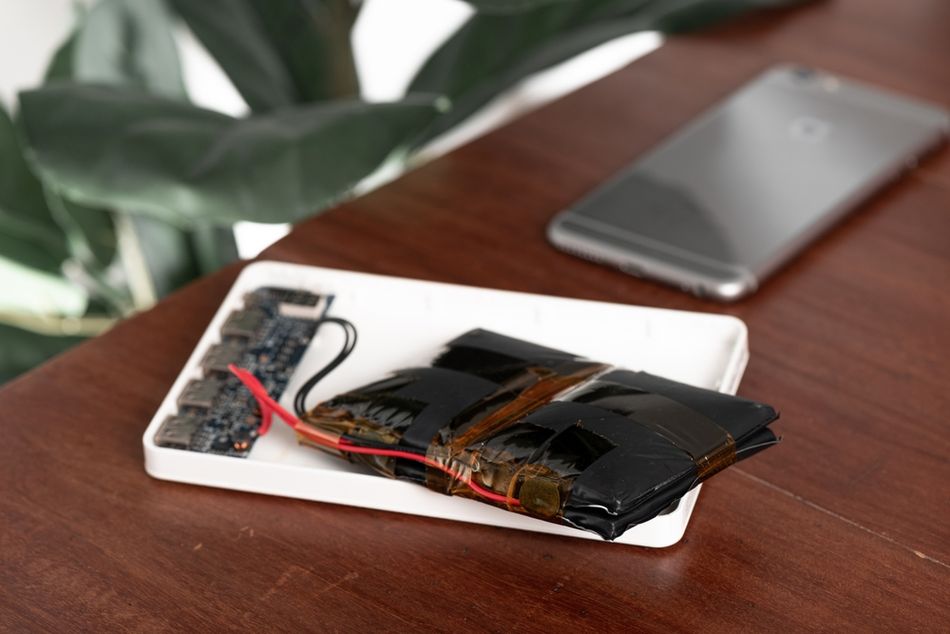
Let’s discuss the major root causes:
Overcharging
Overcharging occurs when a cell is driven beyond its safe voltage range. Excess voltage can cause lithium plating, electrolyte oxidation, gas generation, internal heating, and cathode stress. From an engineering perspective, prevention depends on BMS overvoltage cutoff, charger authentication, cell balancing, redundant voltage sensing, and charge-profile validation. At the user and facility level, batteries should only be charged with manufacturer-approved chargers, and charge controls should never be bypassed or paired with mismatched power supplies.
Short Circuit
Short circuits may be internal or external, but both create high current flow and rapid Joule heating. This can quickly raise cell temperature and initiate thermal runaway. Engineering controls include cell-level fuses, pack fusing, insulation coordination, creepage and clearance design, robust busbar architecture, and contamination control. Users should protect exposed terminals, avoid carrying loose batteries in toolboxes or bags, and never store cells with keys, coins, tools, or other metal objects.
Overheating and Extreme Temperatures
High temperatures accelerate SEI breakdown, electrolyte reactions, separator shrinkage, and long-term aging. These changes reduce safety margins and increase the probability of internal failure. Battery packs should include thermal sensors, derating logic, cooling design, thermal propagation barriers, and hot-spot analysis. In practical use, batteries should be stored at room temperature where possible. USFA and NFPA guidance advises against charging below 32 °F, 0 °C, or above 105 °F, 40 °C.
Physical and Mechanical Damage
Punctured, crushed, bent, cracked, or water-damaged cells can develop internal short circuits or delayed failure. The mechanical damage may not always cause immediate ignition, but it can compromise separators, tabs, electrodes, seals, or insulation. Engineering prevention includes crush-resistant enclosures, strain relief, mechanical isolation, drop testing, ingress protection, and pack-level abuse testing. Damaged batteries should be removed from service immediately, especially after a crash, puncture, swelling, cracking, deformation, or immersion.
Manufacturing Defects
Manufacturing defects can create hidden failure paths that remain dormant until the battery is charged, loaded, heated, or aged. Burrs, contamination, electrode misalignment, poor welds, separator defects, and insufficient insulation can all increase risk. Prevention requires supplier qualification, traceability, formation screening, aging tests, process control, FMEA, and CT inspection where warranted. Users and procurement teams should buy certified products from reputable suppliers and avoid counterfeit packs or unknown replacement batteries.
Aging and Cell Imbalance
Once lithium-ion batteries age, capacity fade and impedance growth can increase heat generation and create cell-to-cell imbalance. A weak or degraded cell may reach unsafe voltage or temperature limits earlier than the rest of the pack. Engineering controls include SOH estimation, balancing algorithms, conservative charge limits, pack diagnostics, and defined service intervals. Batteries showing abnormal runtime loss, recurrent BMS faults, swelling, or unusual heating during normal use should be retired.
Poor Storage or Charging Environment
A battery failure becomes far more dangerous when charging occurs near combustible materials or exit paths. A single-cell event can spread to furniture, cardboard, curtains, vehicles, or stored goods. Facilities should use designated charging areas, noncombustible surfaces, ventilation, detection systems, separation distances, and electrical code compliance. E-bikes and e-scooters should not be charged in hallways, stairwells, bedrooms, or evacuation routes, and chargers should be kept away from sofas, beds, and flammable storage.
Improper Disposal and Battery Recycling
Improper disposal can cause damaged or loose cells to short-circuit in bins, trucks, material recovery facilities, or recycling streams. Engineering and facility controls include collection protocols, terminal isolation, thermal monitoring, and segregation of damaged batteries. Lithium-ion batteries should not be placed in household trash or curbside recycling. Instead, they should be handled through approved collection points, battery recycling programs, or household hazardous waste channels.
Failure Categories in Micromobility Batteries
The micromobility battery failure factors are grouped as: environmental, mechanical, design and manufacturing, electrical, and aging categories. Examples include excessive heat, charging in extreme conditions, drops, crashes, penetration, poor welds, contamination, improper separators, overcharging, imbalance, external short circuits, cycling degradation, and dendrite growth.
Recommended Reading: How to Charge a Lithium-Ion Battery Safely and Efficiently?
Device Context: Electric Vehicles, E-Bikes, E-Scooters, Laptops, and Power Tools
The hazard profile changes with scale and use case. A mobile phone or laptop typically contains a small number of cells, while power tools may use compact high-current cylindrical-cell packs. E-bikes and e-scooters often combine higher stored energy, removable battery packs, exposure to vibration, budget chargers, aftermarket modifications, indoor charging, and proximity to exits. Electric vehicles add high-voltage systems, large pack enclosures, structural integration, and post-crash stranded energy.
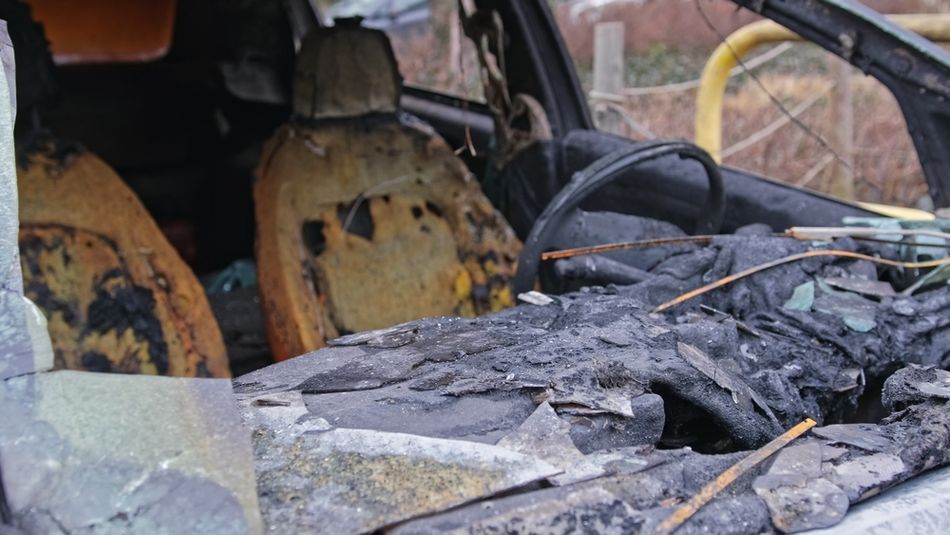
The real-world fire incidents show why system design and behavior matter. The Samsung Galaxy Note7 recall remains a well-known example in consumer electronics. The lithium-ion battery in the phone could overheat and catch fire, posing a serious burn hazard. [6]
Micromobility has become a major urban fire-service concern. New York City had 18 deaths related to lithium-ion batteries in 2023 and 6 in 2024, and 277 lithium-ion battery fires in 2024, compared with 268 in 2023. [7] Similarly, an overcharged seated e-scooter posed extreme hazards to occupants in residential scenarios, and the tested scooter battery was advertised as 60 V, 20 Ah, or about 1.2 kWh. [8]
For electric vehicles, the key emergency-response issues are not only flame but also high voltage, inaccessible cells, stranded energy, re-ignition, contaminated runoff, and post-incident storage. The fires in EVs with high-voltage lithium-ion batteries can expose responders to electric shock risk, and damaged cells can enter thermal runaway, causing reignition or fire due to stranded energy.
Stationary Energy Storage Systems (ESS) introduce a different engineering problem: many modules in one installation, high aggregate energy, containerized or building-integrated enclosures, gas accumulation, explosion control, fire protection design, and local permitting. The Moss Landing 300 battery energy storage system fire states that the 300 MW system held about 100,000 lithium-ion batteries and that about 55 percent were damaged by the fire.
Why These Fires Are Hard to Extinguish and Can Re-Ignite?
Conventional fire suppression focuses on the fire triangle: fuel, oxygen, and heat. Lithium-ion battery fires complicate that model because the initiating heat source is inside sealed or semi-sealed cells. [2] Extinguishing visible flames does not necessarily cool the cell core, stop anode-electrolyte reactions, prevent separator failure, or eliminate stranded electrical energy.
The mechanisms below explain why a battery fire can re-ignite:
Adjacent Cells may be heated but not yet failed. They can enter delayed thermal runaway minutes or hours later.
Battery Pack may retain stranded energy after the visible fire is out.
Vented Gas can accumulate and ignite when mixed with air and an ignition source.
Hot Modules, Busbars, and nearby combustible materials can transfer heat back into cells.
Suppression Agent may not reach cells protected by EV pack enclosures or product housings.
FAA - 2025 Safety Alert for Operators is direct about aircraft cabin events: Halon extinguishers can briefly suppress open flames, but they do not halt thermal runaway. The primary response is to apply large amounts of water to cool the battery and suppress flames; cooling is essential until cells have discharged their energy.
For EV incidents, IAFC guidance advises securing a large, continuous, sustainable water supply, with 3,000 to 8,000 gallons cited in its planning bulletin, and warns that sustained suppression and extended monitoring may be needed. It also advises treating batteries as energized and providing 50 ft of clear space around the vehicle once stored.
The caution on fire blankets is warranted. In 2025, USFA reported an advisory from the Fire Protection Research Foundation and FSRI stating that EV fire blankets eliminated flaming in experiments, but thermal-runaway propagation continued, allowing flammable battery gases to accumulate under the blanket and creating an explosion risk when air was reintroduced.
Recommended Reading: Energy Storage Connectors: The Future of High-Power Energy Storage Systems (ESS) Management
Warning Signs Checklist
It is highly recommended to stop using the battery-powered product and treat it as a potential fire risk if any of the following are present. USFA guidance specifically tells users to stop using lithium-ion batteries if they notice odor, color change, excessive heat, shape change, leaking, or odd noises.
Visible Physical Damage
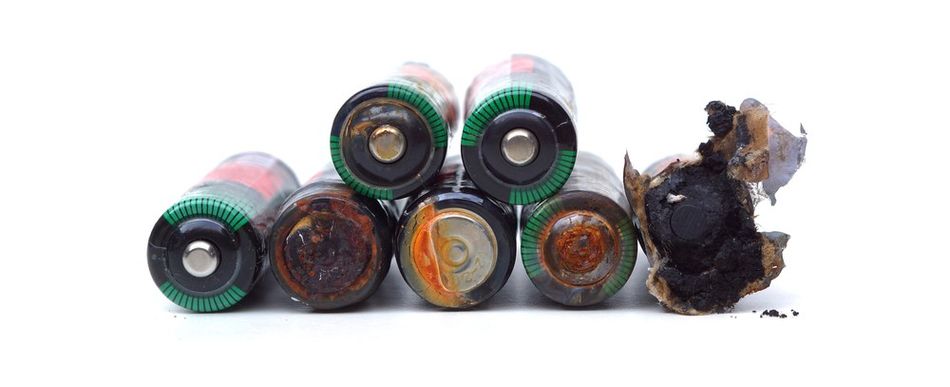
Stop using the device if the battery or product casing shows bulging, swelling, deformation, cracking, punctures, crushed corners, exposed wires, burn marks, melted plastic, or impact damage. Swelling is especially important because it can indicate internal gas generation, cell degradation, or pressure buildup. A battery case that no longer fits correctly, a device cover that will not close, or a pack that looks distorted should not be forced back into service.
Abnormal Heat During Charging or Use
Unusual heat is one of the clearest warning signs of a failing lithium-ion battery. Some warmth during charging or high-load operation can be normal, but the product should not become too hot to touch, heat unevenly, or continue heating after it is disconnected. Overheating during idle storage is particularly concerning because the battery is generating heat without normal load demand. Repeated hot charging cycles, charger overheating, or a warm connector should also be investigated.
Unusual Sounds
Hissing, popping, crackling, clicking, or pressure-venting sounds may indicate gas release, internal arcing, separator failure, or mechanical stress inside the cell or pack. These sounds should be treated as urgent warning signs, especially when they occur with heat, swelling, smoke, odor, or visible damage. A battery making unusual sounds should not be handled closely or moved unless it can be done safely.
Smoke, Vapor, or Gas Release
White, gray, dark, or colored smoke from a battery-powered product can indicate electrolyte decomposition, vented gases, burning insulation, or an active internal failure. Smoke may appear before visible flames. Any smoke coming from a lithium-ion battery, charger, or battery compartment should be treated as an emergency condition. People should move away from the device, avoid inhaling fumes, and evacuate the area if smoke increases or spreads.
Unusual Odor
A sweet, solvent-like, sharp, metallic, plastic-burning, or otherwise unusual odor can indicate electrolyte leakage, overheating components, insulation damage, or vented battery gases. Odor may appear before smoke or visible flame. If a battery-powered product smells abnormal during charging, storage, or use, disconnect power only if it is safe to do so, stop using the device, and keep people away from the area.
Leakage, Residue, or Corrosion
Electrolyte leakage, wetness near seams, powdery residue, corrosion, staining, or sticky deposits around the battery, terminals, charger port, or enclosure should be treated as a sign of failure. Leaked electrolyte may be irritating, corrosive, or flammable depending on the cell chemistry and decomposition products. Do not touch residue with bare hands, and do not continue using the product after leakage is observed.
Charger, Cable, or Connector Problems
Battery fires can also originate from charging faults. Warning signs include charger discoloration, melted insulation, arcing, buzzing, burning smell, loose connectors, intermittent contact, damaged cables, or a connector that becomes unusually hot. A charger that does not match the battery voltage, current rating, connector design, or manufacturer specification can defeat protection controls and increase the risk of overcharging or overheating.
Electrical and Performance Abnormalities
Rapid self-discharge, abnormal voltage sag, sudden shutdown under light load, repeated battery management system cutoffs, unusual error codes, inconsistent charging, or a product that turns off even when the battery indicator shows it's charging can indicate internal degradation or cell imbalance. These symptoms are especially important in larger packs, where a single weak or damaged cell group can create stress throughout the rest of the battery system.
History of Abuse, Modification, or Unknown Repair
The product should be treated with caution if it has been submerged, crashed, dropped hard, modified, opened, repaired with unknown cells, fitted with a non-original charger, or rebuilt without proper testing. Damage may not be visible from the outside. A battery can operate normally for a period after abuse and still fail later because of internal shorts, separator damage, corrosion, or weakened insulation.
Immediate Action
Immediate action should be conservative. Stop using the product and disconnect the power only if you can do so without touching a hot, smoking, leaking, swollen, or damaged battery. Move people away from the device and keep them clear of smoke or fumes. If the product can be moved safely, place it away from exits, sleeping areas, upholstered furniture, cardboard, paper, fuel, solvents, curtains, and other combustible materials.
Immediate action should be conservative. Disconnect power only if you can do so without touching a hot, smoking, leaking, or damaged battery. Move people away. Keep the device away from exits and combustible materials only if movement can be done safely. Evacuate when smoke, hissing, flame, or rapid heating is present, and call the fire service.
Recommended Reading: Engineering Safe and Compliant EV On-Board Chargers with Multi-Domain Protection from TDK Electronics
Prevention: Engineering Controls and Operating Practices
Prevention begins at the cell and continues through pack design, firmware, charger design, user instructions, facility layout, transport, service, and battery recycling. Here, no single control is sufficient.
Product Teams need to specify cells from qualified suppliers with traceable lots, appropriate safety devices, and documented compliance with the relevant application standard. Use conservative current limits, validated charge algorithms, cell balancing, redundant temperature sensing where warranted, and fault handling that fails safe. A BMS should detect overvoltage, undervoltage, overcurrent, short circuit, overheating, cell imbalance, sensor faults, contactor faults, and charger faults. However, BMS protection cannot be treated as a substitute for robust mechanical design, cell quality, and abuse tolerance.
Pack Designers should analyze thermal propagation. Important controls include cell spacing, heat spreaders, insulation, flame barriers, vent paths, pressure relief, noncombustible or fire-resistant enclosure materials, connector strain relief, impact protection, ingress protection, service disconnects, and accessible emergency information. For electric vehicles and large ESS, design work should include hazard mitigation analysis, emergency response planning, and local authority-having-jurisdiction review.
Use only manufacturer-specified chargers and never charge damaged batteries. For larger devices, charge in supervised, ventilated, non-combustible areas. Prohibit charging in hallways, bedrooms, or near primary exits, and keep devices away from upholstered furniture, bedding, or cardboard surfaces.
USFA and NFPA recommend room-temperature storage when possible and advise against charging below 0 °C or above 40 °C. Direct sunlight, hot vehicles, freezing garages, and high-temperature industrial areas can all increase risk or degrade cells.
For Facilities, use a written lithium-ion battery management plan. Include receiving inspection, quarantine criteria for damaged batteries, maximum quantities, separation distances, charger approval, emergency shutoffs, detection, housekeeping, staff training, fire-service preplanning, and waste handling. For battery energy storage systems, NFPA lists NFPA 855, NFPA 1 Chapter 52, NFPA 70 Article 706, and related standards as part of the ESS safety framework. UL 9540A is the test method for evaluating thermal runaway fire propagation in battery energy storage systems, and UL 9540 covers energy storage systems and equipment.
For micromobility, use certified products. NYC Law requires e-bikes, e-scooters, and related batteries sold, leased, rented, or distributed there to be certified to UL 2849, UL 2272, and UL 2271 as applicable. CPSC has also urged manufacturers and importers to comply with UL 2272 for personal e-mobility devices and UL 2849 for e-bikes, stating that compliance significantly reduces the risk of injuries and deaths from micromobility fires. [5]
Response, Suppression, Transport, and End-of-Life Handling
Response priorities are life safety, isolation, cooling by trained responders, exposure protection, and post-incident monitoring. Do not make lithium-ion battery fire response a heroic problem for untrained personnel.

For small consumer devices, the public should stop at warning signs, move away, evacuate if smoke or fire appears, and call emergency services. A trained person may use a portable extinguisher to control surrounding combustibles or incipient flame, but extinguishing visible flame may not stop internal thermal runaway. The responsible message is to avoid inhaling vapors, direct contact with electrolyte residue, and handling hot or venting cells.
For laptops, mobile phones, and power banks on aircraft, FAA guidance supports trained crew procedures that prioritize accessibility, water cooling, and risk management. [4] USFA also advises removing lithium-ion batteries from checked smart luggage and keeping spare loose lithium-ion batteries with you on the plane.
For e-bikes, e-scooters, power tools, and similar packs, isolate damaged batteries outdoors, if safe, and keep them away from combustible materials. Do not place a suspect battery in a sealed container unless the container is designed for the hazard, as vent gases and pressure can accumulate. Do not attempt to open, rebuild, or diagnose a damaged pack on a workbench without proper controls.
For electric vehicles, defer to trained fire-service procedures and the vehicle manufacturer's emergency response guide. EV battery packs may remain energized after a crash, flood, or fire. Post-incident towing and storage should maintain clearance from structures and other vehicles, and personnel should monitor for delayed heating or re-ignition.
Transport is regulated, as well. The lithium batteries are regulated as hazardous material under the U.S. DOT Hazardous Materials Regulations, 49 CFR Parts 171 to 180, and damaged, defective, or recalled batteries have a greater potential to short circuit, release heat, or cause a fire. [3] Lithium cells and batteries can pose both chemical and electrical hazards. Damaged, defective, or recalled batteries may not be transported by air and must comply with specific DOT packaging requirements.
The end-of-life handling is mostly overlooked. Households isolate terminals with nonmetallic tape, individually bag used lithium batteries to protect them from damage, and do not place them in household trash or curbside recycling bins. Instead, they should go to battery collection sites or household hazardous waste facilities.
Conclusion
Lithium-ion battery fires are best understood as system failures, not isolated flame events. A cell can enter thermal runaway from overcharging, overheating, short-circuiting, extreme temperatures, physical damage, or manufacturing defects. Once the separator fails, the electrolyte decomposes, the anode and cathode reactions accelerate, and flammable and toxic gases vent; the incident becomes a thermal, electrical, chemical, and fire-protection problem simultaneously.
The engineering answer is layered prevention. Use certified cells and packs, validated chargers, robust BMS logic, thermal management, mechanical protection, conservative storage, controlled charging spaces, transport compliance, and safe battery recycling. The response is equally disciplined: isolate, evacuate, call the fire service, cool with water when trained and appropriate, monitor for re-ignition, and treat damaged batteries as energized and hazardous. The practical goal is to engineer, use, store, transport, and retire it with controls that match the stored energy, instead of avoiding lithium-ion technology.
Frequently Asked Questions
Q. What causes lithium-ion battery fires?
A. Lithium-ion battery fires usually start when a fault or abuse condition pushes a cell into thermal runaway. Common causes include overcharging, short circuits, overheating, impact damage, water intrusion, manufacturing defects, charger mismatch, aging, and poor pack integration.
Q. What is thermal runaway in a lithium-ion battery?
A. Thermal runaway is a self-accelerating failure where a cell generates heat faster than it can release it. Separator damage, electrolyte decomposition, internal shorts, and gas generation can escalate rapidly, making simple disconnection insufficient once failure is established.
Q. Is water safe to use on lithium-ion battery fires?
A. Water is often used by trained responders because it cools cells and helps slow thermal runaway propagation. However, the public should not approach smoking, hissing, or burning batteries. It is recommended to evacuate, keep distance, and call the fire service immediately.
Q. What are the warning signs of a failing battery?
A. The warning signs include swelling, deformation, excessive heat, smoke, hissing, popping, unusual odor, leakage, discoloration, burn marks, exposed wiring, rapid self-discharge, repeated BMS faults, or abnormal charging behavior. Stop use immediately and disconnect power only if safe.
Q. How should damaged batteries be stored or recycled?
A. Do not place damaged lithium-ion batteries in household trash or curbside recycling. Isolate terminals with nonmetallic tape, keep the battery away from combustibles, and use an approved collection site, hazardous waste facility, or qualified recycling program.
Q. Which standards are most relevant for engineers?
A. Relevant standards depend on the application. Engineers commonly consider UN 38.3 for transport, UL 2271, UL 2272, UL 2849, UL 2580, UL 9540, UL 9540A, and NFPA 855, while also confirming local code and authority requirements.
References
[1] NFPA. Lithium-Ion Battery Safety [Cited 2026 June 30]; Available at: Link
[2] U.S. Fire Administration. Battery Fire Safety [Cited 2026 June 30]; Available at: Link
[3] PHMSA. Transporting Lithium Batteries [Cited 2026 June 30]; Available at: Link
[4] FAA. SAFO 25002: Managing the Risks of Lithium Batteries Carried by Passengers and Crew Members [Cited 2026 June 30]; Available at: Link
[5] UL Solutions. E-Bike / Micromobility Device Safety: Product Certification [Cited 2026 June 30]; Available at: Link
[6] BBC. Samsung Recalls Note 7 Flagship Over Explosive Batteries [Cited 2026 June 30]; Available at: Link
[7] NYC. FDNY Commissioner Robert S. Tucker Announces Significant Progress in the Battle Against Lithium-Ion Battery Fires [Cited 2026 June 30]; Available at: Link
[8] Fleischmann et al. Quantifying the Fire Hazard from Li-Ion Battery Fires Caused by Thermal Runaway in E-scooters [Cited 2026 June 30]; Available at: Link
in this article
1. Key Takeaways2. Introduction3. The Science: What Happens During Thermal Runaway?4. Root Causes: Overcharging, Short Circuit, Overheating, and Damage5. Device Context: Electric Vehicles, E-Bikes, E-Scooters, Laptops, and Power Tools6. Why These Fires Are Hard to Extinguish and Can Re-Ignite?7. Warning Signs Checklist8. Prevention: Engineering Controls and Operating Practices9. Response, Suppression, Transport, and End-of-Life Handling10. Conclusion11. Frequently Asked Questions12. References