Lead-Acid Batteries vs Lithium-Ion Batteries: Efficiency
Engineering tradeoffs for cost, safety, cycle life, and system design.

29 Jun, 2026. 12 minutes read
Key Takeaways
Lead-acid batteries remain strong for engine starting, short-duration UPS, and low-cycle backup. Lithium-ion batteries, especially LiFePO4, usually win high-cycle storage where weight, usable energy, and service interval matter.
The main hardware gap is stored energy per unit volume. DOE lists lead battery volumetric density at 25 to 100 kWh/m³ versus 150 to 500 kWh/m³ for Li-ion systems, which affects cabinet size, rack loading, and mobile installations.
For daily cycling, depth of discharge, replacement interval, and round-trip efficiency often dominate initial purchase price. PNNL found lead-acid batteries can have far higher annualized cost than lithium-ion LFP in stationary storage because of lower cycle life, DOD, and RTE.
Vented wet-cell batteries require water checks, ventilation, and acid-handling controls. AGM, gel, and pure-lead VRLA designs reduce user service needs but still require proper charging and temperature management.
Lithium-ion batteries shift engineering effort toward the BMS, cell balancing, contactors, fusing, thermal design, and validated fault response.
Lead exposure and lead poisoning are central safety issues for manufacturing, service, and recycling. Lithium systems shift the major hazard toward electrical abuse, thermal runaway, and fire propagation.
Introduction
The lead-acid vs. lithium-ion battery comparison is not simply old chemistry against new chemistry. Lead-acid batteries have more than 160 years of field history, a mature supply chain, and a proven role in high-current starting and standby service. Lithium-ion batteries have become dominant in electric vehicles, portable electronics, and many stationary systems because they store more energy per unit mass and volume, recharge faster, and support longer cycling when designed correctly.
In a lead-acid battery, the charged positive electrode is lead dioxide, the negative electrode is metallic lead, and the sulfuric acid electrolyte participates directly in the reaction. During discharge, both electrodes convert to lead sulfate. In lithium-ion batteries, lithium ions move between a cathode and an anode, which is commonly graphite.
This article compares the two technologies as engineering components. It covers chemistry, construction, energy density, lifespan, cycle life, depth of discharge, charging time, maintenance, safety, recycling, total cost of ownership, and application fit across automotive starter batteries, UPS, solar panels with storage, RVs, boats, generators, and electric vehicles. LiFePO4 is emphasized because it is the lithium-ion chemistry most directly competing with flooded, VRLA gel, and pure lead designs in deep-cycle and stationary roles.
Chemistry and Construction: Plates, Electrodes, and Pack Architecture
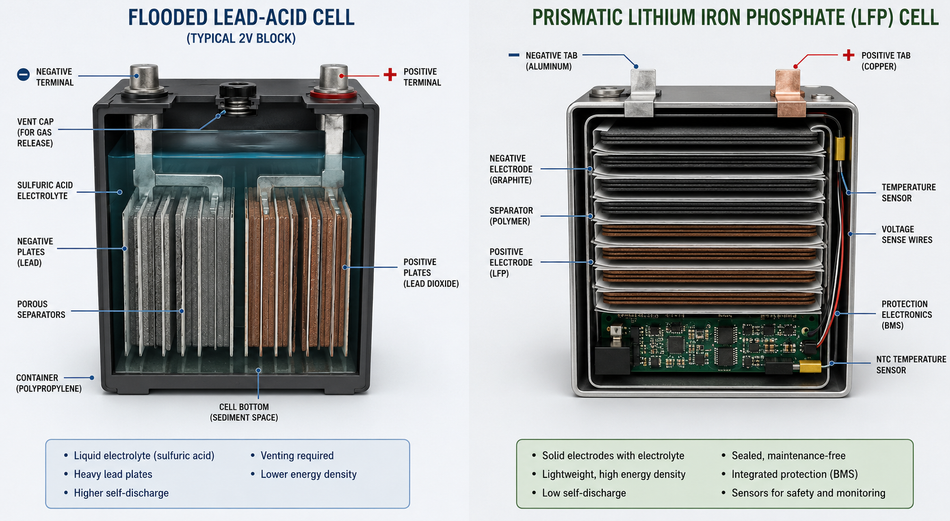
Lead-acid batteries are secondary, rechargeable systems built around lead-based plates and an acid solution. A conventional flooded cell uses a positive plate containing lead dioxide and a negative plate containing sponge lead submerged in sulfuric acid. The acid is active in the reaction, so state of charge affects acid concentration. A nominal 12 V automotive battery contains six cells in series, each near 2 V under typical operating conditions.
Construction variants matter in real designs. Wet-cell designs allow water addition and controlled equalization, but they can vent hydrogen and oxygen during overcharging. AGM batteries immobilize acid in absorbed glass mat separators and are valve regulated.
Gel Cells
Gel cells use a silica-gelled acid and are more sensitive to excessive charging voltage. Thin plate pure lead batteries use high-purity lead and thin plates to lower internal resistance and improve high-rate behavior, often in premium UPS and aerospace-style applications.
Li-ion Cells
Lithium-ion cells are sealed devices assembled into modules and packs. They use current collectors, separator films, organic solvent, and intercalation electrodes. The common graphite anode stores lithium during charge; the cathode determines much of the voltage, cost, thermal behavior, and supply-chain profile. LFP uses iron and phosphate rather than nickel or cobalt in the cathode, making it attractive for stationary storage, marine house banks, and mobile auxiliary systems.
A lithium pack is not just cells. It normally includes a battery management system, current interrupt devices or contactors, fusing, cell balancing, temperature sensing, and logic for voltage, current, and temperature limits. IEC 62619:2022 covers safety requirements and tests for secondary lithium cells and batteries used in industrial applications, including stationary applications such as telecom, UPS, electrical energy storage systems, utility switching, and emergency power.
Side-by-Side Engineering Comparison
Selection parameter | Lead-acid batteries | Lithium-ion batteries, especially LiFePO4 | Engineering consequence |
Nominal cell voltage | About 2 V per cell | About 3.2 V for LFP, about 3.6 to 3.7 V for many NMC/NCA cells | Replacement packs need voltage-window compatibility, not just matching nameplate voltage. |
Main active materials | Lead dioxide positive plate, lead negative plate, sulfuric acid | LFP, NMC, or other cathode; graphite anode; organic solvent | Lead systems are plate-and-acid devices; Li-ion systems are cell-and-control systems. |
Volumetric energy density | DOE: 25 to 100 kWh/m³ for PbA | DOE: 150 to 500 kWh/m³ for Li-ion | Lithium saves enclosure volume and structural mass in mobile and dense cabinet designs. |
Practical depth of discharge | Often designed near 50% for long life; PNNL assumptions vary by duration | Often designed near 80% for LFP stationary systems | A smaller lithium pack can deliver similar usable energy. |
Stationary RTE assumption | PNNL: about 77% to 85% depending on duration | DOE LFP baseline: 85% for a 100 MW, 10-hour 2030 case | Round-trip losses affect operating cost and generator runtime. |
Cycling behavior | Strongly degraded by high DOD, heat, sulfation, and undercharge | Strongly affected by temperature, voltage limits, C-rate, and state-of-charge window | Lead is usually oversized for cycling; lithium is controlled by electronics and thermal design. |
Charging time | Long absorption stage near full charge | Higher charge acceptance when temperature and protection limits allow | Lithium can reduce fuel consumption in hybrid solar and generator systems. |
Maintenance model | Wet-cell designs need water, corrosion checks, and ventilation; AGM and gel need less user service | No watering, but diagnostics, logs, contactors, and thermal monitoring matter | Service work moves from chemical inspection to electrical and data-driven inspection. |
Primary safety hazards | Acid burns, hydrogen, lead exposure, lead dust, toxic metal handling, lead poisoning | Cell fire propagation, flammable gases, high fault current, arc flash, transport restrictions | Different PPE, enclosure, ventilation, and emergency response plans are required. |
Recycling maturity | Mature collection loop; EPA reports 99.3% industry-reported U.S. recycling rate | Infrastructure is expanding, but EPA notes no widely accepted U.S. recycling rate | Lead wins on collection maturity; lithium is improving as EV packs enter the waste stream. |
Best-fit applications | Automotive starter, standby UPS, telecom backup, forklifts, low-budget off-grid storage | Electric vehicles, mobile storage, deep-cycle solar, RVs, marine house banks, high-cycle UPS | Duty cycle usually decides the winner more reliably than chemistry preference. |
Recommended Reading: LiFePO4 vs Lithium-Ion Batteries: Engineering Guide
Energy Density, Usable Energy, Cycle Life, and Lifespan
Energy per unit volume and mass changes more than battery size. It affects cabling length, rack loading, HVAC load, service access, shipping cost, and compliance with mobile or seismic mounting requirements. For the same nominal kWh, lead-acid banks usually need more floor area and more structural support. In an RV, boat, telecom cabinet, or compact UPS room, that difference can be decisive. In a utility yard with available land, replacement cost or O&M procedure may matter more.
Usable energy is the sizing parameter engineers should use. A 10 kWh rated capacity bank does not mean 10 kWh should be extracted daily. A long-life lead design often assumes about 50% depth of discharge because deeper cycling accelerates sulfation, shedding, corrosion, and water loss. PNNL notes that conventional batteries have DOD-dependent cycle life and that lead-acid batteries are often operated at approximately 50% DOD to meet cycle targets; its annualization table uses 80% DOD for lithium-ion LFP and 58% to 82% for lead acid depending on discharge duration.
A practical sizing formula is:
required nominal capacity = required load energy / (allowed DOD × end-of-life capacity fraction × inverter efficiency)
For a 5 kWh daily DC load with an 80% end-of-life capacity reserve, a lead-acid system at 50% DOD needs 12.5 kWh of nominal storage before inverter losses. The same load at 80% DOD needs about 7.8 kWh of LFP storage. The difference compounds when racks, cables, enclosures, and replacement labor are included.
Cycle life is where lifecycle economics often flip. In a PNNL example using a 12 V, 200 Ah lead-acid module, listed cycles fall from 1,030 at about 49% adjusted DOD to 599 at about 82% adjusted DOD. This is not a universal datasheet value, but it illustrates the key rule: high DOD extracts more energy per cycle and reduces available cycles.
Lithium-ion aging depends on temperature, current, time at high state of charge, cell imbalance, and voltage limits. DOE lists a 2030 LFP stationary-storage baseline with 16 years of calendar life, 2,640 total cycles, and 85% RTE for a 100 MW, 10-hour case. Bankable engineering should still use warranted cycles at specified DOD, temperature, C-rate, and end-of-life capacity because commercial datasheets vary widely.
Charging Time, Round-Trip Efficiency, and Controls
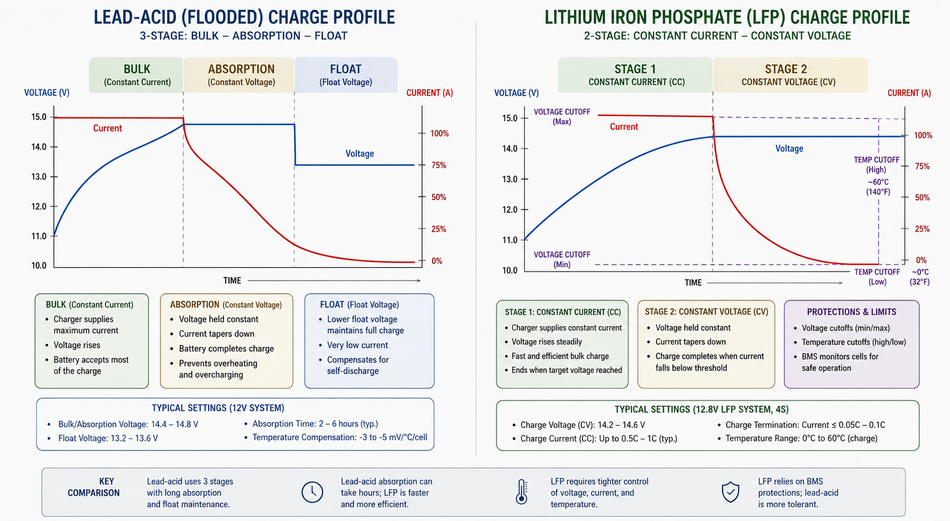
Charging time is often the hidden driver in solar, marine, RV, and hybrid backup systems. Lead-acid charging uses bulk, absorption, and float stages. Bulk charging can move significant current, but current tapers during absorption as the battery approaches full state of charge. Stopping early causes chronic undercharge and sulfation; forcing current too aggressively can cause gassing, heat, and water loss. Gel and AGM products can be permanently damaged by excessive voltage.
LFP charging is usually closer to a constant-current, constant-voltage profile and can accept higher current across much of its operating window when cell temperature is within limits. That can reduce engine runtime because the battery does not spend as long in a low-current absorption tail.
The BMS must still enforce low-temperature charge lockout, high-temperature derating, maximum cell voltage, minimum cell voltage, pack current limits, and balancing. A replacement pack that is electrically compatible at nominal voltage can still be unsuitable if the alternator, solar charge controller, inverter-charger, or DC-DC converter cannot follow the required profile.
Round-trip efficiency links electrochemistry to operating cost. Losses show up as heat, larger solar arrays, more fuel, or higher grid purchases. PNNL estimates lead-acid system RTE typically between 75% and 84%, with assumed values from 77% for a 2-hour duration to 85% for a 10-hour duration in its analysis.
Suggested Reading: How to Charge a Lithium-Ion Battery Safely and Efficiently?
Maintenance and Field Implementation
Service requirements differ in kind, not just quantity. Flooded lead-acid batteries require fluid level checks, distilled water addition, torque checks, terminal cleaning, corrosion control, specific gravity measurements, ventilation inspection, and spill containment. They should be installed with acid-resistant trays or secondary containment where required by local code and site policy. Battery rooms must manage hydrogen accumulation, temperature, access clearance, eyewash and PPE, and DC fault isolation.
VRLA products reduce routine user contact with acid and are often described as maintenance-free. That label can be misleading. Valve-regulated lead-acid batteries still require impedance or conductance testing, float voltage verification, thermal surveys, enclosure inspection, and replacement planning. A single weak block in a long string can reduce runtime or cause unequal charging. Thermal gradients across a cabinet can produce uneven aging.
Lithium-ion batteries remove watering and acid handling but add control-system dependencies. Field implementation should include communications integration with inverters and supervisory controllers, event-log review, insulation resistance checks where applicable, firmware control, and commissioning tests for contactors, precharge circuits, emergency stop, and fault annunciation.
ANSI/CAN/UL 1973 covers battery systems for PV, wind storage, UPS, vehicle auxiliary power, and similar applications, while IEC 62619 applies to industrial secondary lithium cells and batteries.
Safety: Lead Exposure, Lead Poisoning, Acid, Hydrogen, and Lithium Battery Abuse
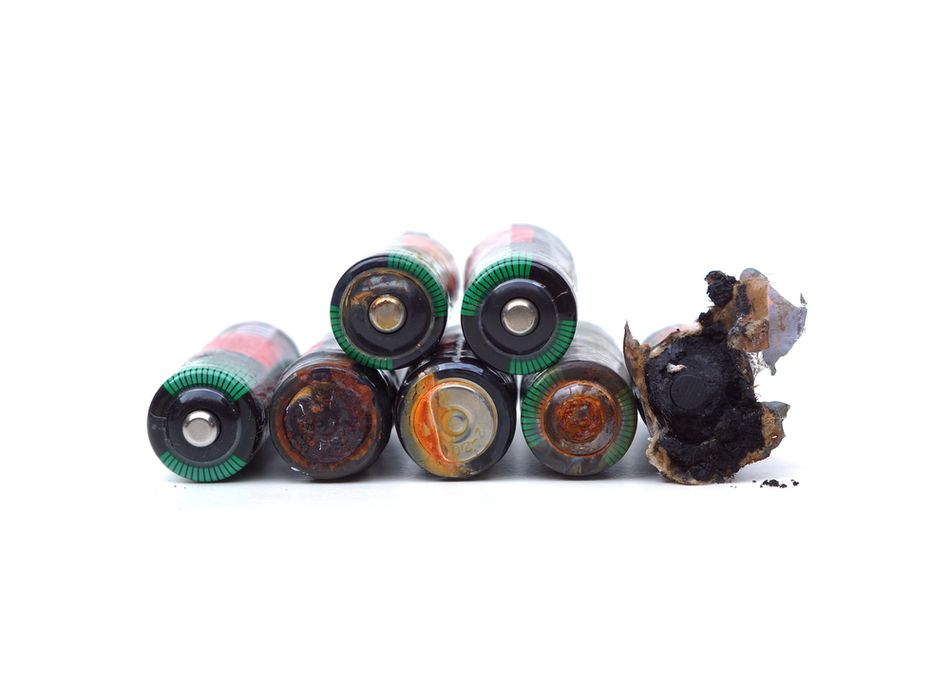
Lead-acid safety begins with chemistry and workplace controls. Sulfuric acid is corrosive and can cause serious burns. Overcharging can generate hydrogen and oxygen, creating a ventilation and ignition-control issue. Lead is a toxic metal, and lead exposure can occur through oxide handling, plate processing, battery repair, reclaim operations, recycling, contaminated PPE, lead dust, and poor hygiene.
OSHA states that employees in battery manufacturing plants may be exposed to lead concentrations greater than the OSHA permissible exposure limit, and its battery manufacturing eTool identifies oxide and grid processing, plate processing, assembly, repair and reclaim, environmental controls, and maintenance as relevant operations.
Lead poisoning is not limited to manufacturing. Battery recycling, field service, cutting, grinding, sweeping contaminated dust, and informal smelting can create lead exposure. Engineering controls should prioritize enclosure, local exhaust ventilation, wet methods or HEPA-filtered cleanup, no dry sweeping, hygiene rooms, respiratory protection when required, and medical surveillance.
CDC/NIOSH states that OSHA's PEL for lead is 50 µg/m³ as an 8-hour time-weighted average, with an action level of 30 µg/m³; employers must begin specific compliance activities above the action level, including blood lead testing and air monitoring.
Blood lead level management should be part of any battery manufacturing, recycling, or heavy service program. Elevated blood lead level results require occupational-health follow-up, exposure-source investigation, housekeeping review, PPE assessment, and process controls. Lead poisoning prevention is fundamentally an industrial hygiene problem: keep lead out of air, off hands, off clothing, and out of take-home pathways.
Lithium-ion safety is different. Cells do not contain lead or liquid acid, but they store high energy in a sealed package and can enter thermal runaway under severe abuse, internal short circuit, overcharge, mechanical damage, external fire exposure, or design defects. A runaway event can release flammable and toxic gases, propagate from cell to cell, and challenge conventional fire response.
Transport adds another layer. UN 38.3 testing is widely used for lithium battery transportation qualification. Intertek summarizes the protocol as including altitude simulation, thermal test, vibration, shock, external short circuit, impact or crush, overcharge for rechargeable batteries, and forced discharge. Lithium-ion batteries shipped alone by air are subject to state-of-charge restrictions and packaging requirements.
Cost, Recycling, and Application Fit
Purchase price favors lead in many small systems, but total cost of ownership depends on delivered kWh over the lifespan of the installation. A low-cost flooded bank that is cycled daily, watered inconsistently, kept hot, or discharged deeply can become more expensive than a lithium system that costs more upfront but lasts longer and uses more of its rated capacity.
For grid-scale modeling, PNNL found that lead-acid batteries had capital cost on par with lithium-ion in a 100 MW, 10-hour case, yet had annualized cost nearly three times higher because of lower cycle life, DOD, and round-trip losses. A practical TCO model should include battery, rack, charger, protection, installation, allowed DOD, replacement interval, service labor, PPE, ventilation, downtime, energy losses, shipping, disposal, and recycling.
Recycling is a major lead-acid advantage when it is done correctly. EPA reports a 99.3% industry-reported U.S. recycling rate for lead-acid batteries, largely due to regulations, core charges, retailer takeback, standard battery design, and a national collection infrastructure. EPA also notes that these batteries should not be placed in curbside trash or recycling and should be handled by trained professionals.
Lithium-ion recycling is developing quickly but remains less uniform. EPA states that there is no widely accepted U.S. lithium-ion battery recycling rate and that the current rate is assumed to be low; it also describes mechanical separation, pyrometallurgy, hydrometallurgy, and direct recycling as common or emerging pathways. Future sustainability depends on collection systems, safer transport, pack traceability, easier disassembly, and recovery of lithium, nickel, cobalt, copper, aluminum, graphite, and other materials.
Recommended Reading: High-Performance Amorphous Carbon Coated Lithium-Nickel-Manganese-Cobalt-Oxide (NMC622) Cathode Material with Improved Capacity Retention for Lithium-Ion Batteries
For application fit, the duty cycle decides. Automotive starter batteries still favor lead because they need low-cost high cranking current and a mature service network. Short-duration UPS and telecom backup can still use VRLA or pure lead effectively, especially when discharge events are rare. Solar panels with daily storage, RVs, boats, mobile power stations, and high-cycle UPS upgrades often favor LFP because weight reduction, fast recharge, and usable capacity matter. Electric vehicles use lithium-ion for propulsion because range and acceleration depend on high stored energy per unit mass; lead acid is mainly limited to accessory or legacy roles.
Recommended Reading: Battery Stack Monitor Maximizes Performance of Li-Ion Batteries in Hybrid and Electric Vehicles
Conclusion
Lead-acid batteries remain an engineering default where low upfront cost, high surge current, mature recycling, and low cycling frequency are primary requirements. They are optimized for automotive starting, standby UPS, telecom backup, and some industrial roles. Their weaknesses are clear: lower packing density, reduced usable energy at long lifespan targets, service burden, lead exposure, acid hazards, and lower efficiency in many cycling applications.
Lithium-ion batteries, especially LFP, are the better fit when a system cycles frequently, has tight weight or volume constraints, needs faster charging, or must deliver more usable energy from the same nameplate capacity. Their engineering burden shifts from watering, acid handling, and sulfation control to pack-controller validation, thermal design, protection coordination, firmware integration, and fire-propagation risk management.
FAQ
1. Are lithium-ion batteries always better than lead-acid batteries?
No. Lithium-ion batteries usually perform better in high-cycle, mobile, and space-constrained applications, but lead-acid batteries still make sense for low-cost starter batteries, standby UPS, telecom backup, and systems that rarely discharge. The decision should be based on load profile, expected cycles per year, temperature, charge source, maintenance capability, safety controls, and replacement cost. A rarely used emergency backup bank can favor lead acid, while daily solar storage usually favors LFP.
2. Why does LFP compete so directly with deep-cycle lead-acid?
LFP is the lithium-ion chemistry that best matches many deep-cycle and stationary requirements: long service life, good thermal stability, relatively flat discharge voltage, no nickel or cobalt in the cathode, and high usable capacity. It is lower in gravimetric density than some EV-focused NMC or NCA cells, but it is usually preferred for solar storage, RVs, boats, telecom, and UPS retrofits where safety margin and cycling durability matter more than maximum specific energy.
3. Can I replace a lead-acid battery with a lithium-ion battery of the same voltage?
Only after validating the full electrical system. Nominal voltage is not enough. Check charge voltage, float behavior, alternator current limit, inverter low-voltage cutoff, solar controller profile, temperature limits, protective disconnect behavior, fusing, wiring ampacity, enclosure ventilation, and certification requirements. A 12.8 V LFP pack can be compatible with some 12 V systems, but it can also damage chargers or alternators if current limiting and voltage profiles are wrong.
4. What is the biggest safety issue with lead-acid batteries?
The largest safety issue depends on lifecycle stage. In normal field use, acid exposure, hydrogen generation during overcharging, short-circuit current, and heavy lifting are common concerns. In manufacturing, service, and recycling, lead exposure is the critical long-term risk because lead dust and contamination can cause lead poisoning. Programs that handle many batteries should control airborne lead, surfaces, PPE, hygiene, waste streams, and blood lead level surveillance.
5. What is the biggest safety issue with lithium-ion batteries?
The defining lithium-ion hazard is uncontrolled energy release, especially a runaway cell event after electrical, thermal, or mechanical abuse. A competent design uses cell qualification, voltage and current limits, fuses, contactors, temperature sensing, physical spacing, enclosure design, and certified chargers. For large systems, installation standards, fire codes, emergency response plans, and test evidence matter as much as cell chemistry. LFP is generally more thermally stable than high-nickel chemistries, but it still requires protection.
6. Which battery has the lower total cost of ownership?
For infrequent discharge and low initial budgets, lead-acid can have the lower project cost. For daily cycling, lithium-ion batteries often have lower total cost because they use more of their rated capacity, last more cycles, require less routine service, and recharge faster. A useful comparison is cost per delivered lifetime kWh, not cost per nameplate kWh. Include replacement labor, downtime, ventilation, charger changes, fuel, and recycling in the calculation.
References
U.S. Department of Energy, Office of Electricity, Technology Strategy Assessment: Lead Batteries (2023).
U.S. Department of Energy, Office of Electricity, Technology Strategy Assessment: Lithium-ion Batteries (2023).
Pacific Northwest National Laboratory, 2020 Grid Energy Storage Technology Cost and Performance Assessment (2020).
CDC / NIOSH, Lead: Information for Employers (OSHA PEL and action level).
U.S. Environmental Protection Agency, Battery Collection Best Practices Repo
in this article
1. Introduction2. Chemistry and Construction: Plates, Electrodes, and Pack Architecture3. Side-by-Side Engineering Comparison4. Energy Density, Usable Energy, Cycle Life, and Lifespan5. Charging Time, Round-Trip Efficiency, and Controls6. Maintenance and Field Implementation7. Safety: Lead Exposure, Lead Poisoning, Acid, Hydrogen, and Lithium Battery Abuse8. Cost, Recycling, and Application Fit9. Conclusion10. FAQ11. References