Featured
JFETs unlock greater performance and efficiency in many IoT applications.

JFETs unlock greater performance and efficiency in many IoT applications.
JFETs unlock greater performance and efficiency in many IoT applications.
IoT projects do not fail because of the technology, they fail because of bad business cases.
The real value of IoT for Electronic Logging Devices
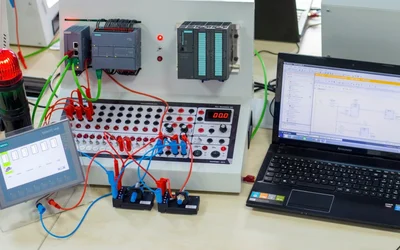
In this article, we'll see how PLC and SCADA systems differ, how they work together, and which protocols, scan times and security controls matter in industrial automation.
18 minutes read.
17 minutes read.
23 minutes read.
18 minutes read.
18 minutes read.
15 minutes read.


Semiconductors
Nordic Semiconductor is a fabless semiconductor company specializing in wireless technology that powers the IoT.
181 Posts

High Tech
High Tech Campus Eindhoven is Europe's smartest square km and has the ultim...
49 Posts

University for science and technology
Freedom and individual responsibility, entrepreneurial spirit and open-min...
43 Posts

Higher Education
Work together. Create smart machines. Serve society. University of Michiga...
40 Posts
A modern vehicle's competitive advantage lies in compiled firmware. Binary-level protection secures that code without source access, hardware changes, or a heavy memory budget.
AI-ready tools for embedded development evolve how engineers address real-world challenges.
Mario Mauerer, maxon's Global Business Development Manager, Robotics, discusses what it takes for robotic deployments to be successful in complex real-world environments.
Join Prof. Fei Chen as he explores advanced bimanual manipulation and teleoperation techniques shaping the future of intelligent human-like robots in this expert-led robotics session.
'Link-bots' can move, explore, cooperate without sensing or computation
This article is part 4 of a 4-part article series on TDK's advanced robotics.
JFETs unlock greater performance and efficiency in many IoT applications.
IoT projects do not fail because of the technology, they fail because of bad business cases.

3 minutes read
The real value of IoT for Electronic Logging Devices

4 minutes read
That’s why we need to focus on software-defined products, allowing for full customization without the need for physical access.
2 minutes read
EPFL researchers have discovered key 'units' in large AI models that seem to be important for language, mirroring the brain's language system. When these specific units were turned off, the models got much worse at language tasks.

4 minutes read
New type of "state-space model" leverages principles of harmonic oscillators.
Teams that are looking at alternative programming languages have two options today: Ada and Rust. Both languages raise the bar in terms of safety and security
"IntersectionZoo," a benchmarking tool, uses a real-world traffic problem to test progress in deep reinforcement learning algorithms.
A new method helps convey uncertainty more precisely, which could give researchers and medical clinicians better information to make decisions.
Service robots have evolved from simple automated machines to intelligent adaptive systems that can navigate unpredictable environments and interact with humans.
Smart locks are forming the front line for home security. Unlike regular locks, they eliminate the need for physical keys, allowing doors to lock and unlock through wireless connectivity. That connectivity brings innovation.

3 minutes read
A new approach could enable intuitive robotic helpers for household, workplace, and warehouse settings.
EPFL researchers have developed the first AI model of language in the brain that captures both how neurons are arranged and how they function.
3 minutes read
ETH Zurich researchers have developed a method that makes AI responses increasingly reliable. Their algorithm specifically selects data relevant to the question. In addition, even AI models up to 40 times smaller achieve the same output performance as the best large AI models.

4 minutes read
A new method from the MIT-IBM Watson AI Lab helps large language models to steer their own responses toward safer, more ethical, value-aligned outputs.