Featuredtechnical news
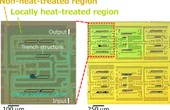
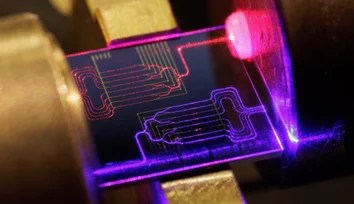
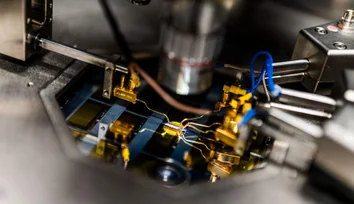
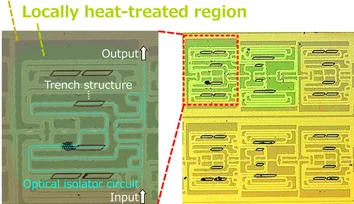
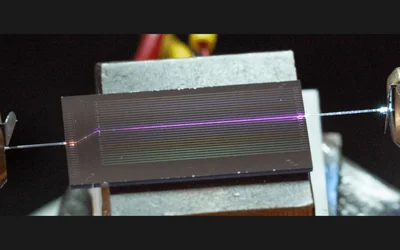
A laboratory device reaches 13.6 dB of isolation at 1540 nm, with heat confined to a window 700 micrometres across instead of the whole wafer going through a furnace.
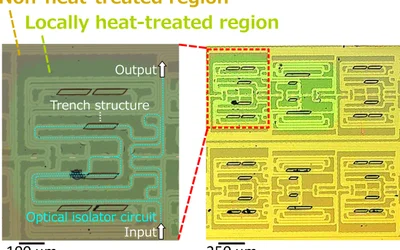
A laboratory device reaches 13.6 dB of isolation at 1540 nm, with heat confined to a window 700 micrometres across instead of the whole wafer going through a furnace.
A laboratory device reaches 13.6 dB of isolation at 1540 nm, with heat confined to a window 700 micrometres across instead of the whole wafer going through a furnace.
PICs are unlocking faster wireless technologies like FSO, 6G, and ISAC, with real solutions already emerging for today's biggest challenges.
Aluminum oxide PICs are gaining attention for their broad wavelength coverage, low optical losses, and support for on-chip optical amplification. In this discussion, Steve Stoffels, the CEO of Aluvia Photonics, explains where the platform fits and how teams can design with it.
Photoresist, a light-sensitive material, is essential in photolithography for transferring intricate circuit patterns onto semiconductor wafers. This article explores positive vs. negative photoresists, detailing their chemical mechanisms, processing parameters, and performance traits.


Higher Education
ITMO University is one of Russia's leading higher education and research institutions, specializing in Information Technology, Opt...
17 Posts

Machinery Manufacturing
We Are Giving Human Materials the Superpowers of Nature Using Lasers
1 Post

PICs are unlocking faster wireless technologies like FSO, 6G, and ISAC, with real solutions already emerging for today's biggest challenges.
Aluminum oxide PICs are gaining attention for their broad wavelength coverage, low optical losses, and support for on-chip optical amplification. In this discussion, Steve Stoffels, the CEO of Aluvia Photonics, explains where the platform fits and how teams can design with it.
Inverse design enables compact, foundry-ready silicon nitride photonic components
XIVER's Sreekanth Chirayath on why photonic innovations fail on the production line and how designing for manufacturing from the start changes the outcome.
A laboratory device reaches 13.6 dB of isolation at 1540 nm, with heat confined to a window 700 micrometres across instead of the whole wafer going through a furnace.
PICs are unlocking faster wireless technologies like FSO, 6G, and ISAC, with real solutions already emerging for today's biggest challenges.
Aluminum oxide PICs are gaining attention for their broad wavelength coverage, low optical losses, and support for on-chip optical amplification. In this discussion, Steve Stoffels, the CEO of Aluvia Photonics, explains where the platform fits and how teams can design with it.
Inverse design enables compact, foundry-ready silicon nitride photonic components
A laboratory device reaches 13.6 dB of isolation at 1540 nm, with heat confined to a window 700 micrometres across instead of the whole wafer going through a furnace.
PICs are unlocking faster wireless technologies like FSO, 6G, and ISAC, with real solutions already emerging for today's biggest challenges.
Aluminum oxide PICs are gaining attention for their broad wavelength coverage, low optical losses, and support for on-chip optical amplification. In this discussion, Steve Stoffels, the CEO of Aluvia Photonics, explains where the platform fits and how teams can design with it.
Inverse design enables compact, foundry-ready silicon nitride photonic components
XIVER's Sreekanth Chirayath on why photonic innovations fail on the production line and how designing for manufacturing from the start changes the outcome.
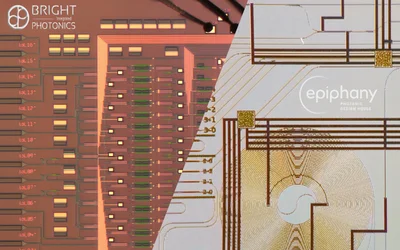
A Q&A with Epiphany Design and Bright Photonics on transforming PIC concepts into manufacturable systems, with practical guidance for teams participating in the Global Photonics Engineering Contest 2026.
A discussion with New Origin CEO Twan Korthorst on why SiN is gaining popularity as an integrated photonics platform and how dedicated foundries can take PICs from prototype to production, creating new opportunities for startups and Global Photonics Engineering Contest 2026 participants.
PhotonVentures explains how venture capital investors assess photonic chip startups, focusing on scalability, ecosystem alignment, and market readiness. They highlight key signals of investment readiness and the role of early validation opportunities like the Global Photonics Engineering Contest.
Indium phosphide (InP) enables fully integrated photonic chips with high performance and efficiency. As an InP foundry, SMART Photonics supports the transition from design to scalable production through mature platforms and proven design flows.
How can photonic integrated circuits push the limits of sensing systems? Join PhotonDelta's Global Photonics Engineering Contest and develop sensing technologies of the future.
Sidewall-poled lithium niobate device paves way for compact UV sources
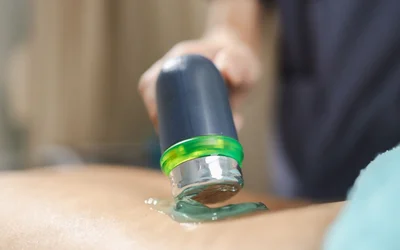
A new technique using ultrasound waves to activate light-emitting nanoparticles could be used to manipulate cell signals or facilitate light-based medical treatments in the future.
Datacom and AI infrastructure demands are rapidly driving the growth of integrated photonics. Philippe Soussan from imec explains his perspective on the recent developments and how he expects the industry to evolve in the next few years.
Learn how compact methane sensors use TDLAS, 1.6 µm detection, and InGaAs photodiodes to deliver stable, repeatable sub-ppm CH₄ measurements in industrial environments.
Insights into electro-optic frequency combs could lead to new applications

2 minutes read