The Focus-Free Advantage of Direct Retinal Projection
Direct Retinal Projection (DRP) technology eliminates vergence-accommodation conflict, delivering focus-free, high-resolution AR and VR experiences with unmatched comfort, clarity, and optical efficiency.

06 Nov, 2025. 4 minutes read
Focus-Free Advantage of Direct Retinal Projection
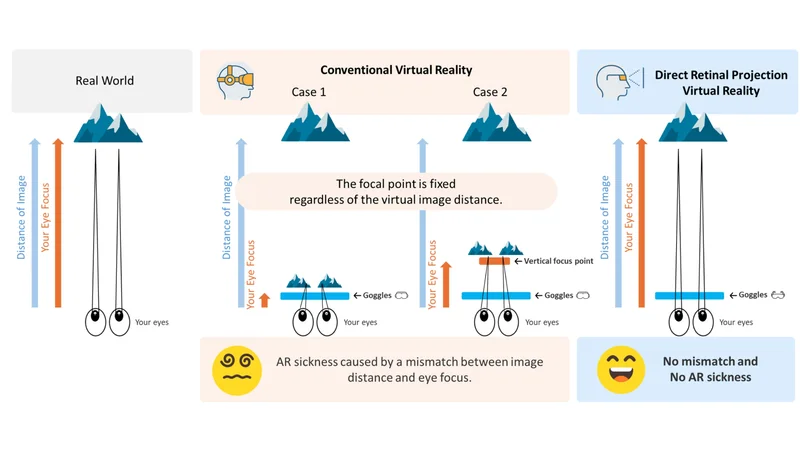
For decades, the design of immersive virtual reality systems has been constrained by a fundamental flaw in conventional display optics. Namely, the need to project an image at a fixed focal plane, even when virtual content is meant to appear at varying depths. This results in the well-documented vergence-accommodation conflict (VAC), a mismatch between where the eyes converge (vergence) and where the lenses of the eyes focus (accommodation). VAC breaks immersion, induces fatigue, eye strain, and can even cause nausea in users.
Fortunately, Direct Retinal Projection (DRP) technology offers an elegant and physiologically coherent solution. With a truly focus-free display system that projects imagery directly onto the retina, VAC can be avoided regardless of the viewer’s focal plane.
Vergence-Accommodation Conflict in Virtual Imaging
In the real world, vergence and accommodation are naturally coupled. When a person focuses on a nearby object, the eye’s lenses accommodate to bring that object into sharp focus, while the eye muscles converge the gaze at that point. This dual adjustment is automatic, coordinated, and essential to depth perception.
However, in traditional virtual imaging displays, images are shown either on a screen of glasses/goggles located a few centimeters from the eye or some fixed focal distance even if focal point is off-set from the screen. The brain is told that an object is located at some variable distance based on virtual imaging, but the eye’s lenses still accommodate to the fixed distance of the screen. This mismatch between convergence and accommodation leads to VAC.
VAC is ultimately a deep-rooted physiological conflict that leads to fatigue and breaks the cognitive illusion of immersion. Various workarounds have been attempted, from varifocal lenses to multi-focal plane displays and light field rendering, but all face significant mechanical or computational complexity.
Why DRP Is Fundamentally Focus-Free?
DRP architecture sidesteps the entire paradigm of focal plane rendering. Instead of forming an intermediate image in space for the eye to focus on, DRP projects a modulated laser beam directly onto the retina using a combination of MEMS mirrors and photonic modulation techniques. The retinal scanning approach bypasses the eye’s need to focus at all. Since the laser light arrives at the retina regardless the adjustment of lens of eyes, human can adjust lenses so that the lenses match with the distance of virtual image.
This eliminates the convergence-accommodation mismatch. Furthermore, because DRP images are always perceived in focus, regardless of where or how the eye is attempting to accommodate, they are uniquely well-suited to support dynamic focal cues without causing VAC.
The Optical Engineering Behind DRP’s Focus-Free Imaging
The DRP system is composed of several interdependent subsystems
Laser Light Sources: Red (638 nm), green (520 nm), and blue (455 nm) laser lights are coupled by a photonic integrated circuit (PIC) to generate full-colors input by coupling three colors.
Photonic Integration: TDK’s use of thin film lithium niobate (TFLN) on sputtered films as PIC to achieve a higher resolution and a lower power consumption down to 1/4 compared to conventional laser direct modulation.
MEMS Beam Scanning: A microelectromechanical system (MEMS) mirror raster-scans the laser beam across the retina in a pre-defined pattern to form the image point-by-point. The scanning mirror is synchronized with color modulation to reproduce full-resolution, full-color imagery.
Laser Integration: RGB three lasers and PIC can be directly integrated with a large coupling efficiency. This is the key to realize stylish glasses by a small form-factor.
All of this results in a self-contained, ultra-compact projection system that delivers consistently sharp images, regardless of user gaze direction, interpupillary distance, or optical aberrations.
Benefits of DRP in Augmented Reality (AR)
Focus-free architecture is impactful in augmented reality applications. In traditional AR displays, whether waveguide-based or holographic combiners, virtual images are projected at a fixed focal distance regardless of the contents of the virtual image. For example, viewing a digital instruction overlay on a real-world object becomes cognitively taxing if the virtual image is focused at 30 cm away, but the real object is at infinity. It causes a VAC issue.
DRP eliminates this barrier by delivering a retinal image that remains sharp and stable regardless of where the user’s eyes are focused. Virtual overlays can then coexist naturally with real-world scenes. Since the image is projected directly onto the retina, users can freely scan between physical and digital content without perceptual disruption.
Moreover, DRP enables transparent overlays even for users with uncorrected vision. Because the image bypasses the cornea and lens altogether, it remains sharp for users with myopia, hyperopia, or astigmatism.
Universal Benefits
The optical benefits of DRP extend well beyond its focus-free nature.
Conventional optical projection systems require increasing lens complexity as resolution grows, but DRP’s retinal scanning architecture is resolution-agnostic with respect to system size. Whether projecting 720p, 2K or even up to 4K, the module's form factor remains the same, as angular deflection and modulation bandwidth – not optics – determine resolution.
Additionally, DRP systems using TDK’s TFLN-PIC can realize higher resolution with lower power consumption due to voltage control.
A Comfortable Future
TDK’s DRP demonstration turns a core weakness of immersive display systems into a physiological strength. By eliminating the need for accommodation, DRP resolves the long-standing vergence-accommodation conflict without mechanical complexity, multi-layered optics, or user discomfort. In doing so, it redefines the expectations for both AR and VR display design. Whether enabling longer, sickness-free virtual imaging that blends smoothly with the real world, DRP provides a unique, retina-centric approach to visual computing.