Pushing Boundaries: Digital Beam Shaping For Quantum Computing and High Power Laser Material Processing
By manipulating light with exceptional accuracy, LCOS-SLM plays a crucial role in improving the performance of quantum systems and refining techniques in laser machining and other related applications.

22 Sep, 2025. 9 minutes read
![Figure 1 - Principle of LCOS-SLM [1]Pushing Boundaries: LCOS-SLM for Quantum Computing and High-Power lasers.](https://image.wevolver.com/eyJidWNrZXQiOiJ3ZXZvbHZlci1wcm9qZWN0LWltYWdlcyIsImtleSI6IjAub2Y4NWFyZnh6MGsyNTA5MTVfV2V2b2x2ZXItMDEuanBnIiwiZWRpdHMiOnsicmVzaXplIjp7IndpZHRoIjo4MDAsImhlaWdodCI6NDUwLCJmaXQiOiJjb3ZlciJ9LCJ3ZWJwIjp7InF1YWxpdHkiOjg1fX19)
Figure 1 - Principle of LCOS-SLM [1]Pushing Boundaries: LCOS-SLM for Quantum Computing and High-Power lasers.
The pursuit of enhanced precision and control is increasingly vital in the rapidly evolving fields of quantum computing and high-power laser material processing. A key component in this advancement is the Liquid Crystal on Silicon Spatial Light Modulator (LCOS-SLM), a cutting-edge technology that enables advanced digital beam shaping solutions. This innovative tool not only provides significant benefits to these diverse applications but also presents new opportunities for future developments. By manipulating light with exceptional accuracy, LCOS-SLM plays a crucial role in improving the performance of quantum systems and refining techniques in laser machining and other related applications.
Introduction to LCOS-SLM Technology
Imagine technology precise enough to manipulate qubits, the fundamental units of quantum computing, through exact control over light phase. This is made possible by LCOS-SLM (Liquid Crystal on Silicon - Spatial Light Modulator), which utilizes the light-modulating capabilities of liquid crystals enclosed between a silicon backplane and a cover glass.
Integrated with CMOS technology, the silicon backplane manages a pixel array, enabling the device to function in a reflective mode. This precision is critical for applications like quantum computing, where LCOS-SLMs create optical microtraps to arrange atoms in specific patterns, enhancing computational fidelity. In high-power laser machining, LCOS-SLMs shape laser beams for optimized cutting and welding, or they create multiple independently controllable laser beamlets, improving process throughput. Hamamatsu’s LCOS-SLM innovations are driving advancements not only in quantum computing but in the fields of laser machining, 3D Metal printing and cyber physical systems. You can read more about LCOS-SLM here[2].
Hamamatsu Photonics -Leading Innovations in LCOS-SLM
Hamamatsu has made significant strides in the development and enhancement of LCOS-SLM technology, as evidenced by its extensive portfolio of research papers and patents. One of the first patents on spatial light modulators from Hamamatsu was filed more than 30 years ago in 1992 [3]. The company has an in-house development process for key components including the LCOS-SLM system, LCOS Chip, CMOS Backplane, and optical thin films, showcasing their expertise in this field.
These innovations in LCOS-SLM technology drive advancements in multiple applications. LCOS SLMs enable the creation of precise optical microtraps, crucial for arranging qubits in desired configurations, enhancing the scalability and accuracy of neutral atom quantum computers. These developments have also resulted in a LCOS-SLM with the highest laser power handling capabilities in the world, and is set to enhance the efficiency of laser metal machining processes with a laser powers of up to 750 W. Additionally, Hamamatsu continues to focus on research and development [4] in spatial light control, striving for high-quality and high-throughput laser processing solutions.
Applications for Quantum Computing
Traditional computing involves manipulating binary operations—0s and 1s—that are stored in registers of various sizes, (8, 16, 32, or 64 bits). In quantum computing, we can think of qubits as the equivalent of these registers, with their manipulation serving as the instruction set. This means they can hold much more information than a classical bit. Think of it like having a register that can hold not just 0 or 1, but also any combination of 0 and 1 at the same time. Because qubits can exist in superpositions, quantum computers can perform many calculations simultaneously.
In neutral atom-based quantum computing, optical tweezers are used to capture or trap atoms, and highly sensitive cameras are then used to observe the location of those trapped neutral atoms. These microtraps are focused fields utilizing a laser to create a potential well that holds individual atoms in place. This provides exact control over the location of qubits, a necessary feature for building stable and scalable quantum systems. By carefully controlling the frequency, duration, and intensity of laser pulses, researchers can perform quantum gate operations [5]. Hamamatsu’s LCOS-SLMs are being used to generate microtrap arrays in various 2D/3D patterns to allow the arrangement of neutral atoms in a desired configuration. The pursuit of enhanced precision and control is increasingly vital in the rapidly evolving fields of quantum computing and high-power laser material processing. A key component in this advancement is the Liquid Crystal on Silicon Spatial Light Modulator (LCOS-SLM), a cutting-edge technology that enables advanced digital beam shaping solutions. This innovative tool not only provides significant benefits to these diverse applications but also presents new opportunities for future developments. By manipulating light with exceptional accuracy, LCOS-SLM plays a crucial role in improving the performance of quantum systems and refining techniques in laser machining and other related applications.
Introduction to LCOS-SLM Technology
Imagine technology precise enough to manipulate qubits, the fundamental units of quantum computing, through exact control over light phase. This is made possible by LCOS-SLM (Liquid Crystal on Silicon - Spatial Light Modulator), which utilizes the light-modulating capabilities of liquid crystals enclosed between a silicon backplane and a cover glass.
Integrated with CMOS technology, the silicon backplane manages a pixel array, enabling the device to function in a reflective mode. This precision is critical for applications like quantum computing, where LCOS-SLMs create optical microtraps to arrange atoms in specific patterns, enhancing computational fidelity. In high-power laser machining, LCOS-SLMs shape laser beams for optimized cutting and welding, or they create multiple independently controllable laser beamlets, improving process throughput. Hamamatsu’s LCOS-SLM innovations are driving advancements not only in quantum computing but in the fields of laser machining, 3D Metal printing and cyber physical systems. You can read more about LCOS-SLM here[2].
Hamamatsu Photonics -Leading Innovations in LCOS-SLM
Hamamatsu has made significant strides in the development and enhancement of LCOS-SLM technology, as evidenced by its extensive portfolio of research papers and patents. One of the first patents on spatial light modulators from Hamamatsu was filed more than 30 years ago in 1992 [3]. The company has an in-house development process for key components including the LCOS-SLM system, LCOS Chip, CMOS Backplane, and optical thin films, showcasing their expertise in this field.
These innovations in LCOS-SLM technology drive advancements in multiple applications. LCOS SLMs enable the creation of precise optical microtraps, crucial for arranging qubits in desired configurations, enhancing the scalability and accuracy of neutral atom quantum computers. These developments have also resulted in a LCOS-SLM with the highest laser power handling capabilities in the world, and is set to enhance the efficiency of laser metal machining processes with a laser powers of up to 750 W. Additionally, Hamamatsu continues to focus on research and development [4] in spatial light control, striving for high-quality and high-throughput laser processing solutions.
Applications for Quantum Computing
Traditional computing involves manipulating binary operations—0s and 1s—that are stored in registers of various sizes, (8, 16, 32, or 64 bits). In quantum computing, we can think of qubits as the equivalent of these registers, with their manipulation serving as the instruction set. This means they can hold much more information than a classical bit. Think of it like having a register that can hold not just 0 or 1, but also any combination of 0 and 1 at the same time. Because qubits can exist in superpositions, quantum computers can perform many calculations simultaneously.
In neutral atom-based quantum computing, optical tweezers are used to capture or trap atoms, and highly sensitive cameras are then used to observe the location of those trapped neutral atoms. These microtraps are focused fields utilizing a laser to create a potential well that holds individual atoms in place. This provides exact control over the location of qubits, a necessary feature for building stable and scalable quantum systems. By carefully controlling the frequency, duration, and intensity of laser pulses, researchers can perform quantum gate operations [5]. Hamamatsu’s LCOS-SLMs are being used to generate microtrap arrays in various 2D/3D patterns to allow the arrangement of neutral atoms in a desired configuration.
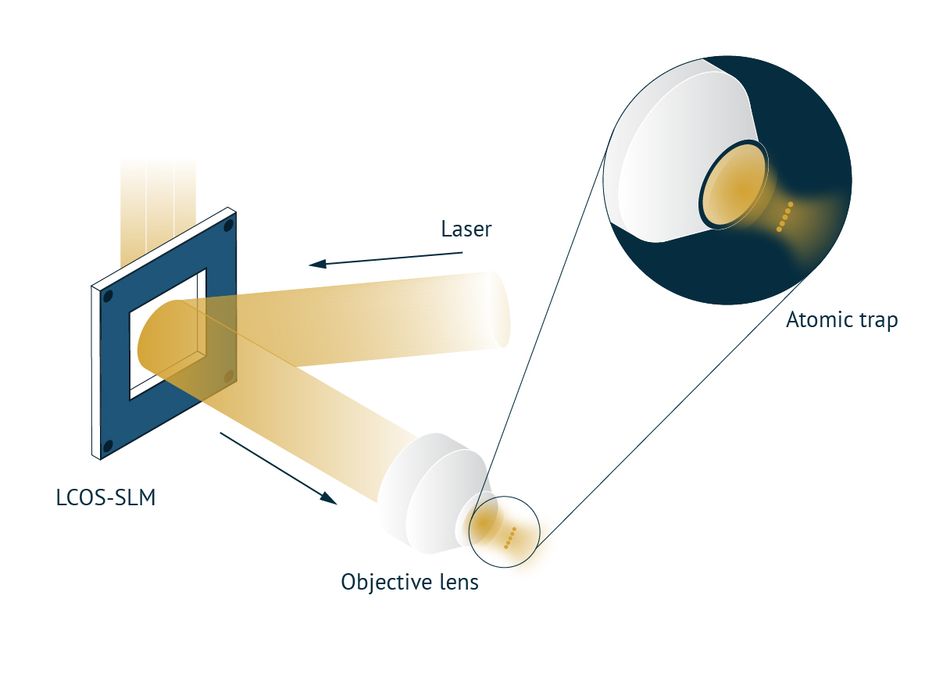
In quantum computers, increasing the number of optical traps related to qubits is crucial for enhancing computational speed. The higher the power of the laser used, the more atoms can be trapped for a longer period. Hamamatsu’s LCOS SLM’s are known for their efficient thermal management solutions. Though the laser powers required for creating a large number of optical traps are much lower than those needed for laser material processing, having an efficient thermal management system integrated into the LCOS SLM ensures extremely steady temperature for liquid crystals. This ensures minimal drift in positions of the optical traps. In addition, Hamamatsu’s LCOS SLMs have a low jitter mode [7] which provides further stability against the rapid twitching motion of liquid crystals for quantum computing and other sensitive applications. Scaling the capabilities of quantum computing requires that the optical traps be stable too. Hamamatsu is contributing to the field of quantum computing by developing LCOS-SLMs with technologies that ensure scalability as well as reliability.
Bringing Digital Beam Shaping to High-Power lasers
Lasers are commonly used in metal machining, but why use an LCOS-SLM (Liquid Crystal on Silicon Spatial Light Modulator) instead of firing a laser directly? Using a direct laser is akin to using a fixed-shaped tool in metal machining, which restricts the types of machining that can be performed. In contrast, an LCOS-SLM offers a dynamic and adaptable tool that can be customized for each specific machining task.
High-power lasers are often required for high-precision machining. However, when a high-power laser beam strikes the LCOS-SLM, it can cause a temperature increase in the liquid crystal layer, decreasing the device's performance and even damaging it permanently.
To address this issue, it is crucial to improve heat dissipation to reduce the temperature rise in the liquid crystal layer. Hamamatsu has already developed and sold a LCOS-SLM model, specifically the LCOS-SLM X15213-03BL/-03BR [8], which can handle laser inputs of up to 200 watts. This level of laser power tolerance is sufficient for laser processing applications like surface modification, marking, and micromachining. However, to target more industrial processing applications and to truly benefit from the multipoint processing which beam shaping offers, tolerance to higher laser powers is necessary.
Hamamatsu has addressed this need with the X15213-03CL LCOS-SLM, featuring a sapphire plate as the cover glass. Since the thermal conductivity of sapphire is about 30 times higher than that of conventional cover glass materials, the heat generated in the liquid crystal layer is more quickly transferred through the cover glass. What’s more, the LCOS-SLM package contains a filler with high thermal conductivity and has an optimized internal structure to increase the heat dissipation efficiency of the cover glass. These improvements proved effective in suppressing the temperature rise in the liquid crystal layer of the LCOS-SLM and succeeded in achieving the world’s highest laser power handling capability of up to 750 W.
Impact and Industry Adoption
Development in LCOS-SLM technology is expected to profoundly impact multiple industries, including 3D metal printing, metal machining with lasers for sectors such as aerospace, the realization of CPS (Cyber-Physical Systems ), and research industries like Quantum computing. Ongoing developments in LCOS-SLM, that entail handling lasers with 750 W power and trapping atoms with microtraps, are not just incremental advancements but rather catalysts for disruptive advancements across a wide range of industries.
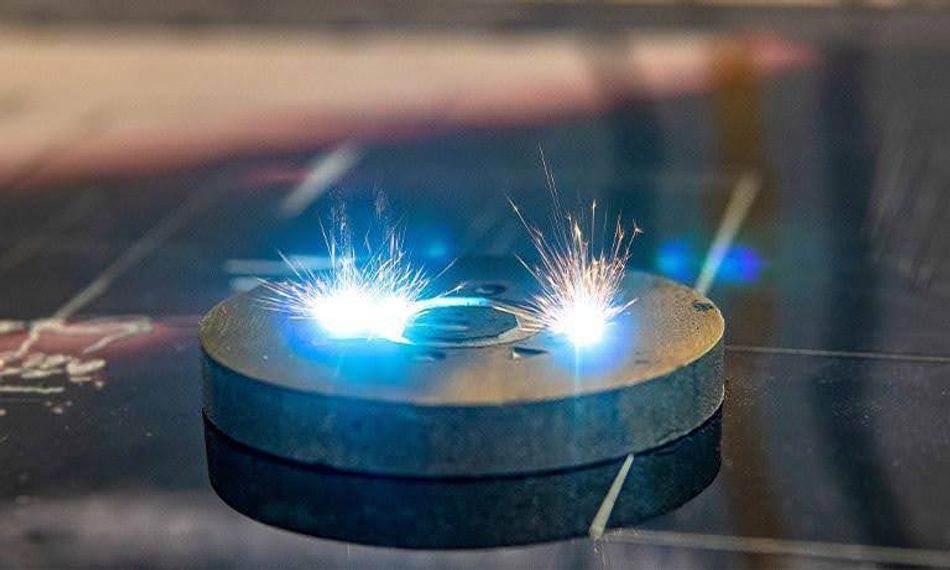
a. 3D metal printing - Metal 3D printing is an advanced technology that uses metal materials to create metal parts in various shapes based on their 3D data. Currently, producing high-strength structures in production quantities is very limited with conventional molding and cutting techniques. LCOS-SLM is promising as an optical device to solve the problems with metal 3D printers since it can freely control the shape of a laser beam. Incorporating an LCOS-SLM into the equipment allows the branching of a single laser beam into various shapes and multiple points.
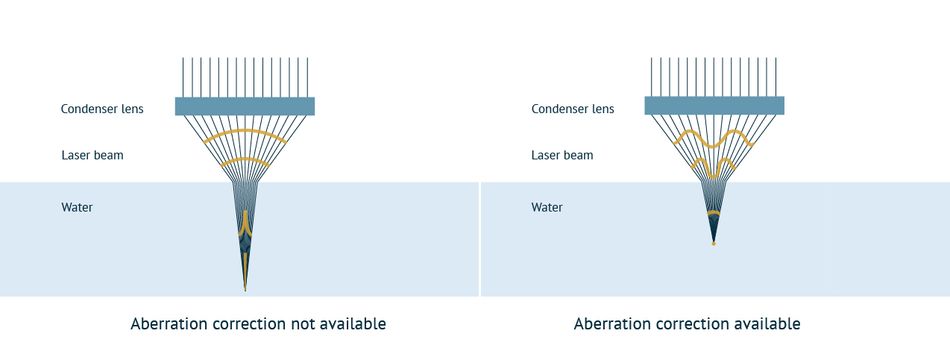
b. Laser machining of metals has advanced significantly with improved spatial light control technology, enabling high-quality micromachining, increased throughput, and enhanced machining stability compared to conventional methods.Hamamatsu’s LCOS-SLM X15213-03CL, featuring a film mirror, water-cooled heatsink, and sapphire glass, is an example of advanced technology designed for metal processing tasks.
c. Realization of Cyber-Physical Systems - One of the key technologies to realize the CPS is a device that controls light precisely, spatial light control technology [11].
d. Quantum Computation – Improving the computational capabilities of Quantum computing systems by providing more microtraps.
e. Stealth Dicing – The stealth dicing™ process is a dicing method that uses a pulsed laser to perform a high-quality cutting by processing the inside of the wafer. This process has become very useful in semiconductor manufacturing.
The Impact of LCOS-SLM on Modern Technology
Hamamatsu has played a significant role in spatial light control. LCOS-SLM devices manufactured by Hamamatsu are helping research industries like Quantum computing by providing precise optical trapping (microtraps) and manipulation of qubits, which is crucial for scalability and complex computations. In laser material processing applications, innovation in light resistance by providing effective thermal management and material science has allowed the industry to use high-power lasers up to 750 Watts with LCOS SLMs. These contributions are pivotal in pushing the boundaries of both quantum computation and high-power laser material processing.
Sources
[1] Hamamatsu Website [Internet] Available from: https://lcos-slm.hamamatsu.com/jp/en/learn/about_lcos-slm/principle.html
[2] Hamamatsu Website [Internet] Available from: https://lcos-slm.hamamatsu.com/jp/en/application/quantum_technology.html
[3] Google Patent Website [Internet] Available from : https://patents.google.com/patent/EP0583114A2
[4] Hamamatsu Website [Internet] Available from: https://lcos-slm.hamamatsu.com/jp/en/rd/sip.html
[5] Hamamatsu Website [Internet] Available from: https://lcos-slm.hamamatsu.com/jp/en/application/quantum_technology.html
[6] Hamamatsu Website [Internet] Available from : https://lcos-slm.hamamatsu.com/jp/en/application/quantum_technology.html
[7] Hamamatsu Website [Internet] Available from : https://www.hamamatsu.com/eu/en/news/featured-products_and_technologies/2025/precision-for-quantum-computing-and-manufacturing.html
[8] Hamamatsu Website [Internet] Available from : https://www.hamamatsu.com/content/dam/hamamatsu-photonics/sites/documents/99_SALES_LIBRARY/lpd/x15213_E.pdf
[9] Hamamatsu Website [Internet] Available from : https://lcos-slm.hamamatsu.com/jp/en/application/laser-processing.html
[10] Hamamatsu Website [Internet] Available from : https://lcos-slm.hamamatsu.com/jp/en/application/laser-processing.html
[11] Hamamatsu Website [Internet] Available from : https://lcos-slm.hamamatsu.com/jp/en/rd/case.html
[12] Hamamatsu Website [Internet] Available from: https://www.hamamatsu.com/us/en/our-company/business-domain/central-research-laboratory/optical-information-processing-and-measurement/holographic.html