Integrated Photonics Spotlight: Rethinking Connectivity in Data Centers and Telecom
How the DataComb Team is Exploring Photonic Frequency Combs to Unclog the Optical Bottlenecks of Tomorrow?

03 Feb, 2026. 6 minutes read

Industry analyses indicate that the explosive growth in data center and telecom traffic — mainly driven by AI workloads — is outpacing the capabilities of current optical interconnect technologies. Traditional pluggable optics and electrical links are approaching practical limits in both bandwidth and energy efficiency, making optical I/O bottlenecks a critical factor in large cluster performance rather than compute hardware alone [1,2,3].
Telecom networks and data centers are both essential for global connectivity, but they are now struggling with congestion. As computing and AI workloads grow, traditional transceiver designs are approaching their bandwidth and energy-efficiency limits [1].
Over time, the industry has adopted coherent optics, wavelength-division multiplexing (WDM), and successive generations of pluggable transceivers to meet increasing bandwidth demands. However, the growing complexity and integration of these materials into high-performance components remain technically challenging, expensive, and power-intensive.
Each wavelength path in a WDM system adds engineering and logistical cost, highlighting both the elegance and complexity of modern optical design [4,5]. This is where integrated photonics is being explored, not as a temporary fix, but as an industry-changing shift in how optical connectivity is built. This article spotlights a creative idea from the DataComb team, submitted to the PhotonDelta Global Photonic Engineering Contest. Their concept proposes a novel optical switch architecture that combines scalable, energy-efficient photonic building blocks to address one of the biggest challenges in data centers and telecom: moving massive data faster, cleaner, and more efficiently.
Current Bottlenecks in Optical I/O and Interconnect
The connectivity dilemma in data centers and telecom backbones is driven by exponentially increasing bandwidth demand and declining energy efficiency. Silicon-based transceivers need expensive individual lasers, drivers, and temperature tuning to deliver terabit-scale throughput across several lanes. Duplicating hardware for each wavelength becomes economically and thermally unsustainable as data centers grow. Modern solutions use WDM systems, in which each wavelength carries a distinct data stream. This approach works, but scaling up requires more-precise lasers, frequently external-cavity types, which are expensive to stabilize and integrate.
Telecommunication systems face similar constraints, especially with next-generation 5G/6G rollouts and AI-native infrastructure, where latency and bandwidth ceilings directly shape user experience and service viability [6]. Coherent transceivers recover both amplitude and phase to boost efficiency and reach, but they introduce complexity through high-power digital signal processing and tight stabilization requirements. [7] While powerful, they are bulky and ill-suited for dense on-board integration. Consequently, there is a widening mismatch between what modern data systems can compute and what their photonic interfaces can effectively move. What’s needed is an interconnect paradigm that is modular, energy-efficient, and photonics-native, something the current state of the art cannot fully deliver.
Hybrid Photonic Integration: A New Class of Comb-Driven Architectures
Photonic frequency combs are novel concepts designed to provide an elegant alternative: a single light source that generates multiple, evenly spaced wavelengths across a broad spectrum. In the frequency domain, the output looks like a set of narrow lines with fixed spacing; in the time domain, it corresponds to a periodic train of short optical pulses. These comb lines would act as built-in carriers for parallel data channels, enabling wavelength-division multiplexing from a single, perfectly spaced, inherently coherent source, potentially generated on-chip.
Small, low-loss microresonators can be used to build frequency combs utilizing Kerr nonlinearities through hybrid photonic integration, particularly on platforms such as silicon nitride (Si₃N₄), which supports high-Q resonators and low propagation loss. These integrated soliton combs suggest scalability, coherence, and compact footprints without the need for discrete lasers.
The open question is how to translate such combs into practical modulation and transmission systems that meet data center and telecom workload requirements. The DataComb team explored this problem space.
Spotlight: The DataComb Team’s Integrated Frequency Comb Engine for Data Centers
The DataComb team, based at ETH Zurich, submitted a conceptual optical switching engine that addresses the triad of challenges in modern interconnects: scalability, energy efficiency, and manufacturability.
Their idea is a reconfigurable photonic switching circuit based on a modular silicon nitride (Si₃N₄) platform. The circuit is interconnected using ultra-low-loss waveguides and a largely passive layout emphasizing stability. The architecture is designed to theoretically scale to hundreds or thousands of ports with minimal insertion loss and power overhead.
The concept outlines using low-voltage electro-optic tuning mechanisms to scale quickly without needing heavy thermal loads, avoiding power-hungry thermal phase shifters or brittle micro-mechanical systems. For dynamic workloads and elastic network topologies, this suggests a path toward reducing energy per bit and enabling nanosecond-scale reconfiguration.
Inside the Technology: Soliton Combs on a Scalable Platform
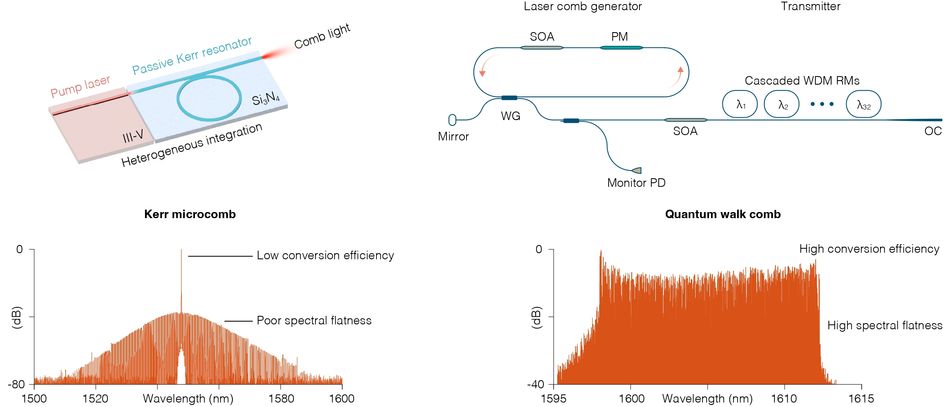
The dissipative Kerr soliton is envisioned as the system's foundation: a stable pulse train generated through nonlinear interactions within the microresonator. Once formed, the soliton could support tens of sharp comb lines across the optical C-band and beyond. Stabilization would rely on integrated thermal elements, locking-tuning elements, and microheaters to lock the pump wavelength with sub-picometer precision.
In terms of footprint, the entire PIC, including the comb generator, modulator array, and power splitters, could fit on a few square centimeters of silicon nitride substrate. This suggests the potential for multi-terabit transceivers with minimal packaging volume, making them ideally suited for integration with switch ASICs or optical engines.
A central attraction in the DataComb team’s vision is the potential for low-noise, low-phase-error comb lines, which could reduce bit error rates in downstream receivers. On-chip optical filtering could isolate specific channels without requiring external mux/demux components.
Potential Performance and Scalability
The architecture is currently a conceptual design rather than a deployed platform. In principle, arrays of such comb engines could feed directly into pluggable optics or co-packaged switch modules. Each unit might deliver tens to hundreds of gigabits per second per line, with total aggregate throughput in the multi-terabit range, all from a single laser source.
Projected power consumption appears promising. The comb generator could operate on only a few hundred milliwatts, and eliminating dozens of individual lasers could yield significant thermal savings. This would directly impact energy efficiency, particularly in hyperscale deployments where power budgets are under intense scrutiny.
The concept also imagines applicability to long-haul telecom-grade transmission. Early lab demonstrations of comb-based systems have shown stability over kilometer-scale fiber spools, hinting at viability for intra-datacenter links and metro and backbone systems. Coherence across channels could also support coherent detection and advanced DSP algorithms, offering a pathway to future-proofing without sacrificing integration potential.
Fields of Application
Should the concept become a reality, its use cases are spread across fields, including;
Data Centers of the Future
In its conceptual framing, DataComb envisions more compact, efficient photonic interconnects for data centers. With integrated frequency combs, a single chip could serve as a dense optical source for thousands of simultaneous data channels, reducing footprint and energy use.
Telecommunications Networks
For long-haul fiber networks, comb-based sources could replace banks of discrete lasers, simplifying architectures and potentially reducing costs. While speculative, it illustrates a vision of streamlined, scalable telecom systems.
Emerging Computing Platforms
Beyond traditional networking, the concept hints at potential intersections with emerging fields such as neuromorphic computing and quantum communications. Frequency combs are already of interest in those domains, and integrating them into PICs could create new synergies.
Because the switching design is material-agnostic and architecture-flexible, the same ideas might also inspire use in:
● Wavelength-selective routers in telecom grids
● Multiplexed optical signal distribution across AI accelerators
● Quantum photonic processors, where ultra-low-loss, reconfigurable networks are vital
It is crucial to emphasize that these are future-facing possibilities. They are not commitments, but imaginative sketches of where photonics might one day find traction.
Conclusion: Ideas for the Networks of Tomorrow
Without reinventing the backbone that moves the data, there is no AI revolution, no 6G future, and no sustainable hyperscale computing. As demand explodes, energy constraints tighten, and latency becomes a first-order priority, integrated photonics offers exciting avenues for innovation.
The DataComb team’s submission demonstrates how hybrid photonic architectures based on soliton frequency combs could one day deliver transformative gains in the data center and telecom domains.
By compressing the optical I/O stack into a conceptual co-packaged, chip-scale solution, the project points toward a possible optical era, one where speed, scale, and simplicity are no longer at odds, and where the next wave of digital infrastructure is inspired not just by products, but by ideas that spark the future.
References:
McKinsey & Company, "Opportunities in Networking Optics: Boosting Supply for Data Centers," McKinsey & Company, 2025.
Data Center Dynamics, "How Optical Interconnect and Optical Processing Are Changing Data Centers," Data Center Dynamics, 2025.
PhotonDelta, "Path to AI Data Centers is Paved with Optical Interconnect," PhotonDelta, 2025.
“Why Choose Indium Phosphide Over Silicon in Optical Communications?” Patsnap Eureka, 2025
“An Introduction to Integrated Photonic Material Platforms,” L&T Photonics, 2024.
Z. Zhang, “6G Wireless Networks: Vision, Requirements, Architecture, and Key Technologies,” IEEE Vehicular Technology Magazine, vol. 14, no. 3, pp. 28-41, Sep. 2019.
A. A. Juarez, Y. Zhu, X. Chen, and M.-J. Li, "Design Considerations for 1.6 Tbit/s Data Center Interconnects: Evaluating IM/DD and Coherent Transmission over O-Band Transmission Window," Photonics, vol. 11, no. 12, pp. 1179, Dec. 2024.