Featured
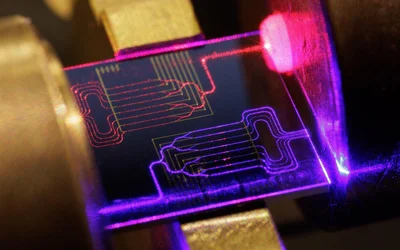
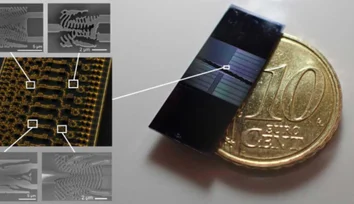
Nanophotonic devices developed at MIT are compact, efficient, reprogrammable, adaptive, and able to dynamically respond to external inputs.

Nanophotonic devices developed at MIT are compact, efficient, reprogrammable, adaptive, and able to dynamically respond to external inputs.
Nanophotonic devices developed at MIT are compact, efficient, reprogrammable, adaptive, and able to dynamically respond to external inputs.
Researchers at ITMO University have developed a new photoluminescence amplification method for silicon. The metasurface designed by the physicists can enhance silicon's ability to absorb and emit light by 10,000 times – at a record-low volume of the material.
Researchers blend theoretical insight and precision experiments to entangle photons on an ultra-thin chip
Photoresist, a light-sensitive material, is essential in photolithography for transferring intricate circuit patterns onto semiconductor wafers. This article explores positive vs. negative photoresists, detailing their chemical mechanisms, processing parameters, and performance traits.


Higher Education
ITMO University is one of Russia's leading higher education and research institutions, specializing in Information Technology, Opt...
17 Posts

Machinery Manufacturing
We Are Giving Human Materials the Superpowers of Nature Using Lasers
1 Post

PICs are unlocking faster wireless technologies like FSO, 6G, and ISAC, with real solutions already emerging for today's biggest challenges.
Aluminum oxide PICs are gaining attention for their broad wavelength coverage, low optical losses, and support for on-chip optical amplification. In this discussion, Steve Stoffels, the CEO of Aluvia Photonics, explains where the platform fits and how teams can design with it.
Inverse design enables compact, foundry-ready silicon nitride photonic components
XIVER's Sreekanth Chirayath on why photonic innovations fail on the production line and how designing for manufacturing from the start changes the outcome.
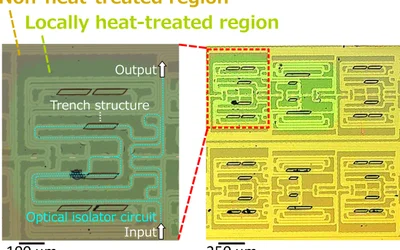
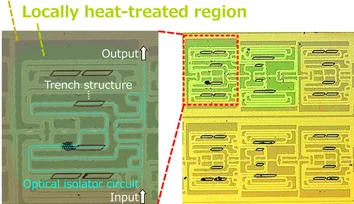
A laboratory device reaches 13.6 dB of isolation at 1540 nm, with heat confined to a window 700 micrometres across instead of the whole wafer going through a furnace.
PICs are unlocking faster wireless technologies like FSO, 6G, and ISAC, with real solutions already emerging for today's biggest challenges.
Aluminum oxide PICs are gaining attention for their broad wavelength coverage, low optical losses, and support for on-chip optical amplification. In this discussion, Steve Stoffels, the CEO of Aluvia Photonics, explains where the platform fits and how teams can design with it.
Inverse design enables compact, foundry-ready silicon nitride photonic components
Nanophotonic devices developed at MIT are compact, efficient, reprogrammable, adaptive, and able to dynamically respond to external inputs.
Researchers at ITMO University have developed a new photoluminescence amplification method for silicon. The metasurface designed by the physicists can enhance silicon's ability to absorb and emit light by 10,000 times – at a record-low volume of the material.

2 minutes read
Researchers blend theoretical insight and precision experiments to entangle photons on an ultra-thin chip

3 minutes read
Ring design could be used in telecom, medicine and more
3 minutes read
What if electrons aren't the future of AI computation? What if photons could shoulder the load?
A team of researchers from ITMO University, Polytechnic University of Milan (Italy), and the University of Brescia (Italy) have developed a new approach to control the properties of metasurfaces using laser radiation.
2 minutes read
This article examines the application of MFX source technology in inspecting cylindrical, pouch, and prismatic battery cells, highlighting its technical advantages, integration capabilities, and the increasing need for such inspections in modern manufacturing environments.
Engineers have harnessed quantum physics to detect the presence of biomolecules without the need for an external light source, overcoming a significant obstacle to the use of optical biosensors in healthcare and environmental monitoring settings.

3 minutes read
PhD candidate Sabrina Corsetti builds photonic devices that manipulate light to enable previously unimaginable applications, like pocket-sized 3D printers.
TFLN offers a much smaller footprint and improved modulation efficiency, making it highly attractive for short-reach optical communication and future integrated photonics.
Scientists at ITMO have come up with a new way to protect microelectronics devices from counterfeit. The new technology is based on gold and silicon nanoparticles with unique optical properties that make it possible to create unclonable functions with a record information density.
3 minutes read
Photonic integrated circuits are enabling smarter, faster, and more sustainable environmental monitoring.
By performing deep learning at the speed of light, this chip could give edge devices new capabilities for real-time data analysis.
Enabling precision, efficiency, and miniaturization in industrial automation through advanced photonics.
The winner of the Global Photonics Engineering Contest, Perceptra from San Francisco, is setting a new benchmark for real-time molecular monitoring.