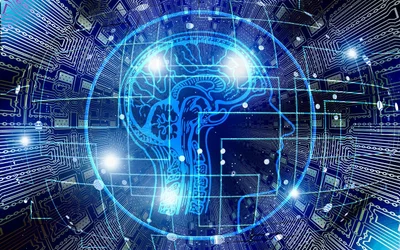
Artificial intelligence (AI) is a wide-ranging tool that enables people to rethink how we integrate information, analyze data, and use the resulting insights to improve decision making

In large-scale warehousing and distribution operations, conveyor belts are an essential infrastructure that must operate with near-zero downtime to ensure the timely delivery of products. The presence of loose or foreign items on a conveyor belt can pose a serious risk to these operations.
To reduce waste, the Refashion program helps users create outlines for adaptable clothing, such as pants that can be reconfigured into a dress. Each component of these pieces can be replaced, rearranged, or restyled.
Smart eyewear promises to transform how we see and interact with the world. Among its many potential advantages, the technology offers hands-free access to information, vision enhancement, and accessibility tools.
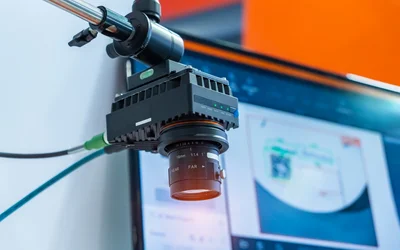
Matroid builds no-code computer-vision detectors that can spot everything from microscopic material defects to real-time safety hazards on a factory floor.
In large-scale warehousing and distribution operations, conveyor belts are an essential infrastructure that must operate with near-zero downtime to ensure the timely delivery of products. The presence of loose or foreign items on a conveyor belt can pose a serious risk to these operations.
In this post, we'll walk through how to evaluate that progress using the same metrics our platform provides automatically, so you can build detectors that get smarter, sharper, and more reliable over time.
The no-code platform from Matroid trains ordinary cameras to act like expert inspectors, turning simple footage into a pixel-level defect checklist. Even a handheld GoPro can spot issues human eyes miss—using remarkably small datasets.
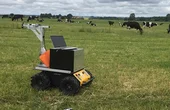
Robots are gradually permeating into more and more areas of our daily life: smart cars are at work on storage facilities and production sites, they test delivery services.
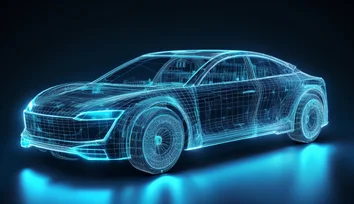
In recent years, we have experienced the success of modern machine learning (ML) models. Many of them have led to unprecedented breakthroughs in a wide range of applications, such as AlphaGo beating a world champion human player or the introduction of autonomous vehicles.
Love is Blind's AI/data scientist Cameron Hamilton speaks with Rachel Gordon of MIT's Computer Science and Artificial Intelligence Laboratory on his AI company, finding love on the hugely popular Netflix show, and where he sees the future of digital dating.
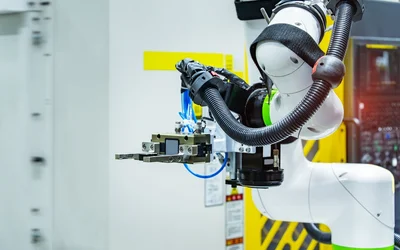
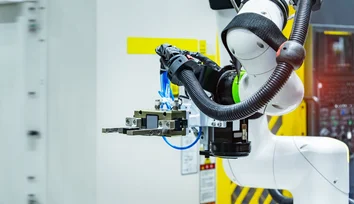
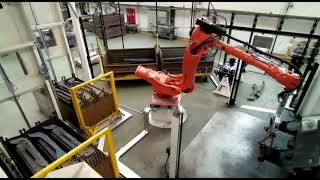
As the world becomes increasingly automated, the IoT (Internet of Things) is already transforming our domestic and business lives. Nowhere is this more apparent than in the use of AI and robotics in the manufacturing industry, with all the benefits offered by Industry 4.0.
Up to this point, no attacks had been discovered targeting a car’s LiDAR system—but a major new finding from researchers at the University of Michigan has demonstrated what that might look like.
The frame in which a human marks out the boundaries of an object makes a huge difference in how well AI software can identify that object through the rest of the video.
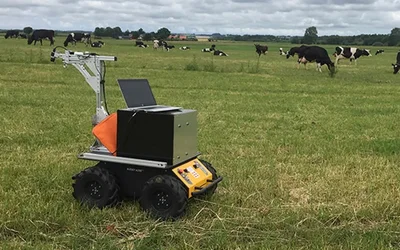
If you’re unfamiliar with the term, GPS Waypoint Navigation is the ability to provide a robot with a set of GPS waypoints (i.e., a set of latitude / longitude pairs), and have the robot autonomously navigate from its current location to each of the defined waypoints.
For robots to keep up with the pace of technological innovation, machine learning has become paramount. While robots are already effective at alleviating the manual operation of routine tasks, an intelligent robot should also be able to process their commands with future actions in mind.
We are announcing the release of our state-of-the-art off-policy model-free reinforcement learning algorithm, soft actor-critic (SAC). This algorithm has been developed jointly at UC Berkeley and Google, and we have been using it internally for our robotics experiment.
Daniel Lofaro talks about how he works hard to make things easier and how co-robotics are the way forward, and how bringing cost down cost and better AI is critical for this.