Featured
Modern robots know how to sense their environment and respond to language, but what they don’t know is often more important than what they do know. Teaching robots to ask for help is key to making them safer and more efficient.
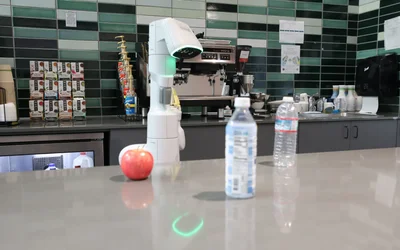
Modern robots know how to sense their environment and respond to language, but what they don’t know is often more important than what they do know. Teaching robots to ask for help is key to making them safer and more efficient.
Modern robots know how to sense their environment and respond to language, but what they don’t know is often more important than what they do know. Teaching robots to ask for help is key to making them safer and more efficient.
Learn more about a groundbreaking solution called Temporal Event-based Neural Networks (TENNs) developed by BrainChip, which efficiently combines spatial and temporal convolutions to process sequential data like never before.
In this episode, we discuss a GPT style AI model being developed by a multidisciplinary team led by the University of Michigan to tackle the battery development bottleneck preventing wide scale adoption of electric vehicles.
Artificial intelligence (AI) is a wide-ranging tool that enables people to rethink how we integrate information, analyze data, and use the resulting insights to improve decision making
15 minutes read.
20 minutes read.
13 minutes read.
17 minutes read.
25 minutes read.
11 minutes read.


Entertainment
The Next Byte Podcast is hosted by two young engineers - Daniel and Farbod - who select the most interesting tech/engineering cont...
165 Posts

High Tech
High Tech Campus Eindhoven is Europe's smartest square km and has the ultim...
49 Posts

University for science and technology
Freedom and individual responsibility, entrepreneurial spirit and open-min...
43 Posts
From leading experts at the CDFAM Computational Design Symposium
eCozy 2.0 system addresses the limitations of traditional thermostats for water heating radiators, delivering efficiency, convenience and sustainability benefits to households
Protect the cloud by securing the edge with hardware-based security, TPMs, HSMs, and resilient edge computing architectures.
Explore the rise of intelligent EV hardware and how real-time processing, ML acceleration, and hardware virtualization are enabling safer, smarter, software-defined electric vehicles.
EPFL researchers are developing AI models that could one day enable vision prosthetics able to restore meaningful, object-level sight for the blind.
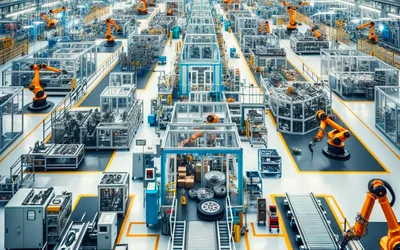
A deep-dive listicle guiding controls, automation, and quality engineers toward the best vision systems for manufacturing applications in 2026.
Understanding industrial vision systems by examining their components, imaging fundamentals, AI integration since 2020, and how to choose the right solution for every application.
The AI-powered tool could inform the design of better sensors and cameras for robots or autonomous vehicles.
Modern robots know how to sense their environment and respond to language, but what they don’t know is often more important than what they do know. Teaching robots to ask for help is key to making them safer and more efficient.

5 minutes read
Learn more about a groundbreaking solution called Temporal Event-based Neural Networks (TENNs) developed by BrainChip, which efficiently combines spatial and temporal convolutions to process sequential data like never before.
In this episode, we discuss a GPT style AI model being developed by a multidisciplinary team led by the University of Michigan to tackle the battery development bottleneck preventing wide scale adoption of electric vehicles.

16 minutes read
Sensor fusion enables the seamless integration of data from multiple sensors, paving the way for advanced Edge AI implementations that optimize real-time processing, enhance decision-making, and boost system responsiveness in dynamic environments.
A research team from EPFL and Wageningen University has developed a new artificial intelligence model that recognises floating plastics much more accurately in satellite images than before. This could help to systematically remove plastic litter from the oceans with ships.
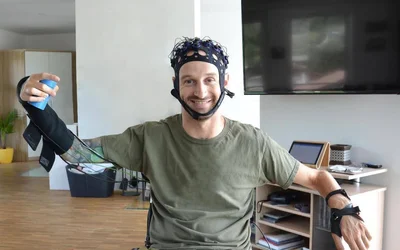
An interdisciplinary venture to shape the future of healthcare, communication, and human capability.
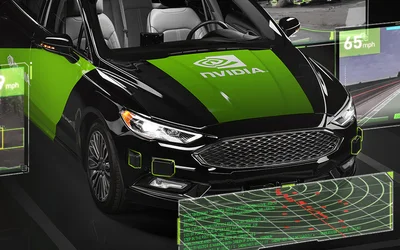
Danny Shapiro, the Vice President of Automotive at NVIDIA discusses the challenges, breakthroughs, and vision that are propelling autonomous vehicles into the next era.
Sponsor interview with Mark Patrick, the Director of Technical Content, EMEA at Mouser Electronics.
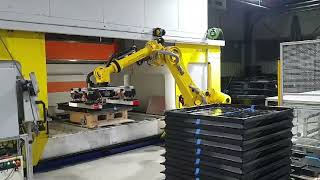
The customer, an automotive manufacturer, needed an automation solution for the palletization and depalletization of large ABS parts. They decided on a solution where one vision-guided robot operates both processes.

Revolutionizing Engineering Quality Control: The Transformative Power of Edge AI
Here we describe a movement known as “Edu Tech” that encourages the development of new technology to bring about major changes in educational methods

7 minutes read
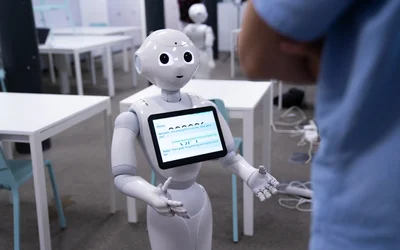
Lessons learnt from integrating ChatGPT in Pepper and NAO

4 minutes read
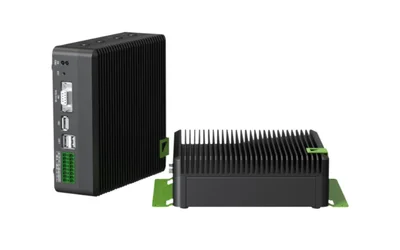
Explore Seeed Studio ReComputer: Industrial AI Devices for Enhanced Efficiency and Automation
In this episode, we talk all about connectomics - the study of animal brains - and how researchers at MIT have started leveraging AI to break through the primary bottleneck: brain image acquisition.
18 minutes read