Regulated vs. Unregulated Converters – When to Choose Which?
Understand the key differences between regulated and unregulated DC/DC converters, their tradeoffs in stability, efficiency, cost, and how to choose the right option for your power design.

22 Jan, 2026. 4 minutes read
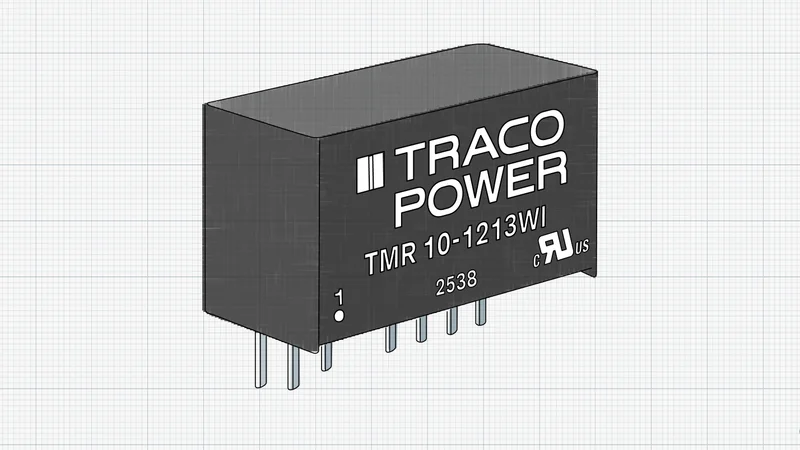
Regulated DC/DC converter | Source: Traco Electronics AG
In power electronics, one of the first considerations in designing a DC system is whether to use a regulated or an unregulated DC/DC converter. The choice directly affects voltage stability, accuracy, efficiency, cost, and overall reliability.
Understanding how regulation influences performance in industrial automation, medical instruments, and IoT devices can determine whether a product succeeds in real-world use.
This article outlines the differences between regulated and unregulated DC/DC converters, highlighting where each type excels and where its limitations become apparent.
What Regulation Means in DC/DC Converters?
A DC/DC converter converts one DC voltage level to another, typically using either a switching or a linear approach. The term “regulation" refers to the converter's capacity to maintain a constant output voltage despite fluctuations in input voltage or load current.
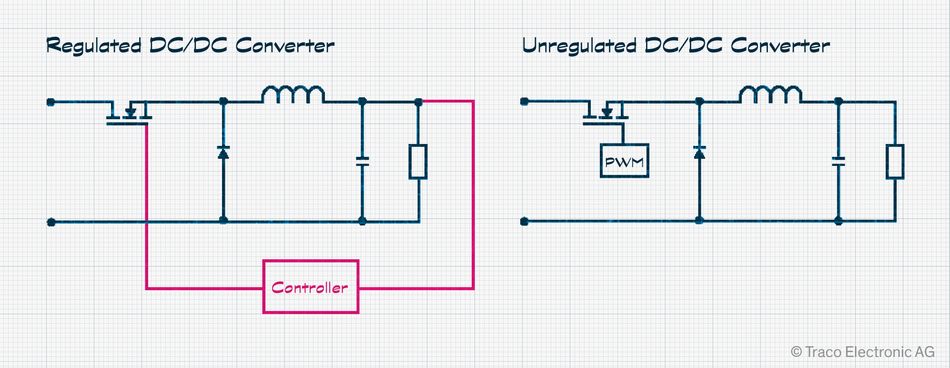
Unregulated Converters are simple designs composed primarily of a transformer (for isolation), a rectifier, and filter components. Because they lack feedback control, their output voltage is directly proportional to the input voltage and the load current. When the input increases or the load drops, the output voltage tends to climb, and vice versa.
Regulated Converters, on the other hand, have a feedback control loop that continuously monitors the output voltage and adjusts the switching duty cycle or other control elements to maintain output stability.
Whether accomplished using linear regulation or switching topologies (such as buck, boost, or isolated forward/flyback), the purpose is the same: measure, compare, and correct. The necessity of voltage regulation in modern systems cannot be overstated, as various subsystems rely on a steady DC rail.
Comparison at a Glance
| Feature | Regulated Converter | Unregulated Converter |
| Stability under Input Changes | Excellent, maintains steady output | Poor – varies proportionally with input |
| Output Voltage Accuracy | Tight voltage control, minimal deviation | Dependent on load current |
| Complexity / Cost | Higher (includes control circuitry) | Lower (simpler design) |
| Efficiency | Varies by topology; can be high with modern switching designs. | Typically higher due to simplicity |
| Typical Applications | Communication equipment, sensors, embedded systems | Motors, LED lighting, non-critical loads |
| Ripple & Noise | Low (with good design and filtering) | Moderate to high |
| Size & Weight | Compact in high-frequency switchers | Generally compact but less stable |
When to Use Each Type?
Use Regulated DC/DC Converters When:
Input Voltage Fluctuates: Battery-powered and renewable energy systems frequently face large voltage swings. Regulation ensures that the downstream electronics see a constant voltage independent of source behavior.
The Load is Sensitive: Microcontrollers, communication modules, and analog sensors require exact voltages to function properly and prevent malfunctions or data corruption.
Multiple Loads Share One Converter: Maintaining voltage stability in dispersed systems with fluctuating current draw reduces cross-interference between circuits.
Long Cable Runs or Environmental Variations Exist: Voltage drops caused by wire resistance or temperature-dependent component movements might compromise supply accuracy. Regulation compensates for these consequences automatically.
Use Unregulated DC/DC Converters When:
Input and Load are Relatively Stable: A fixed industrial DC bus, for example, can withstand mild voltage fluctuations while serving stable loads.
Voltage Tolerance of ±10-20% is Acceptable: Devices such as DC motors, solenoids, and resistive heaters can operate normally within this range.
Cost, Simplicity, and Size Take Priority: Unregulated converters, which have fewer components and no feedback circuitry, are frequently smaller and more efficient at mild loads.
Transient Behavior is Well Understood: In low-power or non-critical applications, voltage variations during switching or load changes may be insignificant.

Both converter types still serve useful purposes. Regulated designs offer steadier, more predictable output, while unregulated versions remain attractive when low cost and simplicity take precedence over precision. The best option is determined by how much voltage change your system can endure without compromising performance.
Key Selection Criteria
The choice between regulated and unregulated DC/DC converters extends beyond the specified output voltage. Engineers should examine how each design performs in real-world scenarios.
Input Voltage Range: Determine how much the source voltage fluctuates during regular and transient operations. Vehicle and battery systems may vary greatly, sometimes from 9 V to 36 V, so controlled converters are required to maintain consistent 5 V or 12 V rails.
Load Characteristics: Unregulated designs may be suitable for constant-current or resistive loads. However, dynamic or digital loads produce quick current pulses that cause voltage drops in the absence of active regulation.
Accuracy and Ripple Requirements: Precision electronics and data-sensitive circuits require millivolt-level stability and minimal ripple. These can only be achieved using regulated DC/DC converters with adequate filtering.
Efficiency Goals: While unregulated designs may appear more efficient due to fewer conversion stages, regulated converters combining synchronous rectification and modern control ICs may currently attain efficiencies of more than 90%, even at small sizes.
Environmental Conditions: Temperature fluctuations can cause noticeable drift in the output of an unregulated converter. In contrast, regulated converters automatically correct these drifts, maintaining a steady voltage across varying conditions.
Budget and Size Constraints: In cost-driven or high-volume designs, unregulated converters are often chosen when a small loss in performance is an acceptable tradeoff. However, in essential systems, the risk of failure or downtime often outweighs the slight price advantage of a regulated unit.
Safety Margins: Evaluate how the converter handles startup surges, brief line spikes, and sudden load changes. The design should remain stable and predictable across its full operating range.
Modern Design Considerations
Advances in semiconductor control, digital feedback, and power MOSFET technology have blurred the distinction between regulated and unregulated converters. Many tiny, cost-effective regulated modules now achieve excellent efficiency and low noise levels equivalent to unregulated devices, but with significantly superior voltage management.
Unregulated converters, at the same time, continue to perform well in contexts where robustness takes precedence over stability. For example, lighting indication bulbs, basic sensors, or low-cost IoT nodes often require minimal circuitry and a long lifespan rather than sub-per cent accuracy.
In many cases, a hybrid approach is used to balance cost and precision. For example, an unregulated converter can provide the main supply voltage, while a low-dropout linear regulator on the output smooths the final voltage.
Conclusion
Regulation in DC/DC converters is essentially a trade-off between control and simplicity. A regulated converter maintains a constant voltage across wide input and load variations, ensuring precise, predictable performance in sensitive electronic systems.
An unregulated converter sacrifices some precision in favor of efficiency, compactness, and cost-effectiveness, making it appropriate for applications where voltage tolerances are eased and system loads are steady.
The optimum design decision is determined by three essential factors: how changeable the input source is, how important voltage precision is to system performance, and how much complexity your budget and space allow.
Traco Power offers a diverse line of regulated and unregulated DC/DC converters designed for performance, stability, and long-term reliability in industrial, medical, and communication applications.