Featured
Learn how vision AI can be used to prevent damage and contamination by detecting unwanted material during processing and manufacturing.

Learn how vision AI can be used to prevent damage and contamination by detecting unwanted material during processing and manufacturing.
Learn how vision AI can be used to prevent damage and contamination by detecting unwanted material during processing and manufacturing.
A solution by Skeletex Research allows users to view and edit 3D scans up-close in VR using Photoneo 3D vision.
The collaboration between Nordic Semiconductor and Edge Impulse provides resource-optimized IoT devices with more accessible machine learning at the edge.
Unsupervised learning is a machine learning approach that finds patterns, structure, or useful representations in unlabeled data. It groups similar observations, compresses high-dimensional features, detects outliers, discovers item relationships, and supports modern representation learning.
13 minutes read.
17 minutes read.
11 minutes read.
16 minutes read.
14 minutes read.
14 minutes read.



High Tech
High Tech Campus Eindhoven is Europe's smartest square km and has the ultim...
49 Posts

University for science and technology
Freedom and individual responsibility, entrepreneurial spirit and open-min...
43 Posts
Protect the cloud by securing the edge with hardware-based security, TPMs, HSMs, and resilient edge computing architectures.
Understanding industrial vision systems by examining their components, imaging fundamentals, AI integration since 2020, and how to choose the right solution for every application.
Explore the rise of intelligent EV hardware and how real-time processing, ML acceleration, and hardware virtualization are enabling safer, smarter, software-defined electric vehicles.
A detailed engineering reference on performance, signaling, and power differences in current graphics memory standards.
how Last Praetorian Interactive made Project Vesperi with one Xsens suit
With Xsens Motion Capture
With Xsens Indie Program
Learn how vision AI can be used to prevent damage and contamination by detecting unwanted material during processing and manufacturing.

3 minutes read
A solution by Skeletex Research allows users to view and edit 3D scans up-close in VR using Photoneo 3D vision.

The collaboration between Nordic Semiconductor and Edge Impulse provides resource-optimized IoT devices with more accessible machine learning at the edge.

3 minutes read
The GCP “Architecting Cloud Solutions” podcast hosts the CEO of Plainsight, Carlos Anchia, to talk about Plainsight’s no-code vision AI platform that utilizes Google Cloud services such as Vertex AI.
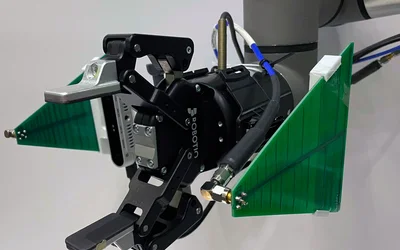
This robotic arm fuses data from a camera and antenna to locate and retrieve items, even if they are buried under a pile.
Utilizing audio edge processors for efficient execution of Machine Learning Tasks.
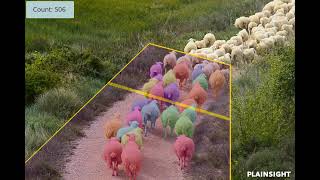
If you own, manage or operate a livestock operation, counting your animals and monitoring the movement of your livestock is a critical part of your business. See how Vision AI can help improve the process.
ATEsystem developed a high-precision solution for automated inspection of heat exchangers, which uses Photoneo 3D vision for accurate navigation.
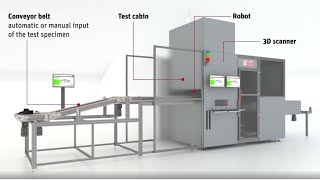
Berghof Testing developed a brilliant and innovative solution for optical quality testing. The system deploys two Photoneo PhoXi 3D Scanners and eliminates the shortcomings of conventional image processing systems.
3 minutes read
With Motion Capture for Analysis

4 minutes read
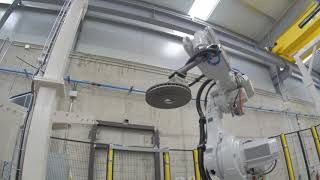
The automation of the production process of brake discs helped increase productivity and reduce the challenging nature of manually picking the brake discs from a bin.
A closer look at the recent market trends and audio technologies that enhance the functionalities of TWS devices.

10 minutes read
In this episode, we talk about a collaboration between two professors at Cornell University to combat the multi-billion dollar annual loss of grapes by combating powdery mildew using AI and how a novel material developed by NASA JPL researchers can significantly reduce the cost of robotics worldwide

2 minutes read
Abagy Robotic Systems, the winner of Photoneo’s contest for the Best Application 2021, developed a revolutionary approach to automated welding enabled by advanced object detection and robot navigation.
3 minutes read
In this episode, we talk about why we are going back to the Saturn system with NASA’s Dragonfly mission, how MIT PhD student’s AI Algorithm could expedite the drug that could cure duchenne muscular dystrophy, and a Cornell professors invention that can track your facial features throughout the day.
2 minutes read